SubscribeLog in
Connect with us

Weiblog

“What? Holland Still Has A King?!” – The Dutch King’s Visit to China on Weibo

The state visit of the Dutch King to China from Oct. 25 to 29 has received a lot of attention from the media in both China and the Netherlands. Chinese netizens share their smartphone pics of the royal couple.

Manya Koetse

Published

on

The state visit of the Dutch King to China from Oct. 25 to 29 has received a lot of attention from the media in both China and The Netherlands. One of the reasons for the Chinese interest in the Dutch royals is the foreign concept of monarchy. On Weibo, Chinese netizens share their smartphone pics of the royal couple.
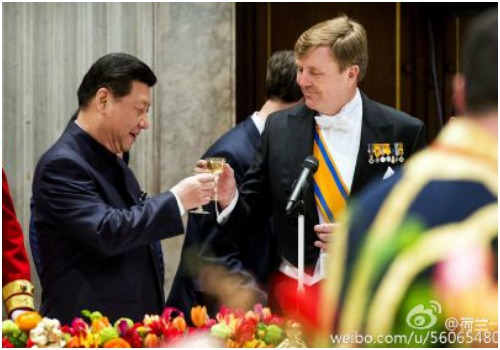
King Willem-Alexander is visiting China from Oct. 25 to 29. Apart from the news that Queen Maxima, who joined the King on the state visit, had to   fly home early due to a kidney infection, the King’s visit is going well.

China and The Netherlands have been working on closer ties, both economically and diplomatically. While Willem-Alexander agreed to boost cooperation with China in infrastructure financing, Xi Jinping promised to send two pandas to The Netherlands; a symbolical move to underline the growth of Sino-Dutch relations.

Xi Jinping and the King are no strangers. Xi already visited The Netherlands in March 2014. It was especially memorable as it was the first incoming state visit since Willem-Alexander and Maxima became king and queen in 2013.  This is the second state visit of the Dutch royals to China. In 1999, the former Dutch queen, Beatrix, also came to Beijing.

The visit of Chinese President Xi Jinping and First Lady Peng Liyuan in 2014. In the middle is King Willem-Alexander, besides him are his wife Queen Maxima and his mother, Princess Beatrix. 

Besides Beijing, the King also visits Yan’an, Shanghai and Hangzhou.

On China’s social media, many people seem to like the King. As he is pictured eating an apple in Yan’an, one Weibo user says: “King Willem Alexander, biting an apple and looking so cute.”

Not all people are aware that The Netherlands has a king. One Weibo user posted the picture below, not only amazed at the fact of the king (“So Holland still has a king?!“), but also at how tall Willem-Alexander actually is.

Other netizens post some pictures taken with their smartphone of Maxima and Willem-Alexander before their official state visit, as they spent their family holiday in China with their three daughters Amalia, Alexia and Ariane. The pics were taken in the old town of Pingyao.

yan'an

pingguo2

One girl has posted pictures of the table where the King was dining in Yan’an, writing: “This is where the Dutch king will have his dinner!”

PicMonkey Collage

Some netizens post a picture of themselves with the royal couple, a photo opportunity that was apparently possible at the Beijing Sino-Dutch reception.

607594a1jw1exeie8ckgij20b407gwfw

After Willem-Alexander and Maxima attended an activity in Beijing to promote football across China, Sport platform Sport 8 posted: “Handsome Dutch king, beautiful Dutch queen, that you came here on this cold and windy autumn day! Your bright smiles are such a heartfelt encouragement to our youngsters.

58c32518jw1exdmc7u7r8j218g0oyait

Besides all the praise for Willem-Alexander and Maxima, there is just one point of critique: Maxima’s pants were not liked by all, with some saying they looked strange and too big on her.

cfd28246gw1exdwy7hm3ej20t40lcdjb

One thing is certain: after this state visit, less Chinese people will be surprised to hear that The Netherlands has a King.

By Manya Koetse

©2015 Whatsonweibo. All rights reserved. Do not reproduce our content without permission – you can contact us at info@whatsonweibo.com.

Manya Koetse is a sinologist, writer, and public speaker specializing in China’s social trends, digital culture, and online media ecosystems. She founded What’s on Weibo in 2013 and now runs the Eye on Digital China newsletter. Learn more at manyakoetse.com or follow her on X, Instagram, or LinkedIn.

Continue Reading
Click to comment

Leave a Reply

Your email address will not be published. Required fields are marked *

China Digital

How Chinese AI Videos Turned Foreigners into Villains

How viral AI videos turn racialized outsiders into threats and violent Chinese heroes into defenders of social order, China’s first nationally broadcast AI drama, and why a newspaper is being sold for 50 times its original price.

Manya Koetse

Published

on

Welcome to China Trend Watch (Week 30–33 | 2026), where I bring you the latest trends, memes, and debates driving conversation across Chinese social media. Subscribe here to receive future editions.


Over the past few weeks, a noteworthy amount of AI-related news has been trending on Chinese social media, which is reflected in this week’s edition.

Now that AI has entered every corner of media consumption and online life, related discussions seem to be reaching a new peak. While well-produced AI dramas are receiving more praise, low-effort AI slop is flooding video feeds and increasingly being used to stir controversy and generate clicks, fueling prejudice, hate, and cyber-nationalism. More about that further down in this newsletter.


🗞️ QUICK SCROLLS


🎬 A new AI-generated micro-drama has become all the rage on Chinese social media. While earlier AI dramas were criticized for being sloppy and repetitive, Laid-Off Girl (被裁掉的女孩) is praised for its quality and appealing protagonist, Fang Taozi (方桃子), a small-town woman pursuing her dream of becoming a model in Paris. She is so believable that viewers almost forget they are not watching a live-action production. This marks a real step up in quality for the industry, raising the bar for others. (If you want to get a taste of what it looks like, here’s a YouTube link).

Stills from the popular micro AI drama Laid-Off Girl (被裁掉的女孩).

📺 China’s national TV has now also aired its very first AI drama. While AI dramas mostly belonged to the realm of unofficial short-form online productions, the phenomenon has now made the leap to longer productions broadcast on national satellite television. Anhui TV is airing the Ming-dynasty drama The Tale of Peach Blossom Pool (桃花潭记), promoted as China’s first fully AI-produced medium-length drama centered on cultural heritage.

📱 China’s cheap & easy SIM-card era has ended. There was a time when you could get a SIM at any street corner in a Chinese city. That changed over a decade ago when real-name registration became strictly enforced. Now, as of 1 August, China Mobile, China Telecom and China Unicom will sell cards online only through their own apps and websites, cutting off all third-party internet sellers who have been the go-to source for cheap data plans. The move is meant to curb third-party SIM cards ending up in grey-market chains, being used for bulk account registration and telecom fraud. But most people just fear that plans are becoming less affordable.

🚇 “Half an hour queuing for a ten-minute ride” was a common complaint after Shenzhen Metro tightened its security checks on July 20. Much to the dismay of commuters, the stricter checks led to long lines, as all carry-on items must now pass through an X-ray machine, while every passenger is also subject to a handheld body scan. Some wondered why, in an era of AI-powered image screening, security couldn’t be handled more efficiently. Shenzhen is hosting the APEC Economic Leaders’ Meeting later this year, in November.

☀️ Summer childcare worries have been trending, as even dual-income families are reportedly struggling to arrange childcare during the school holidays. Summer programs often last only a month and still require pick-ups during hot afternoons, while private tutors sometimes charge around 200 yuan per hour ($30). More Chinese parents have therefore turned to hiring university students, offering 3,500 to 4,000 yuan per month ($520–$590) to look after their children during the summer break.


👁️ EXPLAINER

How Chinese AI Videos Turn Foreigners Into Villains


I’m American! You can’t do anything to me!” says a young white man, moments before a strong Chinese man kicks him and throws him to the ground in a single move. A crowd of Chinese aunties standing nearby applauds as the foreigner hits the ground. “Don’t think we’re still the Chinese people of the past,” the Chinese man says. “You don’t want to mess with the Chinese people of today.”

This is just one example among hundreds of similar short videos flooding Chinese social media these days. Featuring various kinds of anti-foreign and racist content, they depict foreigners as threats to China’s social, moral, and national order. Strong, confident Chinese people confront, violently beat, and humiliate them in defense of their country.

Stills from AI videos showing Chinese men beating up misbehaving foreigners.

These videos, which often last between ten seconds and half a minute, are posted by online creators across platforms such as WeChat, Kuaishou, and Douyin. Many of these creators run content-farming accounts devoted entirely to this type of content, which attracts many likes and reactions: the videos are short, visually striking, emotionally powerful, and play into existing prejudices and racialized thinking.

Racist and anti-foreign content is nothing new on Chinese social media and dates back to the earliest days of China’s online video platforms. But the age of AI has brought new dynamics to such content. Last fall, Joshua Dummer reported in Foreign Policy on the growing popularity of AI-generated anti-Black videos presented as cautionary tales about Chinese women becoming involved with African men.

This time, it’s different.

The latest wave of anti-foreign content goes beyond gender dynamics and focuses more broadly on the negative influence foreigners supposedly have on Chinese people and society. Foreigners disrupt orderly Chinese public spaces or threaten the safety of Chinese women, security personnel, or lower-status workers, after which a morally upright Chinese person restores order through violence.


Four Types of Videos


In the dozens of AI videos I’ve analyzed, roughly four categories can be discerned, with different groups of foreigners performing different “narrative jobs.”
(See examples of these videos on my X here, or find them on Bluesky)

 
1️⃣ The Uncivilized Outsider
 

Roughly 40% of the videos show foreigners engaging in “uncivilized” behavior and disrupting China’s cleanliness, etiquette, and public order. In these scenes, foreigners are portrayed as dirty, smelly, and disorderly.

One example shows an entire plane of Chinese passengers holding handkerchiefs over their noses because of the smell from an Indian man’s bare feet. He refuses to comply with the flight attendant’s instructions, after which a strong Chinese man approaches and slaps him in the face.

AI video: An Indian passenger disrupts a Chinese flight with smelly feet.

Other examples include foreigners attempting to urinate in the street, occupying multiple seats on public transport, putting their bare feet up on a high-speed train, or otherwise disregarding public etiquette.

These videos predominantly feature Indian characters, but to a lesser extent also white/Western and Filipino characters.

 
2️⃣ The Entitled Foreign Bully
 

Roughly 30% of the videos depict foreigners as arrogant, entitled, and aggressive bullies who believe their nationality places them above Chinese rules.

Examples include foreign men and women skipping queues by invoking their foreign status or showing disrespect toward China’s vulnerable elderly or lower-status workers, until a Chinese person teaches them to “respect China’s rules.”

AI video: A Western woman is hit by a shop owner for using her foreign status as a reason to cut the line.

These videos mostly feature white people, but sometimes also Black, Indian, or Japanese characters.

AI video: entitled Indian man gets curry thrown in the face by waiter.

One scene shows an Indian man demanding that the Chinese waiter serving him curry kneel before him, after which the waiter scolds him and throws the curry in his face.

 
3️⃣ The Sexual and Demographic Threat
 

Roughly 20% of the videos fall into the category described in Foreign Policy last October, in which foreign men are portrayed as sexual and demographic intruders.

These videos often show Chinese women following foreign partners to Africa or India, only to end up living a nightmare of poverty, abuse, or infidelity. Some explicitly warn Chinese women not to marry foreigners.

AI video: A Chinese woman is first shown in a happy relationship with her African partner, and then shown in a state of desperation after she moved to Africa with him.

There are also many videos showing Chinese men as heroic protectors of women being harassed by foreign men. One recurring scenario shows a Black man harassing a Chinese woman in a shopping street before being beaten by a Chinese man who comes to her defense.


AI video: Chinese man saves Chinese woman from getting harassed by a foreigner.

Although these videos mainly feature Black African men, with Africa portrayed as a kind of dystopia, some also include white or Indian men.

 
4️⃣ The Undesirable/Dangerous Migrant
 

About 10% of the videos take place at airport immigration or border control, showing foreigners arriving without money, carrying drugs, or seeking to exploit Chinese hospitality.

One example shows Indian men arriving at the Chinese border and claiming that they want to “enjoy Chinese women.” They are refused entry after an official questions them about their finances.


AI video: Indians denied at the border.

The endgame is always the same: they are denied entry and sent back to their country. These stories predominantly feature Indian characters.

💡 To get a rough idea of which racialized groups appear most often, I analyzed a sample of 35 videos collected from my timeline: approximately 39% featured Indian characters, 28% White/Western characters, 24% Black/African characters, 6% Filipino characters, and 3% Japanese characters.


Reversed Humiliation


The xenophobic AI slop that we’re seeing is about more than just “foreigners behaving badly.” Besides the videos showing Chinese women moving to Africa, the basic formula running through most of them is:

Foreigners cross moral or social boundaries and violate rules → they victimize Chinese people or otherwise bring humiliation or inconvenience to others → forceful intervention by a morally upright Chinese person → punishment and restored order.

These videos do two things.

➡️ One important effect is that they produce a sense of “Chineseness” by constructing a threatening “Other” that is never Chinese (even though the foreigners all look different, they are never ethnically Chinese). In doing so, Chinese national identity is defined through contrast with how bad the Other is.

The foreign villain is deceptive, uncivilized, backward, and disruptive—a threat to women, public order, and social stability—whereas the Chinese characters are morally superior, embodying loyalty, civility, modernity, collective responsibility, and the protection of social and historical continuity. The foreigner therefore does more than play the villain: his imagined identity helps define who the Chinese are and what contemporary China is.

➡️ Another effect is that these videos offer a form of catharsis in China’s “new era.” They coincide with increasingly prominent narratives about China’s exceptional rise, its emerging superpower status, and the “decline of the West.” At the same time, they evoke the painful history of 19th China and the “century of humiliation”—a period portrayed in contemporary education as one in which foreign powers aggressively and violently imposed their rules on a weak China.

These AI fantasies symbolically reverse that history. The videos show that Chinese people are no longer passive victims, but strong and assertive defenders who fight back against foreigners who disrespect them or exploit Chinese hospitality. Through violence presented as morally justified, historical humiliation is transformed into national victory: China is no longer subjected to rules imposed by outsiders, but has become the country that sets the rules and possesses the strength to enforce them.


The Many Faces of Chinese Digital Nationalism


This recent trend shows that digital nationalism in China has many faces, and that this one in particular is not actively boosted by state media nor supported by official voices.

The timing of these videos does not just mark a new era of Chinese digital nationalism; it also coincides with a new wave of China tourism and a travel boom, with trips to China by foreign nationals rising sharply since the Covid era amid more lenient visa policies. This includes an increase in visas issued to Indians at a time when Indian and Chinese authorities have been working to normalize bilateral relations.

Earlier in July, Chinese newspaper The Paper published an article pushing back against growing online hostility toward Indians in China, arguing that individual misconduct should be addressed without stereotyping an entire nationality or turning it into xenophobic outrage. In a noteworthy move, the full article was republished on the website of the Chinese embassy in New Delhi—showing Chinese authorities pushing back against these trends and defending Indians to Chinese netizens.

At the same time, this is perhaps also a case of lead by example. An AI-animated video released by state media outlet China Daily which depicted the Philippines as a “ragged monkey” has also made international headlines recently, with the imagery called racist and unacceptable.

Even though the authorities might not be happy about the flood of racist or xenophobic AI videos at a time when state media are promoting just how welcoming China is to foreigners, official videos such as these can also fan the flames and provide examples for grassroots creators to draw on.


🔗 SEEN ELSEWHERE


🔹 Fresh “feet juice,” anyone? Chinese female cosplayers recently caused a stir at an anime convention in Guangzhou by selling cups of lemon water from the tubs in which they were soaking their feet. Read via SCMP.

🔹 China saw a new series of cyber crackdowns in July, including one targeting so-called companion bots—AI characters created to offer consumers emotional support as virtual friends. Having to bid farewell to these companions in light of the new ban has been really tough for users, with some even trying to “rescue” their virtual friends by downloading them. Read via Ginger River Review.

🔹 Earlier this year, Amsterdam-based cybersecurity researcher and journalist Marc Hofer came across a futuristic-looking dashboard that turned out to be an unsecured Zhangjiakou police dashboard, offering a rare window into how Chinese local authorities track foreigners by collecting and aggregating vast amounts of private data. Read via The New York Times.

🔹 People in China can now get paid US$15 to US$700 to license their faces for AI-generated entertainment productions. As the AI boom drives demand for an ever-wider range of human faces, Chinese companies have found a solution: buying the legal rights to people’s faces. Read via Rest of World.


🀄 ONLINE PHRASE OF THE WEEK


洛阳纸贵 Luòyáng zhǐ guì

Lit.:Paper has become expensive in Luoyang
Meaning:Flying off the shelves / selling like hotcakes

Who thought print media could still go viral in this digital age?

Just a few months ago, Chinese mathematician Wang Hong (王虹, b. 1991) from Guangxi became the first woman to win the top prize at China’s most prestigious math congress for her work on the three-dimensional Kakeya conjecture. On July 23, she was awarded the Fields Medal, also dubbed the “Nobel Prize of mathematics,” one of the highest and most prestigious international honors a mathematician can receive.

Together with fellow math talent Deng Yu (邓煜), she became one of the first two Chinese citizens to be awarded the Fields Medal and is only the third woman ever to win the prize.

After her win on July 23, the provincial Party newspaper Guangxi Daily (广西日报) featured her on its front page with a long article about her story and the headline “Wang’s Conjecture” (王的猜想, Wáng de Cāixiǎng). The article was praised for its “great title,” as it literally refers to her research but can also be read as “the conjecture of the king” (王 Wáng also means king), hinting at Wang’s ascension to the throne of mathematics.

Because of its unusual headline and prominent coverage—and because the Fields Medal wins were seen as confirmation of China’s status as a “strong mathematics country” (数学强国, shùxué qiángguó), especially since both mathematicians were educated in China until adulthood—the article went viral, turning that issue of Guangxi Daily into a must-have item.

This popular demand for physical copies created what Chinese commentators called a case of 洛阳纸贵 (luòyáng zhǐ guì), “paper has become expensive in Luoyang”—a classical idiom for a text so popular that it drives up the price of paper.

The idiom originated during the Western Jin dynasty (265–316 CE), when a work by writer Zuo Si (左思) became so popular that people across Luoyang rushed to make handwritten copies of it. The work’s popularity supposedly drove up the price of paper, giving rise to the expression 洛阳纸贵. It’s now an idiom used for written work that is in high demand.

Although a single copy of Guangxi Daily costs 1.35 yuan (about $0.19), the print edition’s resale price on e-commerce platforms initially jumped to 65 yuan ($9.60), with the going price now around 38 yuan ($5.60).

On apps like Xiaohongshu, showing off your own copy of the “Wang’s Conjecture” Guangxi Daily newspaper became a way for users to “check in” and show their support for Wang, Guangxi, and China’s mathematical talent. In doing so, Wang’s win unexpectedly also created one of the most viral moments in Chinese print media in a long time.


That’s a wrap! Thanks to Miranda Barnes, who contributed to topics discussed in this edition. Also thanks to Ed Sander for sending in some of the videos that have helped me in my research of the main topic.


Eye on Digital China, by Manya Koetse, is co-published on Substack and What’s on Weibo. Both feature the same new content — so you can read and subscribe wherever you prefer. Substack offers community features, while What’s on Weibo provides full archive access.

Spotted a mistake or want to add something? Please let us know in comments below or email us. First-time commenters, please be patient – we will have to manually approve your comment before it appears.

©2026 Eye on Digital China/Whatsonweibo. All rights reserved. Do not reproduce our content without permission – you can contact us at info@whatsonweibo.com.

Continue Reading

China Trend Watch

“God Won’t Save Us, but the PLA Will”: Floods, Faith, and Kung Fu Soccer Nostalgia

Also: the Hong Kong bookstore arrests that did not go trending, AI bank cards, Haaland becoming China’s summer meme king, and a delivery rider winning the Lu Xun Literature Prize.

Manya Koetse

Published

on

Welcome to China Trend Watch (Week 28–29 | 2026), where I bring you the latest trends, memes, and debates driving conversation across Chinese social media. Subscribe here to receive future editions.


In this issue, I’m catching you up on the stories you need to know about, including the extreme weather and the noteworthy narratives surrounding it, China’s second “DeepSeek moment,” the nostalgic summer hit at the cinemas, how the Hong Kong bookshop raids did not go trending, and why “grassroots plagiarism-detection” is the word of the week.


🗞️ QUICK SCROLLS


😷 COVID-19 returned to the top of Weibo’s hot lists. Mainland China recorded 79,000 newly confirmed COVID-19 cases between June 1-30, including 130 severe cases and 1 death. In July, COVID numbers have continued to climb. This summer surge reignited discussions about wearing face masks and other precautions to avoid contracting COVID (again). One commenter wrote: “What do you mean, “COVID is back? It never completely went away!

💳 Chinese banks are giving away AI tokens as loyalty rewards. Six of China’s major banks are launching “AI bank cards” – debit and credit cards – that come with token allowances and AI memberships from companies such as Kimi, MiniMax, Alibaba Cloud, and Tencent instead of traditional perks like coffee coupons or travel benefits. The moves show new ways for traditional banks to embrace the AI boom.

👑 Erling Haaland has become China’s meme king for summer 2026. The Norwegian striker became the biggest viral sensation of the 2026 World Cup on Chinese social media, where his combination of monstrous goal-scoring, Viking-like appearance, and cheeky behavior (such as drinking his opponent’s water during matches) made him irresistible and highly ‘memeable’ to netizens. Haaland also joined the fun on Douyin, where he soon had over 7.3 million followers (& counting).

📚 China’s best-known “delivery poet” has won one of the country’s highest literary awards. Former delivery rider Wang Jibing (王计兵), known as China’s “delivery rider poet” (外卖诗人), is receiving renewed attention after his poetry collection Flying Low (低处飞行) was first shortlisted and then won the prestigious Lu Xun Literature Prize. The 56-year-old first rose to fame in 2022 for writing relatable poems on scraps of paper between food deliveries, and he is the first delivery rider to ever win the award.

🚗 A parking dispute between an ordinary citizen and a local official turned into one of China’s biggest online discussions recently. What started with a Changsha resident finding his privately owned parking space occupied by the car of a government official spiraled into a days-long standoff involving police, mediation, and a social media circus. For netizens watching the story unfold, it wasn’t about parking space but about abuse of power and privilege.

📸 An AI-generated “photo” won first prize in a much-discussed photography contest. The contest was organized by the Federation of Literary & Art Circles in Hohhot, the capital of Inner Mongolia. It was only after it became the winning entry that the picture, showing sanitation workers laughing in the sun, was discovered to be AI-generated. For now, the federation has not only revoked the award but also canceled the entire competition to reflect and do some soul-searching (officially: “carrying out a comprehensive review and rectification process”) in these confusing AI times.


The “photo” that originally won the contest in Hohhot before the organizers discovered it was AI-generated.

🚖 Baidu is doing the Belt and Road by robotaxi. On the sidelines of the World Artificial Intelligence Conference (=WAIC, where Xi Jinping personally delivered the opening keynote), Baidu signed a partnership deal to bring its robotaxi service, Apollo Go (萝卜快跑), to Kazakhstan, marking its first major expansion into Central Asia. Apollo Go, with a strong focus on international expansion from Germany to Dubai, has already facilitated 22 million rides worldwide.

🌙 Overnight, everybody is talking about K3, the latest model by the Beijing-based Moonshot AI (月之暗面). Released just before the WAIC, Kimi K3 is now the world’s largest open-source model with 2.8 trillion parameters. Compared to Western counterparts, it stands out for its affordability and coding capabilities. Kimi K3 is available through Moonshot’s own website and API, but they promised to release the full downloadable version around July 27. That would make it the largest, most powerful AI model ever made freely available for download. Some are already calling this a second “DeepSeek moment.”


👁️ EXPLAINER

“God Will Not Save Us, the PLA Will”: Extreme Weather Highlights Divisions, but Official Narratives Stress Unity

Dear, you Chinese are very strange,” says a Western woman at the start of a video recently posted on social media, questioning why Chinese people don’t share a collective belief in God.

The video appeared after the floods in Guangxi earlier this month—marking the beginning of an extreme summer weather period that disrupted daily life, flooded villages, and caused buildings to collapse.

Starting on July 4, Typhoon Maysak wreaked havoc in Guangxi, where the breach of the Liulan Reservoir led to massive floods (see videos). Farms became completely submerged, while snakes escaped from breeding facilities into nearby villages (one woman in Hengzhou died after getting bitten). At least 39 people were killed in the floods.

Severe storms also killed eleven people in Hubei, while a rain-triggered landslide left 21 dead in Gansu. In Liaoning, more than 260,000 people had to evacuate their homes as Typhoon Bavi brought intense flooding. On July 17, a massive hillside collapse in Pengshui County, Chongqing, left at least eight people dead and 34 missing.

Despite the devastation, there were also more lighthearted moments surrounding the extreme weather. Residents in Shanghai, Jiangsu, and Zhejiang prepared for Bavi with the so-called “Bavi Shopping Festival” (巴威购物节), using the weather as an excuse to stock up on food and snacks and treat themselves while staying indoors.

Although many joined in on the fun, the trend also triggered criticism. Some argued that turning a natural disaster into a “festival” trivialized the suffering of those affected. It also highlighted a rural-urban and labor divide. While some residents in Shanghai’s high-rise buildings could turn the weather into a moment of comfort, delivery riders and public cleaners had to continue working. Meanwhile, farmers in Guangxi (affected by Maysak) saw their livestock drown.

There was also criticism that celebrity gossip climbed higher on the trending charts than the deadly Guangxi floods. Questions arose about why the Liulan Reservoir, a major water infrastructure project, had suffered a breach and why residents of local villages allegedly weren’t told to evacuate.

But the main message from Chinese officials was one of unity, strength, and collective faith in times of crisis.

One particularly noteworthy 3.5-minute AI-made video contrasted Western spiritual beliefs with Chinese trust in the authorities. Posted on X by the Chinese Consul in Osaka and also shared across Douyin, Bilibili, Facebook, and Instagram, it was titled: “Your God May Not Save You, but the People’s Liberation Army Will” (你的神或许不会救你!但是人民子弟兵会!).

The video shows a Western woman and Chinese man having a romantic dinner after which the sky darkens and a dam breaks. Calling the flood “Satan’s tears,” she insists that God will save them.

“God won’t save us,” he says. “But…”

The video then shows the PLA coming to the aid of people in need. As the Chinese man carries a little girl out of a flooded school, she asks: “Will we die, uncle?”

“No,” he says. “The PLA has already come.”

After being rescued, the woman observes the soldiers working in the rain and sacrificing their own needs to serve the people. She says:

That day, I saw a miracle. They didn’t come down from the sky, and there was no parting of the Red Sea. But whenever they heard someone crying out, they rushed over. When they saw danger, they stepped up. They don’t believe in God, but they believe in the people.”

Mixing actual footage of PLA rescue operations with AI-generated scenes, the video portrays the PLA as a “miracle” of modern-day China. In doing so, it creates a dichotomy between passive, hopeless Western belief in divine intervention and proactive, optimistic Chinese trust in the power of the Party and the PLA.

Similar narratives are widespread on Chinese social media, where hashtags such as “The Chinese-style unity foreigners will never understand” (#外国人永远无法理解的中国式团结#) are used to share images of rescue workers helping people.

Although narratives of unity are part of the propaganda playbook in times of crisis, these state-centered stories of national resilience and strength truly resonate, especially among netizens whose brothers, fathers, cousins, or friends are serving in the military or involved in rescue efforts.

These messages draw on public solidarity and boost collective belief that China is strong because the people, the Party, and the PLA stand together in times of disaster. In doing so, they also redirect attention away from more uncomfortable questions of responsibility and the divisions exposed during times of crisis.

One Douyin commenter replied:

Please remember that the People’s Army we cherish and support is led by the Communist Party of China. So don’t let the trivial frustrations of everyday life, personal disappointments, or attempts by internet trolls, agenda-pushers, and ‘[foreign] colonizer dogs’ to sow division and make you abandon our true faith.

Another person wrote:

The gods will not save the people, but the people will save the people.”


📱ON THE FEEDS

“Kung Fu Soccer” Scores for Cartoonish Moves and a Sense of Nostalgia

The latest movie by Hong Kong comedy legend Stephen Chow (周星驰), Kung Fu Soccer (功夫女足), has become a social media breakout hit this summer.

The film is a spiritual successor to Chow’s 2001 classic Shaolin Soccer (少林足球), this time swapping genders and focusing on a Chinese women’s team that combines kung fu with football and competes in the AFC Women’s Champions League.

Scenes from “Kung Fu Soccer”

Although opinions on the comedy are polarized (it has only received a 6.5 rating on Douban), the film, featuring stars such as Zhang Xiaofei (张小斐), Dilraba Dilmurat (迪丽热巴), and Lay Zhang (张艺兴), passed 1.2 billion yuan (US$177.1 million) at the box office within a single week. It is also all over Chinese social media feeds thanks to its anime-like moves, comic dialogue, and numerous Easter eggs.

For many viewers, the film evokes a sense of nostalgia, bringing back memories of Shaolin Soccer and how it made them feel at the time.

From 2001 Shaolin Soccer

One Xiaohongshu user wrote after seeing the film:

The fire inside me is still there. As a kid, I watched Shaolin Soccer and remembered the line: ‘If a person has no dreams, what’s the difference between them and a salted fish?’ (做人如果没有梦想,跟咸鱼有什么分别) […] Maybe the fire doesn’t burn as fiercely as it did when I was younger. But it hasn’t gone out.”


WHAT’S NOT TRENDING

Hong Kong’s Bookstore Arrests and the Silence on China’s Social Media


One story of great significance this week, despite not trending at all, is the recent round of bookstore arrests in Hong Kong. Following similar operations in March and June this year, authorities targeted the “Have a Nice Stay” (留下书舍) and “Greenfield Bookstore” (田园书屋) shops in the Mong Kok area this time. Both are being investigated for selling “seditious” publications, and five people were arrested.

One much-shared clip showed a female bookstore employee being taken away wearing a simple black T-shirt with the words “I am bookstore staff”, almost turning the phrase into a defiant slogan.

It’s noteworthy that although news of the raids has been widely discussed on X and covered by international media, it has barely circulated on mainland Chinese social media. At the time of writing, I could find just two Weibo posts about the arrests. One was published by a nationalist blogger who wrote: “Good work! Crack down as soon as they rear their heads! ✊”

Another commentary by pro-Beijing Hong Kong commentator “Ko Sir” (@香港高Sir高松杰) described the bookstore employee’s T-shirt as a deliberate attempt to “win sympathy” and “conceal a crime.” Ironically, Ko Sir also saw his own post censored, as two of the four images he posted were taken offline.


🀄 ONLINE PHRASE OF THE WEEK

“Grassroots plagiarism-detection”

民间鉴抄 (mínjiān jiànchāo)

Recently, the phenomenon of “grassroots plagiarism-detection” 民间鉴抄 (mínjiān jiànchāo) and “plagiarism-checking bloggers” 鉴抄博主 (jiànchāo bózhǔ) have received spotlight attention in China.

民间鉴抄 (mínjiān jiànchāo) is a word to describe how ordinary internet users independently scrutinize books, theses, and other publications for signs of plagiarism.

The phenomenon first gained attention in 2024 and reached a climax this week, when two well-known writers were exposed for plagiarism and had their academic degrees revoked. The cases concern Jia Qianqian (贾浅浅), a poet and the daughter of the famous Chinese author Jia Pingwa (贾平凹), and Jiang Fangzhou (蒋方舟), a former child prodigy-turned-writer.

The reason both writers lost their credentials within just a few days of each other is that their theses were flagged for plagiarism by the enthusiastic book blogger Wang Hao (王浩). Writing under the alias “Lyrical Forest” (抒情的森林), he began checking well-known literary authors for academic plagiarism in 2024 after discovering a plagiarized passage in a book by coincidence. He has since uncovered suspected plagiarism involving nearly forty well-known authors, including Jia Qianqian and Jiang Fangzhou.

In this case, both Renmin University, where Jiang earned her master’s degree, and Shaanxi Normal University and Northwest University, where Jia earned her degree and obtained her teaching qualifications, took action following the allegations.

Many netizens applaud this kind of plagiarism detection: if the authorities do not check, it is up to the people. In their eyes, this is not just about individual cases of plagiarism, but about a deep-rooted problem of academic misconduct in China and the power dynamics that perpetuate it. For now, it looks like “grassroots plagiarism detection” is here to stay, especially as long as formal institutions fail to address these problems.


That’s a wrap! Thanks to Miranda Barnes, who contributed to multiple topics discussed in this edition.


Eye on Digital China, by Manya Koetse, is co-published on Substack and What’s on Weibo. Both feature the same new content — so you can read and subscribe wherever you prefer. Substack offers community features, while What’s on Weibo provides full archive access.

Spotted a mistake or want to add something? Please let us know in comments below or email us. First-time commenters, please be patient – we will have to manually approve your comment before it appears.

©2026 Eye on Digital China/Whatsonweibo. All rights reserved. Do not reproduce our content without permission – you can contact us at info@whatsonweibo.com.

Continue Reading

Subscribe

Eye on Digital China is a reader-supported publication by
Manya Koetse (@manyapan) and powered by What’s on Weibo.
It offers independent analysis of China’s online culture, media, and social trends.

To receive the newsletter and support this work, consider
becoming a paid subscriber.

Manya Koetse's Profile Picture

Get in touch

Have a tip, story lead, or book recommendation? Interested in contributing? For ideas, suggestions, or just a quick hello, reach out here.

Popular Reads