
Featured
Women Get Days Off During Their Period – And China’s Female Netizens are Not Happy About It
Anhui Province announced that starting from next month, women can get paid leave when they are on their period. Anhui is the third Chinese province to offer female workers ‘menstrual leave’. On Weibo, many female netizens are not happy with the new rule.


Suffering from menstrual cramps is enough reason to get two days off work, according to officials in Anhui province. Starting in March, female workers will be able to take a paid leave when they can show doctor’s proof that they suffer from menstrual pain.
According to Chinese media, the new law will start from March 1st 2016. China’s northern province Shanxi and central province Hubei already implemented this rule, although it is not clear whether or not they will continue to do so, Ifeng News reports. Other countries, such as Japan, Indonesia, South Korea and Taiwan, already have laws that allow women to take menstrual leaves.
Although many Chinese media have published the menstrual leave news, it was first reported by CNN on February 15th. CNN reports that some female workers in Beijing also hope that the regulations will be extended to their province, as it is a step towards “taking menstruation seriously as a women’s health issue.”
News about Anhui’s ‘menstrual leave’ (痛经假) has received much attention on Weibo, where some news threads have thousands of comments. The majority of Weibo netizens do not agree with the woman from CNN’s report, and are not thrilled about the new rule at all.
One of the top female commenters says: “Before you’ve put up with going to the hospital while suffering from menstrual pains to request proof of your period, and then having to go through all kinds of procedures to get your leave, your menstrual leave will already be over.” China’s bureaucratic system is notorious for being slow and inefficient; some bureaucratic processes even require proof that one has proof of proof (what?! Yes, read more here).
Other female commenters are also displeased with the new law: “This will only make it harder for women to get a job” and: “again, this will cause more difficulties for women to find work” are much-repeated comments throughout the different Weibo threads about the menstrual leave.
As Chinese laws on maternity leave are quite generous, many employers would rather hire a man than a woman who has not had children yet. With the new two-child-policy, a woman could take a total paid leave of almost 200 days if she had two children. Calls to extend maternity leave to three years also caused controversy on Weibo in 2014, when women said that nobody would hire a woman that could potentially be gone for six years.
“This will just lead to companies looking to recruit men instead of women,” one female netizen says. “Your superiors won’t like you and you won’t get promoted,” another Weibo user says: “It’s just not easy being a woman.”
Except for a few netizens who say they are in favour of the new law (“I wish I had a menstrual leave right now, I really need it!” – one woman says), the majority of Weibo users seem to disagree with it.
“And what about when you have the flu or suffer from a cold?” one netizen comments: “Why is there no paid leave for that?”
Most male netizens also seem displeased with the new rule: “I am a guy :-(“ , one disappointed commenter simply says.

– By Manya Koetse
Follow @WhatsOnWeibo
©2016 Whatsonweibo. All rights reserved. Do not reproduce our content without permission – you can contact us at info@whatsonweibo.com.


China Trend Watch
“God Won’t Save Us, but the PLA Will”: Floods, Faith, and Kung Fu Soccer Nostalgia
Also: the Hong Kong bookstore arrests that did not go trending, AI bank cards, Haaland becoming China’s summer meme king, and a delivery rider winning the Lu Xun Literature Prize.

In this issue, I’m catching you up on the stories you need to know about, including the extreme weather and the noteworthy narratives surrounding it, China’s second “DeepSeek moment,” the nostalgic summer hit at the cinemas, how the Hong Kong bookshop raids did not go trending, and why “grassroots plagiarism-detection” is the word of the week.
🗞️ QUICK SCROLLS
😷 COVID-19 returned to the top of Weibo’s hot lists. Mainland China recorded 79,000 newly confirmed COVID-19 cases between June 1-30, including 130 severe cases and 1 death. In July, COVID numbers have continued to climb. This summer surge reignited discussions about wearing face masks and other precautions to avoid contracting COVID (again). One commenter wrote: “What do you mean, “COVID is back? It never completely went away!”
💳 Chinese banks are giving away AI tokens as loyalty rewards. Six of China’s major banks are launching “AI bank cards” – debit and credit cards – that come with token allowances and AI memberships from companies such as Kimi, MiniMax, Alibaba Cloud, and Tencent instead of traditional perks like coffee coupons or travel benefits. The moves show new ways for traditional banks to embrace the AI boom.
👑 Erling Haaland has become China’s meme king for summer 2026. The Norwegian striker became the biggest viral sensation of the 2026 World Cup on Chinese social media, where his combination of monstrous goal-scoring, Viking-like appearance, and cheeky behavior (such as drinking his opponent’s water during matches) made him irresistible and highly ‘memeable’ to netizens. Haaland also joined the fun on Douyin, where he soon had over 7.3 million followers (& counting).
📚 China’s best-known “delivery poet” has won one of the country’s highest literary awards. Former delivery rider Wang Jibing (王计兵), known as China’s “delivery rider poet” (外卖诗人), is receiving renewed attention after his poetry collection Flying Low (低处飞行) was first shortlisted and then won the prestigious Lu Xun Literature Prize. The 56-year-old first rose to fame in 2022 for writing relatable poems on scraps of paper between food deliveries, and he is the first delivery rider to ever win the award.
🚗 A parking dispute between an ordinary citizen and a local official turned into one of China’s biggest online discussions recently. What started with a Changsha resident finding his privately owned parking space occupied by the car of a government official spiraled into a days-long standoff involving police, mediation, and a social media circus. For netizens watching the story unfold, it wasn’t about parking space but about abuse of power and privilege.
📸 An AI-generated “photo” won first prize in a much-discussed photography contest. The contest was organized by the Federation of Literary & Art Circles in Hohhot, the capital of Inner Mongolia. It was only after it became the winning entry that the picture, showing sanitation workers laughing in the sun, was discovered to be AI-generated. For now, the federation has not only revoked the award but also canceled the entire competition to reflect and do some soul-searching (officially: “carrying out a comprehensive review and rectification process”) in these confusing AI times.
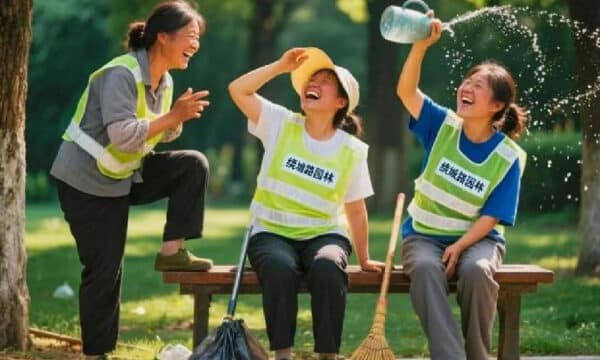
The “photo” that originally won the contest in Hohhot before the organizers discovered it was AI-generated.
🚖 Baidu is doing the Belt and Road by robotaxi. On the sidelines of the World Artificial Intelligence Conference (=WAIC, where Xi Jinping personally delivered the opening keynote), Baidu signed a partnership deal to bring its robotaxi service, Apollo Go (萝卜快跑), to Kazakhstan, marking its first major expansion into Central Asia. Apollo Go, with a strong focus on international expansion from Germany to Dubai, has already facilitated 22 million rides worldwide.
🌙 Overnight, everybody is talking about K3, the latest model by the Beijing-based Moonshot AI (月之暗面). Released just before the WAIC, Kimi K3 is now the world’s largest open-source model with 2.8 trillion parameters. Compared to Western counterparts, it stands out for its affordability and coding capabilities. Kimi K3 is available through Moonshot’s own website and API, but they promised to release the full downloadable version around July 27. That would make it the largest, most powerful AI model ever made freely available for download. Some are already calling this a second “DeepSeek moment.”
👁️ EXPLAINER
“God Will Not Save Us, the PLA Will”: Extreme Weather Highlights Divisions, but Official Narratives Stress Unity

“Dear, you Chinese are very strange,” says a Western woman at the start of a video recently posted on social media, questioning why Chinese people don’t share a collective belief in God.
The video appeared after the floods in Guangxi earlier this month—marking the beginning of an extreme summer weather period that disrupted daily life, flooded villages, and caused buildings to collapse.
Starting on July 4, Typhoon Maysak wreaked havoc in Guangxi, where the breach of the Liulan Reservoir led to massive floods (see videos). Farms became completely submerged, while snakes escaped from breeding facilities into nearby villages (one woman in Hengzhou died after getting bitten). At least 39 people were killed in the floods.
Severe storms also killed eleven people in Hubei, while a rain-triggered landslide left 21 dead in Gansu. In Liaoning, more than 260,000 people had to evacuate their homes as Typhoon Bavi brought intense flooding. On July 17, a massive hillside collapse in Pengshui County, Chongqing, left at least eight people dead and 34 missing.
Despite the devastation, there were also more lighthearted moments surrounding the extreme weather. Residents in Shanghai, Jiangsu, and Zhejiang prepared for Bavi with the so-called “Bavi Shopping Festival” (巴威购物节), using the weather as an excuse to stock up on food and snacks and treat themselves while staying indoors.
Although many joined in on the fun, the trend also triggered criticism. Some argued that turning a natural disaster into a “festival” trivialized the suffering of those affected. It also highlighted a rural-urban and labor divide. While some residents in Shanghai’s high-rise buildings could turn the weather into a moment of comfort, delivery riders and public cleaners had to continue working. Meanwhile, farmers in Guangxi (affected by Maysak) saw their livestock drown.
There was also criticism that celebrity gossip climbed higher on the trending charts than the deadly Guangxi floods. Questions arose about why the Liulan Reservoir, a major water infrastructure project, had suffered a breach and why residents of local villages allegedly weren’t told to evacuate.
But the main message from Chinese officials was one of unity, strength, and collective faith in times of crisis.
One particularly noteworthy 3.5-minute AI-made video contrasted Western spiritual beliefs with Chinese trust in the authorities. Posted on X by the Chinese Consul in Osaka and also shared across Douyin, Bilibili, Facebook, and Instagram, it was titled: “Your God May Not Save You, but the People’s Liberation Army Will” (你的神或许不会救你!但是人民子弟兵会!).
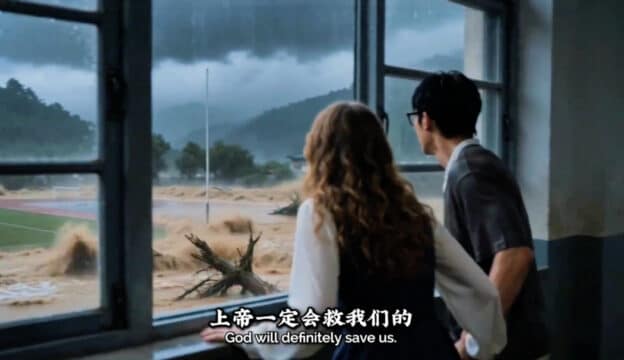
The video shows a Western woman and Chinese man having a romantic dinner after which the sky darkens and a dam breaks. Calling the flood “Satan’s tears,” she insists that God will save them.
“God won’t save us,” he says. “But…”

The video then shows the PLA coming to the aid of people in need. As the Chinese man carries a little girl out of a flooded school, she asks: “Will we die, uncle?”
“No,” he says. “The PLA has already come.”
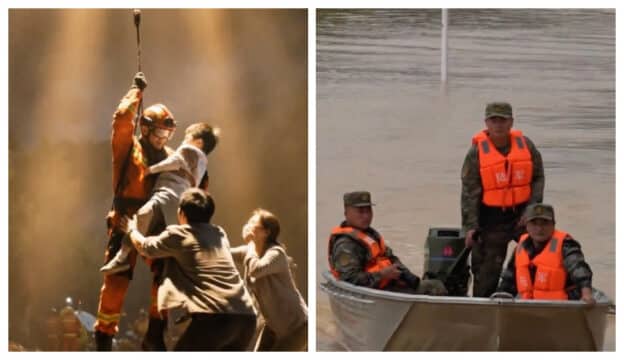
After being rescued, the woman observes the soldiers working in the rain and sacrificing their own needs to serve the people. She says:
“That day, I saw a miracle. They didn’t come down from the sky, and there was no parting of the Red Sea. But whenever they heard someone crying out, they rushed over. When they saw danger, they stepped up. They don’t believe in God, but they believe in the people.”
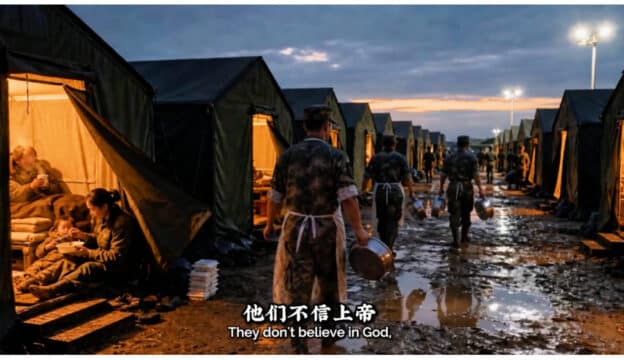
Mixing actual footage of PLA rescue operations with AI-generated scenes, the video portrays the PLA as a “miracle” of modern-day China. In doing so, it creates a dichotomy between passive, hopeless Western belief in divine intervention and proactive, optimistic Chinese trust in the power of the Party and the PLA.
Similar narratives are widespread on Chinese social media, where hashtags such as “The Chinese-style unity foreigners will never understand” (#外国人永远无法理解的中国式团结#) are used to share images of rescue workers helping people.

Although narratives of unity are part of the propaganda playbook in times of crisis, these state-centered stories of national resilience and strength truly resonate, especially among netizens whose brothers, fathers, cousins, or friends are serving in the military or involved in rescue efforts.
These messages draw on public solidarity and boost collective belief that China is strong because the people, the Party, and the PLA stand together in times of disaster. In doing so, they also redirect attention away from more uncomfortable questions of responsibility and the divisions exposed during times of crisis.
One Douyin commenter replied:
“Please remember that the People’s Army we cherish and support is led by the Communist Party of China. So don’t let the trivial frustrations of everyday life, personal disappointments, or attempts by internet trolls, agenda-pushers, and ‘[foreign] colonizer dogs’ to sow division and make you abandon our true faith.”
Another person wrote:
“The gods will not save the people, but the people will save the people.”
📱ON THE FEEDS
“Kung Fu Soccer” Scores for Cartoonish Moves and a Sense of Nostalgia

The latest movie by Hong Kong comedy legend Stephen Chow (周星驰), Kung Fu Soccer (功夫女足), has become a social media breakout hit this summer.
The film is a spiritual successor to Chow’s 2001 classic Shaolin Soccer (少林足球), this time swapping genders and focusing on a Chinese women’s team that combines kung fu with football and competes in the AFC Women’s Champions League.
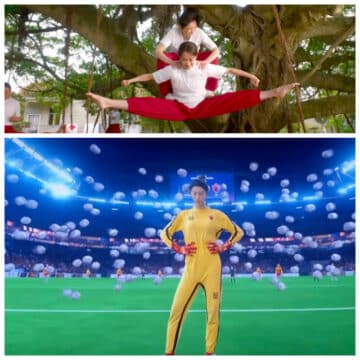
Scenes from “Kung Fu Soccer”
Although opinions on the comedy are polarized (it has only received a 6.5 rating on Douban), the film, featuring stars such as Zhang Xiaofei (张小斐), Dilraba Dilmurat (迪丽热巴), and Lay Zhang (张艺兴), passed 1.2 billion yuan (US$177.1 million) at the box office within a single week. It is also all over Chinese social media feeds thanks to its anime-like moves, comic dialogue, and numerous Easter eggs.
For many viewers, the film evokes a sense of nostalgia, bringing back memories of Shaolin Soccer and how it made them feel at the time.
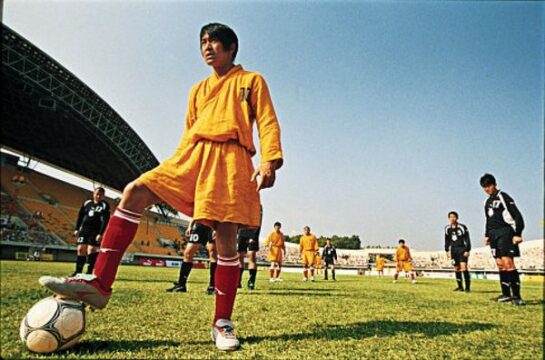
From 2001 Shaolin Soccer
One Xiaohongshu user wrote after seeing the film:
“The fire inside me is still there. As a kid, I watched Shaolin Soccer and remembered the line: ‘If a person has no dreams, what’s the difference between them and a salted fish?’ (做人如果没有梦想,跟咸鱼有什么分别) […] Maybe the fire doesn’t burn as fiercely as it did when I was younger. But it hasn’t gone out.”
WHAT’S NOT TRENDING
Hong Kong’s Bookstore Arrests and the Silence on China’s Social Media
One story of great significance this week, despite not trending at all, is the recent round of bookstore arrests in Hong Kong. Following similar operations in March and June this year, authorities targeted the “Have a Nice Stay” (留下书舍) and “Greenfield Bookstore” (田园书屋) shops in the Mong Kok area this time. Both are being investigated for selling “seditious” publications, and five people were arrested.
One much-shared clip showed a female bookstore employee being taken away wearing a simple black T-shirt with the words “I am bookstore staff”, almost turning the phrase into a defiant slogan.
It’s noteworthy that although news of the raids has been widely discussed on X and covered by international media, it has barely circulated on mainland Chinese social media. At the time of writing, I could find just two Weibo posts about the arrests. One was published by a nationalist blogger who wrote: “Good work! Crack down as soon as they rear their heads! ✊”
Another commentary by pro-Beijing Hong Kong commentator “Ko Sir” (@香港高Sir高松杰) described the bookstore employee’s T-shirt as a deliberate attempt to “win sympathy” and “conceal a crime.” Ironically, Ko Sir also saw his own post censored, as two of the four images he posted were taken offline.
🀄 ONLINE PHRASE OF THE WEEK
“Grassroots plagiarism-detection”
民间鉴抄 (mínjiān jiànchāo)

Recently, the phenomenon of “grassroots plagiarism-detection” 民间鉴抄 (mínjiān jiànchāo) and “plagiarism-checking bloggers” 鉴抄博主 (jiànchāo bózhǔ) have received spotlight attention in China.
民间鉴抄 (mínjiān jiànchāo) is a word to describe how ordinary internet users independently scrutinize books, theses, and other publications for signs of plagiarism.
The phenomenon first gained attention in 2024 and reached a climax this week, when two well-known writers were exposed for plagiarism and had their academic degrees revoked. The cases concern Jia Qianqian (贾浅浅), a poet and the daughter of the famous Chinese author Jia Pingwa (贾平凹), and Jiang Fangzhou (蒋方舟), a former child prodigy-turned-writer.
The reason both writers lost their credentials within just a few days of each other is that their theses were flagged for plagiarism by the enthusiastic book blogger Wang Hao (王浩). Writing under the alias “Lyrical Forest” (抒情的森林), he began checking well-known literary authors for academic plagiarism in 2024 after discovering a plagiarized passage in a book by coincidence. He has since uncovered suspected plagiarism involving nearly forty well-known authors, including Jia Qianqian and Jiang Fangzhou.
In this case, both Renmin University, where Jiang earned her master’s degree, and Shaanxi Normal University and Northwest University, where Jia earned her degree and obtained her teaching qualifications, took action following the allegations.
Many netizens applaud this kind of plagiarism detection: if the authorities do not check, it is up to the people. In their eyes, this is not just about individual cases of plagiarism, but about a deep-rooted problem of academic misconduct in China and the power dynamics that perpetuate it. For now, it looks like “grassroots plagiarism detection” is here to stay, especially as long as formal institutions fail to address these problems.
That’s a wrap! Thanks to Miranda Barnes, who contributed to multiple topics discussed in this edition.
Eye on Digital China, by Manya Koetse, is co-published on Substack and What’s on Weibo. Both feature the same new content — so you can read and subscribe wherever you prefer. Substack offers community features, while What’s on Weibo provides full archive access.
Spotted a mistake or want to add something? Please let us know in comments below or email us. First-time commenters, please be patient – we will have to manually approve your comment before it appears.
©2026 Eye on Digital China/Whatsonweibo. All rights reserved. Do not reproduce our content without permission – you can contact us at info@whatsonweibo.com.
China Insight
“Even Pigs Have AC”: The European Heatwave Through Chinese Eyes
As Europe struggles through record heat, Chinese social media is turning the story into something much bigger than the weather. Plus: the graduation speech everyone is talking about & more.

🔥 China Trend Watch (week 26/27 | 2026) Part of Eye on Digital China, this is my premium newsletter where I explain the stories, memes, debates, and viral moments shaping online conversations in China. This edition was sent to paid subscribers — subscribe to receive the next issue in your inbox.
Here’s your weekly update on what’s been trending. In case you missed it, earlier this week I published a deep dive into the CITIC Tower plane crash and how its immediate aftermath was handled online. In this newsletter: Louis Vuitton’s victory in a noteworthy trademark case against a Chinese tea brand; how and why the European heatwave has become a major topic in China; a controversial gaming character; and an inspiring must-know phrase of the week.
🗞️ QUICK SCROLLS
🍉 Don’t buy precut watermelons. During these hot days, watermelons are a popular snack, but this stern warning went viral: avoid pre-cut watermelons sold by roadside vendors, as they’re a potential health hazard due to improper refrigeration and cross-contamination from cutting surfaces and knives —you have no idea what else they’ve been used for 😬.
🇯🇵 China blames Japan for ties hitting a new low. During a July 1st press briefing, China’s Foreign Ministry said Sino-Japanese relations are facing “severe difficulties,” blaming Tokyo’s stance on Taiwan and security issues. The remarks come amid renewed tensions, including Japan’s announcement that multiple Chinese naval vessels had transited waters near the country and the reported formal arrest of a Japanese citizen detained in Dalian.
🌾 No messing around with China’s heroes. A Chinese agricultural influencer with over 2 million followers has been permanently banned from Douyin after posting negative remarks about the hybrid rice breeding technology developed by the late Yuan Longping (袁隆平), China’s national hero and “Father of Hybrid Rice,” widely praised for his role in combating poverty and hunger.
🛎️ The 24-hour checkout as a new hotel standard? Check in at 3 pm, check out at 3 pm the next day—that’s the idea behind a viral checkout policy introduced by the Chinese hotel chain Qinzhu Hotel (沁住酒店). The policy breaks with the long-standing industry practice of requiring guests to check out before noon. Instead, checkout is calculated from the guest’s actual check-in time, allowing them to stay for a full 24 hours before checking out. The policy is generating discussions, with many wondering if this could point towards changing policies in the broader industry.
🎖️ The Party turns 105. July 1 marked the 105th founding anniversary of the Communist Party, an occasion heavily promoted across Chinese social media as eight Party members received the “July 1 Medal” (七一勋章), the Party’s highest honor. Among them was Henan village Party secretary Li Liancheng (李连成), who transformed a poor village into a model of rural development. July 1 also marks 29 years since Hong Kong’s return to Chinese sovereignty in 1997.
📅 Interesting fact: July 1 is not the Communist Party’s actual founding date. The 1st National Congress opened in Shanghai on July 23, 1921. The Party settled on July 1 as its anniversary in 1938 only because the Yan’an-based delegates who had attended the congress, including Mao Zedong and Dong Biwu, could remember that it had taken place in July, but not the exact day (and wartime conditions made archival verification difficult).

🌸 Whose flower is it anyway? The French luxury house Louis Vuitton won a first-instance trademark infringement case against the new Chinese tea chain Molly Tea (茉莉奶白) this week. The Chinese brand was sued over the four-petal flower symbol in its logo, similar to LV’s core floral element. But many netizens disagree with the judge’s decision, arguing that the flower can be traced to the iconic Baoxianghua (宝相花) motif that flourished during the Tang Dynasty (618-907).
👁️ WHAT STOOD OUT
Nationalism, Soft Power, and the European Heatwave in China

AI-generated images posted on Chinese social media showing Europeans suffering in the heat while Chinese pigs are relaxing with cool units (left) and Chinese manufacturers selling out (right).
The high temperatures in Europe have become a hot topic in China, where the heatwave across France, Belgium, Germany, and other countries has been one of the biggest international stories of the past two weeks, with China cast in a particularly prominent role.
In China, the European heatwave, with temperatures reaching 40–45°C and causing deaths across several countries, is discussed from various angles and is also used to make broader geopolitical, economic, and ideological points about Europe and China-EU relations. These are the three dominant ways in which the heatwave is currently being discussed on Chinese social media:
🌡️ 1. “China Is Keeping Europe Cool”: European Heat Through the Lens of Chinese Soft Power and Anti-”De-Risking” Narratives
Chinese state media have framed the European heatwave by emphasizing the role of Chinese-made air conditioners. In countries such as Spain, Germany, and France, air-conditioner sales have nearly doubled compared to last year, with Chinese manufacturers such as Haier and Midea reporting sales increases of up to 70% while ramping up production to meet demand.
A main narrative is that China is helping Europe by meeting demand at a critical time. A similar narrative emerged during the 2022 energy crisis, when Chinese media emphasized how made-in-China products, from blankets to heaters, were keeping Europeans warm.
As a recent Xinhua commentary argued, the current shortage demonstrates that Chinese manufacturers are filling a gap where European companies are falling short. While Europe increasingly frames China-EU trade in terms of “de-risking,” the article argues that Chinese manufacturing actually provides resilience during times of crisis and should therefore be seen as an asset rather than a risk.
🌡️ 2. “Even Pigs Have Air Conditioning in China”: Schadenfreude and Nationalism
The heatwave story and the fact that most European homes do not have air conditioning have also been met with ridicule and disbelief on Chinese social media, where one recurring joke is that while Europeans are suffering through extreme heat, even pigs have air conditioning in China.
The story partly originated on Chinese social media but was also fueled by posts on X. Around June 24, one tweet showing Chinese pigsties equipped with air conditioners received thousands of likes.

Chinese netizens also had plenty of banter over other X posts in which Europeans proudly showed off their newly purchased air conditioners, as though they had just discovered a new technology. For many Chinese commenters, it is simply unimaginable that air conditioning is still considered a luxury in much of Europe.
A local Hai’er account on Xiaohongshu joked:
💬 “Europeans spend hundreds of euros on an AC and still have to check the regulations; we spend a few thousand yuan (…) and enjoy wrapping ourselves in a quilt while eating watermelon in the middle of summer.”
A recurring theme in these discussions is that China once admired Western technology and modernity, whereas today the roles seem reversed. Now, some commenters say, Europeans are marveling at Chinese-made air conditioners. As one Weibo wrote: “It’s like our ancestors when they first saw cars.”
🌡️ 3. Europe Is Putting Climate Policy Ahead of Ordinary People: Criticism of EU Governance
Another dominant theme is the idea that Europe has become hypocritical—or excessively “politically correct”—in its environmental policies. Many commenters argue that the low prevalence of air conditioning in European homes is partly the result of regulators’ longstanding skepticism toward air conditioning on environmental grounds.
This has fueled the narrative, amplified by Chinese media this month, that Europeans are now suffering and even dying during heatwaves because green ideology has stigmatized air conditioning.
At the same time, many users mock what they see as the EU’s willingness to criticize other countries over greenhouse gas emissions while failing to protect its own citizens from extreme heat.

One AI-generated meme showed crying polar bears, monkeys, and penguins alongside the slogan:”Save nature! Save the animals! Oppose Europe installing air conditioning—this is a betrayal of Mother Nature.” One of the meme’s posters wrote on Weibo:
💬 “Europeans have been preaching the gospel of environmentalism (环保圣经). Now, it’s finally coming back to bite them.”
Another depicted Ursula von der Leyen relaxing beneath a powerful Midea air conditioner, comfortably enjoying the very equipment that her policies supposedly discourage.

All in all, for some, the debate over air conditioning is about something much bigger. The lack of air conditioning in many European countries—along with the regulations, infrastructure constraints, and electricity costs surrounding it—has become symbolic of a broader reassessment of Europe. For some Chinese netizens, it challenges the long-held idea that life in Europe is necessarily better or more idyllic than life in China.
One netizen even advised fellow Chinese against emigrating to Europe:
💬 “Over the next five to ten years, I think people in China will become much more clear-eyed, and many existing illusions about Europe will gradually disappear.”
📱ON THE FEEDS
No More Werewolves in the Love and Deepspace House

The Chinese mobile game Love and Deepspace (恋与深空) has been all over the feeds, with some Weibo discussions garnering nearly half a billion views after the game was hit by controversy.
The game, developed by Papergames, is a so-called otome game — a story-based romance video game aimed primarily at women. Recently, a new male character lead was introduced: Ao Yin (敖尹, English name: Valk0), introduced as a werewolf, who breaks into the home of a woman living alone as part of a romantic scenario, after which he says: “What’s wrong with inviting the wolf into the house?” (引狼入室有什么不好) — a line critics say romanticizes non-consensual home intrusion.
What also sparked outrage was a reference to an “A-0731” file number tied to an in-game human drug-trial dossier. Players connected “0731” to Unit 731, the biological and chemical weapons program operated by the Japanese Army in China during the Second Sino-Japanese War/WWII.
The developers apologized, and for now, Ao Yin is canceled entirely — no more werewolves coming in the house.
🀄 ONLINE PHRASE OF THE WEEK
“Move forward firmly amid the noise”
在众声喧哗中坚定前行 (zài zhòngshēng xuānhuá zhōng jiāndìng qiánxíng)

An unusual speech by a Peking University professor made waves over the past week. Cheng Lesong (程乐松), chair of Peking University’s Department of Philosophy, delivered a graduation speech on June 26 that sparked widespread discussion for breaking away from the usual clichés and generic commencement themes.
In the speech, Cheng captured the cultural mood and social pressures facing China’s younger generations today: a society where everything—from career choices to a cup of milk tea—needs to be meaningful, yet increasingly feels meaningless; and where everyone is expected to succeed while increasingly feeling like they’re falling short.
“The anticipatory anxiety about the ruthlessness of social competition leads us to plunge into an overwhelming fear of failure,” Cheng said. “Because we expect constant affirmation, we come to interpret every ordinary day as proof that our lives have failed. We become absorbed in the hope that one day we will ‘begin our real lives,’ forgetting that we are already living them.”
Life was never meant to be meticulously ordered, Cheng argues, and needs room for a certain amount of chaos and twists and turns that no one saw coming. A completely disordered life is unimaginable, but so too is a life of perfect precision. How we go through life depends on how we deal with it, how we understand ourselves, and how we learn to allow life to unfold.
The true mission in our lives, the lifelong task that philosophy presents to us according to Cheng, is therefore to carve out a unique spiritual path for ourselves, and “to move forward steadily amid the cacophony of many voices.”
That message has struck a chord among netizens, with some saying they replayed the speech over and over again because they felt Cheng was really talking about the predicament facing young people today.
That’s a wrap. Have a good week, and keep your head cool.
If you find these newsletters useful, please be sure to like them, and share them if you want. I only started out Eye on Digital China on Substack late last year and could use some help in making sure the right audiences – like you – find my work.
Best,
Manya
Eye on Digital China, by Manya Koetse, is co-published on Substack and What’s on Weibo. Both feature the same new content — so you can read and subscribe wherever you prefer. Substack offers community features, while What’s on Weibo provides full archive access. If you’re already subscribed and want to switch platforms, just get in touch for help. If you no longer wish to receive these newsletters, or are receiving duplicate editions, you can unsubscribe at any time.
Eye on Digital China is a reader-supported publication by
Manya Koetse (@manyapan) and powered by What’s on Weibo.
It offers independent analysis of China’s online culture, media, and social trends.
To receive the newsletter and support this work, consider
becoming a paid subscriber.


“God Won’t Save Us, but the PLA Will”: Floods, Faith, and Kung Fu Soccer Nostalgia

“Even Pigs Have AC”: The European Heatwave Through Chinese Eyes

China’s CITIC Tower Crash: The Story That Never Trended

Quack Like a Goose: Why Beijing Street Vendor “Auntie Goose Legs” Sparked a Nationwide Debate

Auntie Goose Legs, China’s Shrinking Condom Market, and DeepSeek’s AI Blind Spot

Comrade Trump Returns: The 2026 Trump–Xi Summit on Chinese Social Media

My Mum Has Two Husbands: The OPPO Mother’s Day Fiasco and 7 Other Gender Marketing Fails in China
Auntie Goose Legs, China’s Shrinking Condom Market, and DeepSeek’s AI Blind Spot

The AI Actor Debate, Tragedy in China’s “Fireworks Capital,” and the Viral Labubu Fridge
China’s CITIC Tower Crash: The Story That Never Trended
-

 China Insight12 months ago
“Jiangyou Bullying Incident”: From Online Outrage to Offline Protest
-

 China Arts & Entertainment10 months ago
The Wong Kar-wai Scandal Explained: The Dark Side of ‘Blossoms Shanghai’
-

 Chinese New Year5 months ago
Inside Chunwan 2026: China’s Spring Festival Gala
-
 China Society12 months ago
The Rising Online Movement for Smoke-Free Public Spaces in China