
China Media
American Student Gets 15 Years of Hard Labour in North Korea For Stealing Poster
The 21-year-old American student Otto Warmbier joined a Chinese tour group to Pyongyang in late December, where he was later arrested and given 15 years of hard labour for crimes against the state. The news has got Weibo talking.


Yonhap News reported on March 16 that the North Korean Supreme Court sentenced the 21-year-old Virginian student Otto Warmbier to 15 years of hard labour in a public trial. Warmbier is suspected of stealing a political poster in a Pyongyang Hotel in January of this year. His conviction for ‘crimes against the state’ was reported by several Chinese media and shared on Sina Weibo, where many netizens don’t seem to sympathize much with the US citizen.
“What was he doing there anyway?” many netizens wonder. Other netizens draw a comparison between China and North Korea; “This punishment sounds very familiar..” is a comment made by multiple Weibo users. “North Korea is no joke,” one netizen comments: “If it wasn’t for the reform policies of Deng Xiaoping, we would also be in a similar situation.”
“This boy was too bold, too naive, and did not understand that some countries are really scary. I would never dare to go to North Korea, and if I did, I would never pull something like that,” one netizen writes.
News of Warmbier’s arrest was first released by North Korean state media on January 22 (see screenshot, from the North Korean state news agency website). Young Pioneers Tours, the budget travel group joined by Warmbier, also released a statement about his arrest on the same day.

Chinese news portal The Observer and CCTV report that Warmbier committed the crime in return for financial compensation from an American church group, the Friendship United Methodist Church, that promised him a 10,000 US dollar second-hand car for the poster. In case he would be detained, the church group had promised to give his mother 200,000 US dollar. The church allegedly had close connections with the American CIA. The Friendship United Methodist Church released an official statement on its website, saying they prayed for Warmbier’s quick and safe return, and that “any further comment would neither be appropriate or helpful while the student is still being detained.”
Information about the alleged agreement between Warmbier and the church was shared by Warmbier himself, who spoke at a government-arranged news conference in Pyongyang on Monday February 29th – but it is unknown if Warmbier was forced into this confession, that seemed rehearsed and unnatural (see footage of press conference below).
Many of Weibo netizens believe that the American church group ordered Warmbier to commit the crime: “There have always been connections between religious groups and spies,” one Weibo user comments.
“What kind of church is this?! How scary!” others write.
“In China there are also more and more followers of Christianity, maybe this is also a movement that is secretly supported by the Americans,” one netizen says.
“This guy is just a victim,” another Weibo user says: “If the relations between North Korea and the United States don’t improve, he might be stuck there for life.”
Another Weibo netizens expresses a different view: “He’s treated well, gets to learn Korean for free, and can write a book about his experiences and make money with it when he gets home!”
– By Manya Koetse
Follow @WhatsOnWeibo
©2016 Whatsonweibo. All rights reserved. Do not reproduce our content without permission – you can contact us at info@whatsonweibo.com.


China Insight
Mbappé, Mao, and the Joke That Shall Not Be Named
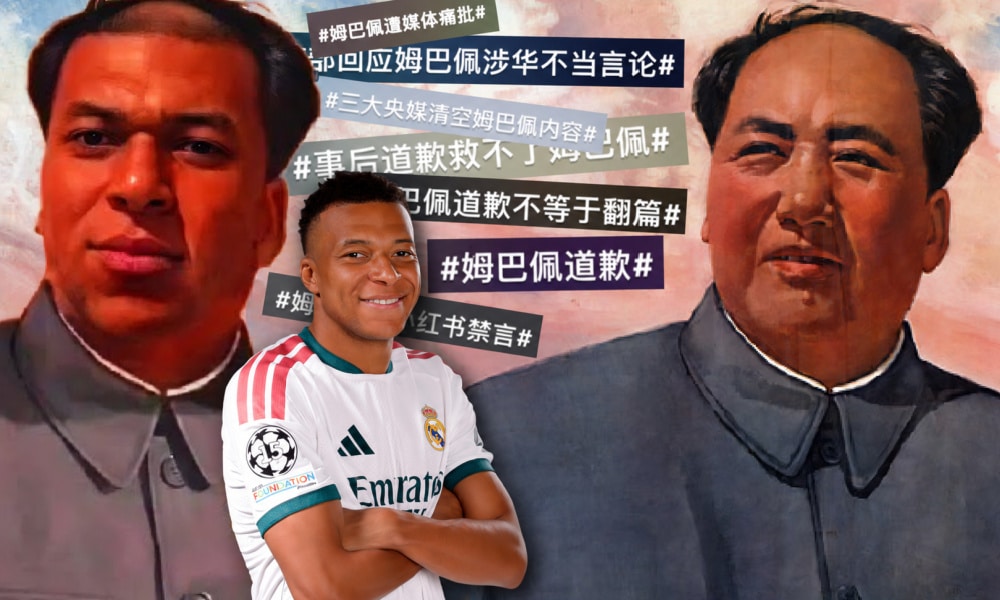
Mbappé’s favorite Mao meme sparked major backlash in China. More on what the controversy reveals about political red lines, online humor, and censorship.
RESOU 热搜 | What’s Trending in China, Explained
Here, I briefly unpack the stories making waves on Chinese social media and share what stands out to me. Don’t miss an update: become a subscriber to Eye on Digital China today.
Oh oh oh, Mbappé, all those goals, yet you lost so many points on Chinese social media over the past 48 hours.
Following his 100th goal for Real Madrid during El Clásico and finishing second on Ballon d’Or night, French football player Mbappé is all the talk on Chinese social media — not for his achievements, but for what is seen as crossing a major red line in an online interview.
On Tuesday night, a text came in from Ruixin: “I am wide awake tonight and somehow witnessed live how the footballer Kylian Mbappé was getting blocked and totally canceled on Chinese social media for his comments about Mao Zedong over the past, like, three hours 😅”
I quickly grabbed my phone and saw the flood of Mbappé posts rapidly coming in, and it was clear that people were very cross with him.
Although it was already clear that this might not blow over any time soon, by early Wednesday morning it became painfully clear how the controversy had snowballed. Dongpeng Beverage Group (东鹏), one of the many Chinese companies that signed the famous sportsman as its brand ambassador, publicly stated that it was cutting all commercial ties with Mbappé. Soon, others followed.
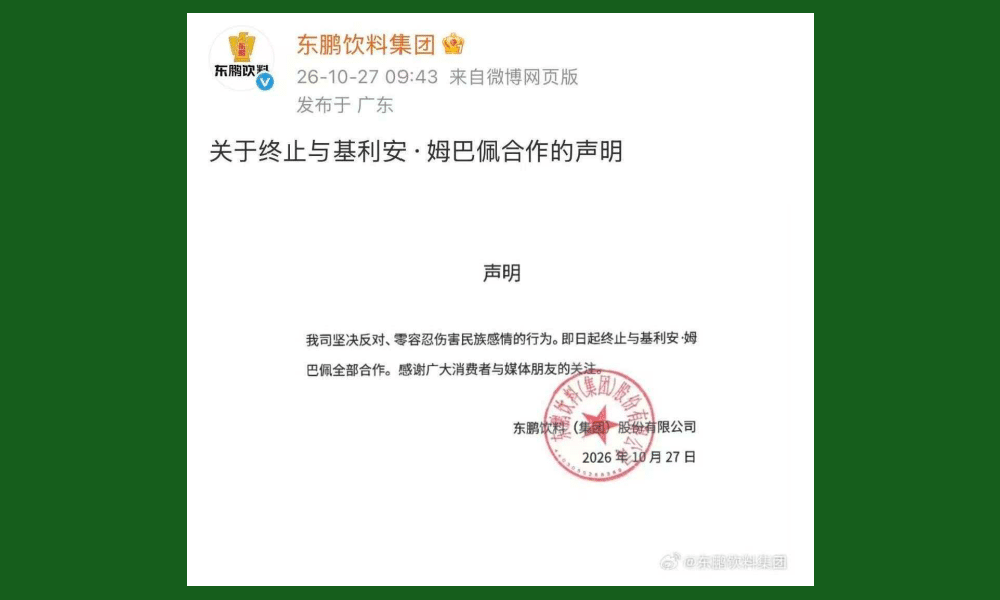
Dongpeng Beverage Group (东鹏): the first in a string of companies to cut ties with French footballer Kylian Mbappé.
Mbappé’s fall from grace in China has been sudden and spectacular, like a major avalanche of backlash that unfolded in one night, and it can all be traced back to one segment of an interview the footballer previously did on a French YouTube show (The Bridge) that resurfaced online — initially through Reddit and X, and then on Chinese social media apps, like football platform Dongqiudi (懂球帝).
In that segment, when asked about his favorite meme, Mbappé replied that one of the memes he finds funniest is:
🗣️ “the one where they put my face on some guy, a Chinese dictator. That really makes me laugh, I use it with my friends all the time.”

The interview segment where Mbappé shares his favorite meme: his face photoshopped onto the face of a “Chinese dictator.”
The show, created by Mbappé’s Real Madrid teammate Aurélien Tchouaméni, added the image Mbappé referred to: his face photoshopped on a Mao propaganda visual. It’s part of a series of memes that emerged in 2024 in which Mbappé’s face is edited onto the faces of dictators.1
Chapter Dive
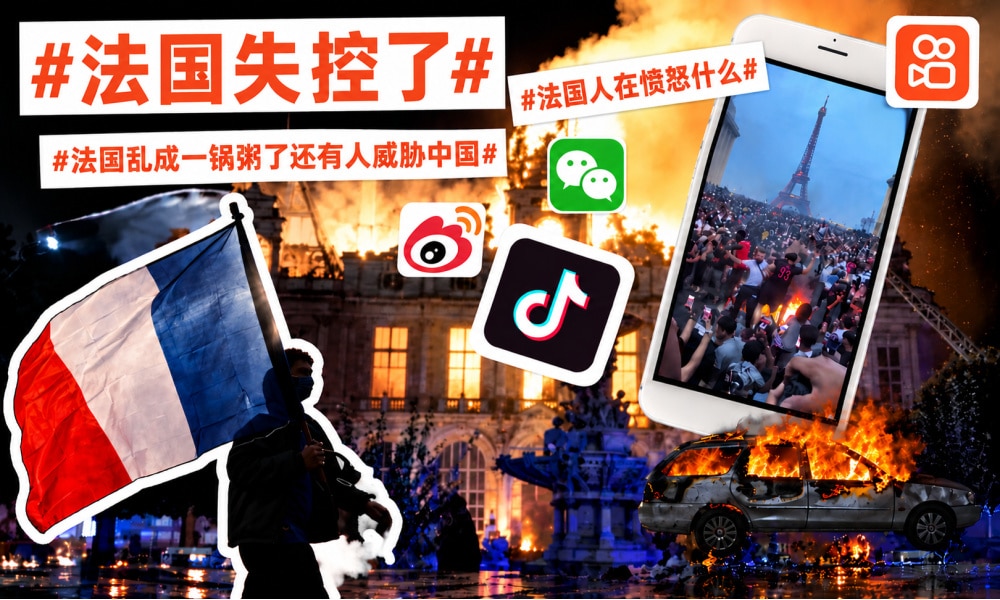
The French Protests, Viewed from China: Five Narratives on Chinese Social Media
From the decline of Europe to historical karma: these 5 narratives reveal how Chinese social media discusses the recent unrest in France.
Eye on Digital China is a reader-supported publication by
Manya Koetse (@manyapan) and powered by What’s on Weibo.
It offers independent analysis of China’s online culture, media, and social trends.
To receive the newsletter and support this work, consider
becoming a paid subscriber.

Mbappé, Mao & the Backlash on Chinese Social Media

Mbappé, Mao, and the Joke That Shall Not Be Named

The French Protests, Viewed from China: Five Narratives on Chinese Social Media

What Does 20 Yuan ($3) Mean Anymore? China’s Disappearing Living Rooms & the Great Laundry Debate

Starbucks Goes Xinjiang & The Kardashians in China

Why Japan Has So Many Surnames, China’s Back-to-School Shifts & Taiwan Pavilion Trouble

The Power of Ugly: Why Niu Lai Became China’s Unlikeliest Box-Office Hit

The Rise of “Shuaqi-ism,” Taking Starbucks to the Fields, and Pretending to Go to Work

AI Actress Ad Pulled, Baihaitun Disrupts Shanghai and Cicada Meme Bugs Huawei

Blame Games & Bad Signs: Nepal–Tibet Floods, Huawei’s Toilet Trouble, “Screwed” Graduates
-
 Chinese New Year9 months ago
Inside Chunwan 2026: China’s Spring Festival Gala
-
 China Brands, Marketing & Consumers12 months ago
Hasan Piker’s China Trip & the Unexpected Journey of a Chinese School Uniform to Angola
-

 Chapter Dive8 months ago
Inside the Great Chinese Debate Over the Iran War
-

 China Trend Watch12 months ago
Japan Tensions, Nexperia Fallout, Yunnan’s ‘Wild Child,’ & “Modern Opium”