
Chapter Dive
Behind the Spotlights of Transgender China
Transgenderism is becoming an increasingly popular topic on Chinese social media. The general attitude towards transgenderism in China is seemingly tolerant, but what goes on behind the spotlights of Transgender China?

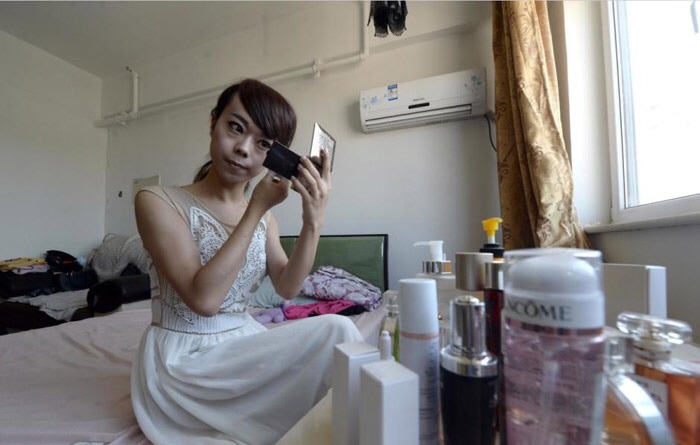
Six years ago I met Han Bingbing (寒冰冰) in a Beijing bar, and I was intrigued by her right away. My friends told me she was a well-known post-operation transsexual who had a successful career in the fashion and entertainment industry, and called herself “China’s Number One Transsexual Beauty” (“中国第一变性美女”). We started talking, and Han invited me to come on her online talkshow the next day.
 Han Bingbing, well-known Beijing transgender who underwent sex reassignment surgery.
During our noodle lunch afterwards, we spoke about her life. The seemingly advanced emancipation of Chinese transsexuals surprised me. Mainland China is not exactly known for its excellent fundamental rights, yet here I was speaking to a radiant girl who had her male-to-female sex change in 1999, and now was not only officially a woman in body and on paper, but had also become the mother of her own adopted child. She was independent, successful, and seemingly happy and free.
“Mainland tabloids have entered a phase of fascination with transsexuals.”
Over a decade ago, China Daily wrote that “Mainland tabloids have recently entered a phase of sudden fascination with transsexuals.” With the rise of social media, ‘transgenderism’ has still remained a recurrent topic in Chinese media and on social media sites like Sina Weibo.
Earlier this week, pictures of a Lithuanian male-to-female transgender woman became trending on Chinese social media, where the 21-year-old woman was praised for her beauty and ‘female elegance’ (image below).

Many Chinese transgenders have stepped into the limelight to share their story with the public – such as Chen Lili (陈莉莉), who was the first transsexual woman to attempt to compete in the Miss Universe contest, or Liu Xuanyi (刘炫怡), “China’s first online transsexual celebrity”, or transgender opera star Bian Yujie (边玉洁).
Although there is a nuanced difference between ‘transgender’ and ‘transsexual’ in English (‘transgender’ being an umbrella term for those whose identity does not conform to what is associated with the sex they were born with, and ‘transsexual’ referring to those who transition from one sex to another, Medical Daily), there is no such nuance in common Chinese language, where both would be translated as ‘bianxing‘. ‘Bianxing’ (变性) literally means ‘change sex’, and a transgender or transsexual would be referred to as a ‘bianxingren‘ or ‘change-sex-person’.
China’s most famous transgender woman probably is Jin Xing (金星), a dancer, director and actress who formerly was a colonel in the People’s Liberation Army dance troupe and underwent sex change surgery in 1995. Years ago, Jin Xing stated that she was “quite pleased” with the way in which Chinese people have dealt with her transsexuality, and that she had “experienced no discrimination” (Canada 2000). With over 6 million followers on Weibo, the dance star is very popular on China’s social media. She now has her own talk show, simply called The Jin Xing Show, which is received well by netizens.
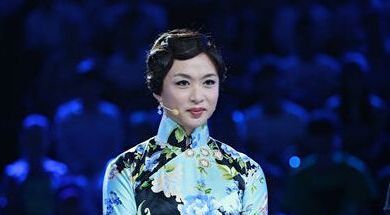 Chinese celebrity Jin Xing underwent sex change operation in 1995.
Zhang Kesha (张克莎), who had a sex change surgery in 1983, has written a book about her experience as a transgender called ‘A Woman’s Dream’ (女人梦). She has become famous for being the first transgender in China to undergo a sex change surgery. Han Bingbing has also been open about her story, even sharing the price of the operations that turned her into “an ordinary girl”: she spent 200,000 RMB (over 30,000 US dollars) on them.
 Zhang Kesha, ‘China’s first transsexual’, who had sex reassignment surgery in 1983
And there are more who openly discuss transgenderism. Earlier this year, famous Chinese sexologist Li Yinhe stated on her Weibo blog that she had been living together with her female-to-male transgender partner for 17 years. Her revelation lead to online discussions about transgender people, raising awareness about different gender identities within China.
“China may be surpassing the U.S. in its tolerance and acceptance of transgender people.”
With so much exposure on transgenderism in China’s (social) media, the topic can hardly be called a taboo anymore. It is now possible for Chinese transgenders to undergo surgery, change their gender in their official ID, and get married. Some even report that “China may be surpassing the U.S. in its tolerance and acceptance of transgender people.”
Indeed, it is striking how many transgenders are present in China’s popular culture, and how accepted they are by the public. Virtually all of China’s well-known transgenders are artists, dancers or performers. It is perhaps no coincidence that transgender performance has been an important part of Chinese entertainment for centuries (Kile 2013).
“China has an estimated 400,000 transgender people.”
But beyond the limelight, the situation of transgenders in China is less rose-colored. Although China has an estimated 400,000 transgender people, the numbers of the two main centres for sex change operations reveal that no more than 800 transgender patients underwent surgery in the past 30 years, suggesting that many patients have gone to private clinics or foreign countries for their sex change (Jiang et al 2014).
Sex reassigning surgeries are not covered by medical insurance in China, and are very costly. The basic surgery starts at 50,000 RMB (7900 US dollars), while the average annual salary of a Chinese worker is 28,752 RMB (around 4540 US dollars). Besides the price, the guidelines on sex change provided by the Chinese Ministry of Health are also a hurdle to many. For example, the patient must get approval by family members and obtain proof of clean criminal records (ibid., 2014).
Earlier this week, the difficulty of Chinese bureaucracy concerning sex reassignment became painfully clear when Sichuan News reported that a Chinese transgender who underwent surgery in Thailand returned to China, only to find out she could not officially change her gender on paper (read her story).
Another major problem is employment discrimination. Within the arts and entertainment, transgenderism is commonly accepted, but in everyday life, transgender individuals are often discriminated, as they are considered “abnormal” or even “disgusting” by many. Especially female transgenders who identify as male will encounter discrimination, even from within the LGBT community (Jun 2010, 351-352).
The difficulty in finding a job leads many to work in the entertainment industry. “Many transsexuals have to work in she-male shows to make money,” Han Bingbing tells China Daily.
I saw Han Bingbing again this year, at Beijing Fashion Week, after our initial meeting in 2009. She had cut off her hair and was now a blonde, wearing a pearly pink dress that showed off her sexy cleavage. She was doing fine, and life had been treating her good, she told me, before her manager came round to take her to her next appointment. Transgender China is well-off within the spotlights. But there is a lot of room for improvement behind the limelight.
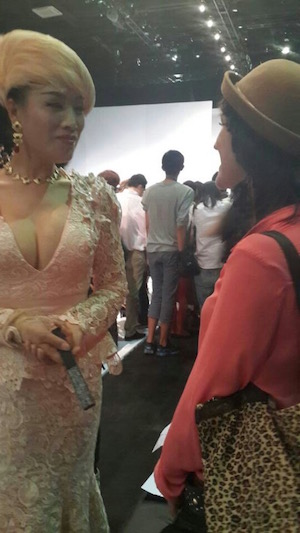 A brief encounter with Han Bingbing at the Beijing Mercedes Benz Fashion Week.
By Manya Koetse
Follow @WhatsOnWeibo
References
* Thanks to Pei Yuxin (裴谕新) for her input on this article.
*Available online sources have been directly linked within this article.
Canada: Immigration and Refugee Board of Canada. 2000. “China: Treatment of transsexuals who have undergone a sex change operation, particularly in Hong Kong (1997-2000).” Refworld (4 April). http://www.refworld.org/docid/3ae6ad4e10.html [11.08.15]
Jiang, Hua, Xian Wei, Xiaohai Zhu, Hui Wang, and Qingfeng Li. 2014. “Transgender Patients Need Better Protection in China.” The Lancet 384 (9960). Elsevier Ltd: 2109–10. doi:10.1016/S0140-6736(14)62372-2.
Jun, Pi. 2010. “Transgender in China.” Journal of LGBT Youth 7 (May 2013): 346–58. doi:10.1080/19361653.2010.512518.
Kile, Sarah E. 2013. “Transgender Performance in Early Modern China.” Differences: A Journal of Feminist Cultural Studies 24 (2): 130-149.
Hore, B. D., F. V. Nicolle and J. S. Calnan. 1973. “Male Transsexualism: Two Cases in a Single Family.” Archives of Sexual Behavior 2 (4): 317–21.
Jun, Pi. 2010. “Transgender in China.” Journal of LGBT Youth 7 (May): 346–58.
Ruan, F. F., V. L. Bullough and Y. M. Tsai. 1989. “Male Transsexualism in Mainland China.” Archives of Sexual Behavior 18 (6): 517–22. doi:10.1007/BF01541677.
©2015 Whatsonweibo. All rights reserved. Do not reproduce our content without permission – you can contact us at info@whatsonweibo.com.

Chapter Dive
Red Carpet, Pandas, and Power: How China Read the Trump-Xi Summit
On Chinese social media, Washington’s red-carpet reception wasn’t just diplomacy but read as recognition of China’s restored status on the global stage.
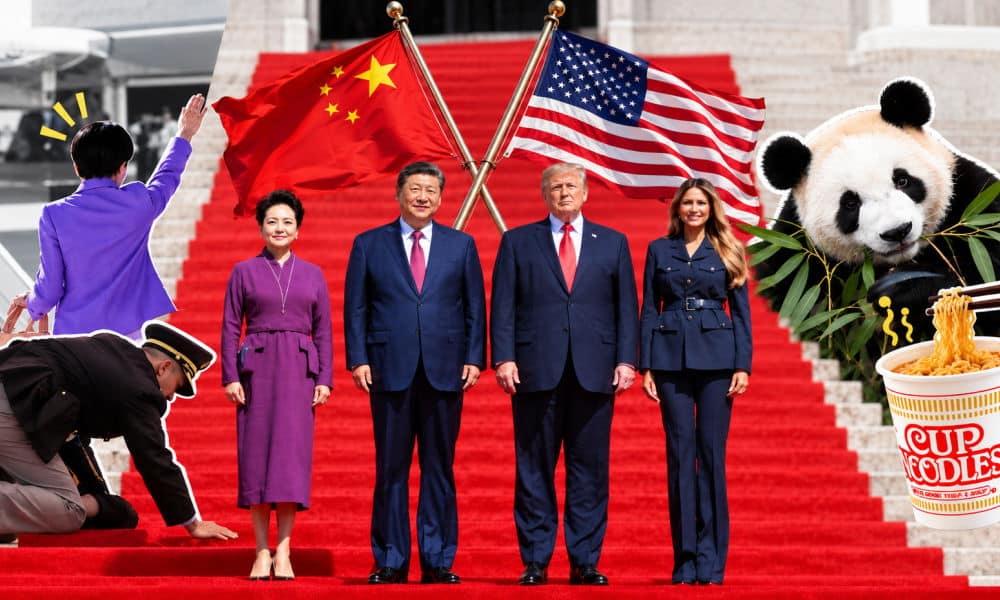
Originally published in the Eye on Digital China newsletter on Sunday, September 27, 2026. Want to receive the next edition in your inbox? Become a paid subscriber here.
The past week was all about the Trump-Xi meeting in Washington. On mainstream Chinese social media feeds, much of the focus wasn’t on what was discussed, who gained what, or what was promised. It was about: How was China welcomed? How far did they go? How exceptional was the reception? And what does this say about China’s status as a major power on the world stage today?
Symbolic moments mattered more than strategic talks. Within that framework, President Trump, along with First Lady Melania Trump, hit the right notes.
The US visit by Xi Jinping and First Lady Peng Liyuan began on Wednesday (Sep 23), with Donald Trump and the First Lady personally welcoming them at Joint Base Andrews, a highly unusual move. Presidents typically receive foreign leaders at the White House; in recent decades, airport welcomes at Andrews have been reserved almost exclusively for popes. The last comparable presidential welcome was Kennedy’s 1962 greeting of British Prime Minister Harold Macmillan, a particularly close US ally at the time.
Wednesday’s welcome came with a red carpet, which members of the US military meticulously inspected and cleaned on their hands and knees right before Xi and Peng’s arrival. A photo of that scene was widely shared on Chinese social media, where many netizens seemed both bemused and struck by the sight of Americans quite literally bending over backward for their Chinese guests, with one popular Weibo account (@提刀探花在缅北) writing: “This is a scene that we will remember for decades.”
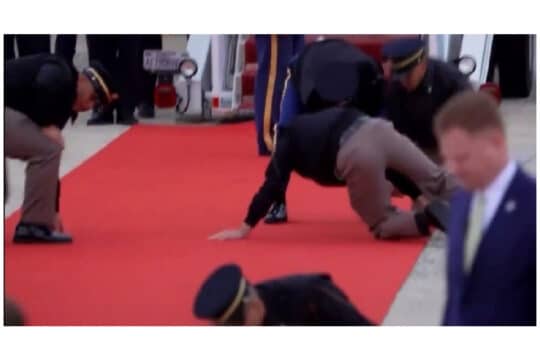
Red-carpet preparation at Joint Base Andrews
At the White House welcome ceremony on Thursday (Sep 24), where both leaders delivered remarks, Trump touched on the history of war and mentioned the American volunteer fighter group in China — the Flying Tigers — saying:
🗣️ “If we focus on our common interest, I’m confident there is much we can achieve. Throughout history, the pursuit of those common interests has connected our people across the vast oceans, across big, tremendous distances and many differences, and even made us allies in World War II. Look at the greatness we had together fighting in World War II.”
After the Washington summit concluded, Trump posted on Truth Social, calling the meeting one of “Friendship, Strength, and Success, for both China and the U.S.A.,” and adding that he looked forward to the next US-China meeting in November.
Historical Memory at the White House
But why did the special treatment given to the Chinese delegation in the US seem to matter so much in China, especially considering the ubiquitous anti-American sentiment of recent years? Not only did official media highlight it, but it also resonated strongly with netizens and became the defining story about this meeting on social media.
It goes much deeper than flattery.
Narratives of “never…
Chapter Dive
Keeping Score of History: The Mukden Incident and China’s Basketball Defeat to Japan
China’s defeat against Japan at the Asian Games trended on the same day as the commemoration of the Mukden Incident—not as a separate event, but as a painful reminder of the humiliation of war.
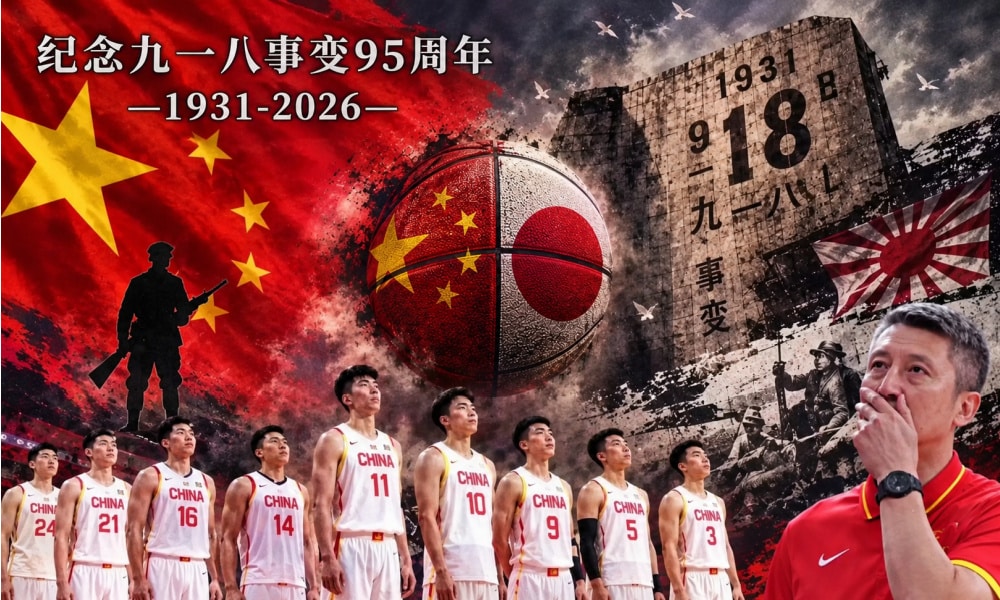
Football can be a useful way to gauge the state of nations.1 So can basketball, apparently.
One of the most discussed topics on Chinese social media on September 18 was the China vs. Japan men’s basketball semifinal at the Asian Games, a topic that was collectively viewed not merely through a sports angle, but through the lens of history and WWII – especially on an important commemoration day that was all about China’s war against Japanese aggression.
September 18 marks the anniversary of the Mukden Incident in 1931. Right next to the basketball game, that topic became one of the top keywords on Weibo and other Chinese platforms on Friday.2
The Mukden Incident —a staged explosion that damaged a section of Japanese railway in Shenyang [Mukden] on September 18, 1931—was used as a pretext for Japan’s invasion of Manchuria and has come to be widely regarded by Chinese historians and officials as the true starting point of the Second Sino-Japanese War.
On this significant day, the China vs. Japan game in Nagoya ended in a major 77-97 loss for the Chinese team, which critics attributed to a lack of speed and tactical weaknesses that left them defenseless against the Japanese team’s swift attacks. Making it worse, the Chinese had the advantage of taller players, and the Japanese weren’t even playing with their best team.
“Like a top-grade horse losing to a bottom-grade horse,” one sports columnist wrote (“是我们的上等马输给了对方的下等马”).
Prior to the game, many commenters already questioned why a China-Japan face-off should take place on such a sensitive date, while others suggested that the Chinese team “could not afford to lose on this day.”
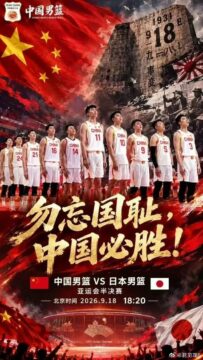
Posted by Weibo user 君见理5, this AI poster transforms…
Eye on Digital China is a reader-supported publication by
Manya Koetse (@manyapan) and powered by What’s on Weibo.
It offers independent analysis of China’s online culture, media, and social trends.
To receive the newsletter and support this work, consider
becoming a paid subscriber.


Starbucks Goes Xinjiang & The Kardashians in China

Red Carpet, Pandas, and Power: How China Read the Trump-Xi Summit

Keeping Score of History: The Mukden Incident and China’s Basketball Defeat to Japan

The Rise of “Shuaqi-ism,” Taking Starbucks to the Fields, and Pretending to Go to Work

Why Japan Has So Many Surnames, China’s Back-to-School Shifts & Taiwan Pavilion Trouble

“God Won’t Save Us, but the PLA Will”: Floods, Faith, and Kung Fu Soccer Nostalgia

How Chinese AI Videos Turned Foreigners into Villains
Why Japan Has So Many Surnames, China’s Back-to-School Shifts & Taiwan Pavilion Trouble

The Power of Ugly: Why Niu Lai Became China’s Unlikeliest Box-Office Hit

AI Actress Ad Pulled, Baihaitun Disrupts Shanghai and Cicada Meme Bugs Huawei
-
 Chinese New Year8 months ago
Inside Chunwan 2026: China’s Spring Festival Gala
-

 China Brands, Marketing & Consumers11 months ago
Hasan Piker’s China Trip & the Unexpected Journey of a Chinese School Uniform to Angola
-

 Chapter Dive7 months ago
Inside the Great Chinese Debate Over the Iran War
-

 China Trend Watch11 months ago
Japan Tensions, Nexperia Fallout, Yunnan’s ‘Wild Child,’ & “Modern Opium”