
China Insight
Force-Feeding Wasabi: Abuse of Toddlers at Shanghai Kindergarten Sparks Outrage


Surveillance footage of the abuse of toddlers at a company’s in-house kindergarten has surfaced on Chinese social media, leaving Shanghai parents and Weibo netizens shocked and outraged.
The abuse occurred at the Shanghai daycare facilities of Chinese travel giant Ctrip.
The footage, captured by surveillance cameras on November 1-3, shows how a female staff member forcefully takes off the backpack of a little girl and throws it away, after which she pushes the toddler to the ground.

Other fragments show how a staff member puts something – which was later confirmed to be wasabi – in the mouths of several toddlers, leaving them gasping and crying.
A video of the incidents shared by Beijing News on Sina Weibo was shared almost 15.000 times on Wednesday, triggering some 20.000 comments. The topic #Ctrip Kindergarten# was viewed more than 26 million times.
News site Sina reports that the Ctrips’s HR department received reports about alleged abuse from concerned staff at the daycare on November 3. The abuse was exposed on November 6 when surveillance footage was inspected by company staff.
News of the abuse then quickly spread to parent support groups. Sohu writes that Weibo netizen @PrettySoldierHelloKitty (@美少女战士helloKitty) first exposed the videos online, after which they soon became trending.
The daycare is home to five groups of around 20 children each. Their parents are all employees of Ctrip.
Sixth Tone reported that the staff involved have since been fired and that the police is currently investigating the issue.
On November 8, Ctrip organized an ‘apology meeting’ where the kindergarten’s staff members in question, kneeling to the ground, faced the outraged parents. Footage of this meeting also widely circulated online afterwards, showing parents crying and screaming.

During the ‘apology meeting’, parents shoved wasabi into the mouth of one of the involved teachers [pictured].

Parents tried to attack the staff members, and were held back by security.
Other various screenshots of WeChat conversations with the kindergarten’s employees show that parents already had concerns before the abuse was exposed, asking staff about bruises on their child and if something had occurred at the daycare.

Parents previously asked staff about the bruises on their child, but employees denied their role in the matter.
“I usually look through Weibo before sleeping, but after seeing this, I can no longer sleep,” one female netizen writes: “I am so angry I wish I could go out and scold these people.”
“This makes me worry for the safety of my own daughter at school,” another person wrote.
Abuse of children by teachers often makes headlines in China. In August, an essay by a primary school student that exposed daily abuse by a schoolteacher also went viral on Weibo.
A widespread survey across ten provinces in China among elementary and junior secondary school students showed that 15.4% of young students suffered corporal punishment as a form of discipline at school.
But stories of abuse amongst the very young children, as in the Ctrip case, also frequently surface. In 2012, another story in which a Guangzhou female teacher beat a 4-year-old girl made headlines. In 2016, another abuse case in Hebei also sparked outrage.
Many netizens hold the Ctrip company responsible for the incident: “I am furious! I will immediately delete the Ctrip app from my phone,” many commenters said.
Ctrip has apologized and promised to “offer physical examinations and psychological counseling to children in the day-care center and parents , in an effort to minimize the impact of the incident,” Global Times reports.
State media write that the problem of abuse in Chinese (pre)schools relates to a lack of professional kindergarten teachers and the widespread employment of unqualified kindergartens.
By Manya Koetse
Follow @whatsonweibo
Spotted a mistake or want to add something? Please let us know in comments below or email us.
©2017 Whatsonweibo. All rights reserved. Do not reproduce our content without permission – you can contact us at info@whatsonweibo.com.




China Insight
Mbappé, Mao, and the Joke That Shall Not Be Named
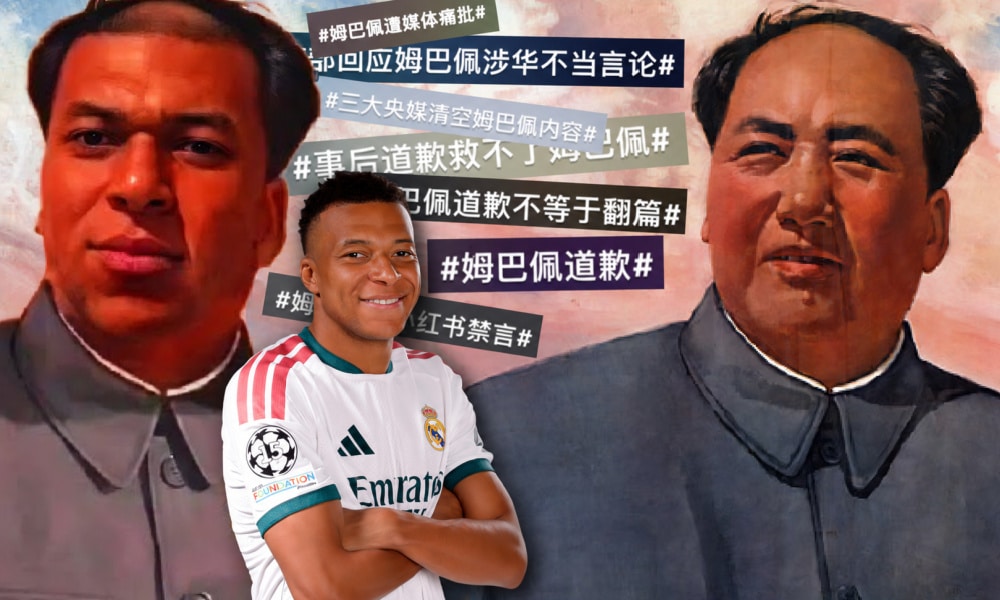
Mbappé’s favorite Mao meme sparked major backlash in China. More on what the controversy reveals about political red lines, online humor, and censorship.
RESOU 热搜 | What’s Trending in China, Explained
Here, I briefly unpack the stories making waves on Chinese social media and share what stands out to me. Don’t miss an update: become a subscriber to Eye on Digital China today.
Oh oh oh, Mbappé, all those goals, yet you lost so many points on Chinese social media over the past 48 hours.
Following his 100th goal for Real Madrid during El Clásico and finishing second on Ballon d’Or night, French football player Mbappé is all the talk on Chinese social media — not for his achievements, but for what is seen as crossing a major red line in an online interview.
On Tuesday night, a text came in from Ruixin: “I am wide awake tonight and somehow witnessed live how the footballer Kylian Mbappé was getting blocked and totally canceled on Chinese social media for his comments about Mao Zedong over the past, like, three hours 😅”
I quickly grabbed my phone and saw the flood of Mbappé posts rapidly coming in, and it was clear that people were very cross with him.
Although it was already clear that this might not blow over any time soon, by early Wednesday morning it became painfully clear how the controversy had snowballed. Dongpeng Beverage Group (东鹏), one of the many Chinese companies that signed the famous sportsman as its brand ambassador, publicly stated that it was cutting all commercial ties with Mbappé. Soon, others followed.
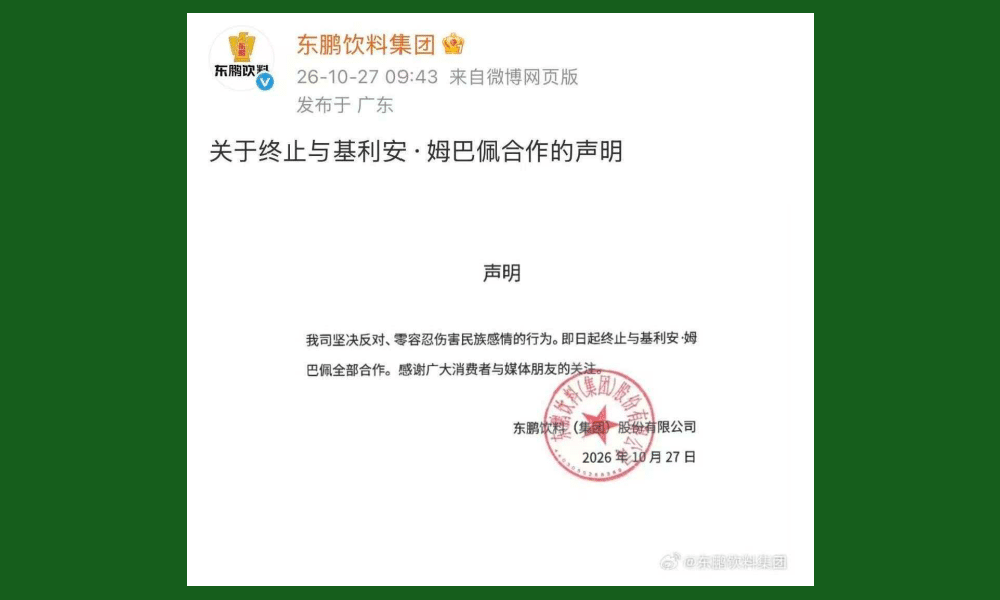
Dongpeng Beverage Group (东鹏): the first in a string of companies to cut ties with French footballer Kylian Mbappé.
Mbappé’s fall from grace in China has been sudden and spectacular, like a major avalanche of backlash that unfolded in one night, and it can all be traced back to one segment of an interview the footballer previously did on a French YouTube show (The Bridge) that resurfaced online — initially through Reddit and X, and then on Chinese social media apps, like football platform Dongqiudi (懂球帝).
In that segment, when asked about his favorite meme, Mbappé replied that one of the memes he finds funniest is:
🗣️ “the one where they put my face on some guy, a Chinese dictator. That really makes me laugh, I use it with my friends all the time.”

The interview segment where Mbappé shares his favorite meme: his face photoshopped onto the face of a “Chinese dictator.”
The show, created by Mbappé’s Real Madrid teammate Aurélien Tchouaméni, added the image Mbappé referred to: his face photoshopped on a Mao propaganda visual. It’s part of a series of memes that emerged in 2024 in which Mbappé’s face is edited onto the faces of dictators.1
Chapter Dive
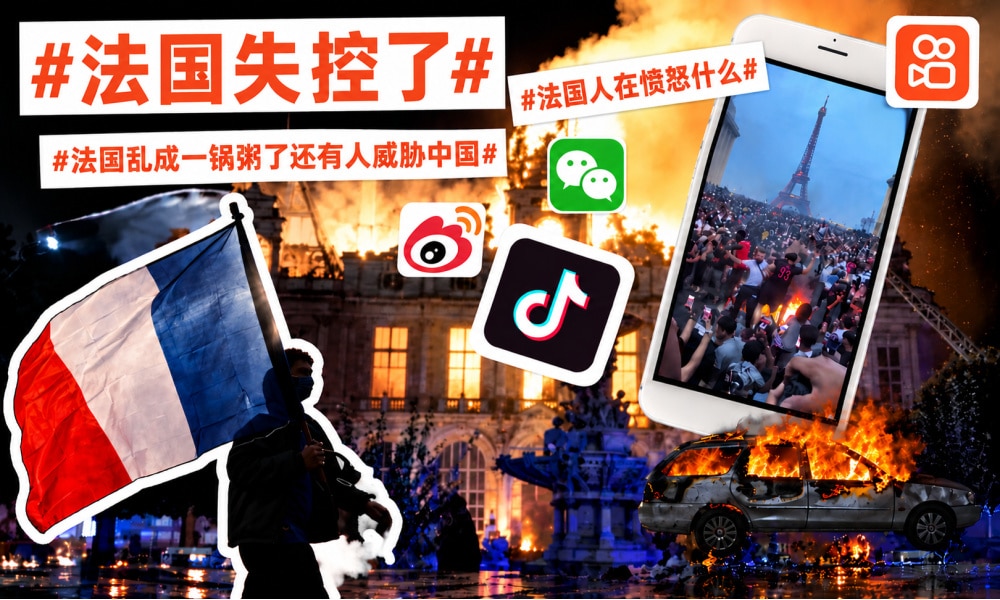
The French Protests, Viewed from China: Five Narratives on Chinese Social Media
From the decline of Europe to historical karma: these 5 narratives reveal how Chinese social media discusses the recent unrest in France.
Eye on Digital China is a reader-supported publication by
Manya Koetse (@manyapan) and powered by What’s on Weibo.
It offers independent analysis of China’s online culture, media, and social trends.
To receive the newsletter and support this work, consider
becoming a paid subscriber.


Mbappé, Mao & the Backlash on Chinese Social Media

Mbappé, Mao, and the Joke That Shall Not Be Named

The French Protests, Viewed from China: Five Narratives on Chinese Social Media

What Does 20 Yuan ($3) Mean Anymore? China’s Disappearing Living Rooms & the Great Laundry Debate

Starbucks Goes Xinjiang & The Kardashians in China

Why Japan Has So Many Surnames, China’s Back-to-School Shifts & Taiwan Pavilion Trouble

The Power of Ugly: Why Niu Lai Became China’s Unlikeliest Box-Office Hit

The Rise of “Shuaqi-ism,” Taking Starbucks to the Fields, and Pretending to Go to Work

AI Actress Ad Pulled, Baihaitun Disrupts Shanghai and Cicada Meme Bugs Huawei

Blame Games & Bad Signs: Nepal–Tibet Floods, Huawei’s Toilet Trouble, “Screwed” Graduates
-
 Chinese New Year9 months ago
Inside Chunwan 2026: China’s Spring Festival Gala
-
 China Brands, Marketing & Consumers12 months ago
Hasan Piker’s China Trip & the Unexpected Journey of a Chinese School Uniform to Angola
-

 Chapter Dive8 months ago
Inside the Great Chinese Debate Over the Iran War
-

 China Trend Watch12 months ago
Japan Tensions, Nexperia Fallout, Yunnan’s ‘Wild Child,’ & “Modern Opium”