China Digital
Here’s Xi the Cartoon – Online Animations Are China’s New ‘Propaganda Posters’
Easy to click, view & share – short cartoons and gifs are the propaganda posters of China’s new digital era.
Published
9 years agoon
PREMIUM CONTENT ARTICLE
In an era where China’s young generations are practically glued to their smartphone screens, China’s propaganda departments are stepping up their game. Online animated videos and gifs use bright colors, simple design, and a very likable Xi to deliver strong political messages.
The speech that was delivered by president Xi Jinping at the APEC summit last week made its rounds on Chinese social media this Tuesday – not as a video, but as an animated cartoon.
The APEC Economic Leaders’ Meeting took place in Vietnam’s Da Nang from November 10-11, and was attended by international world leaders such as Japanese Prime Minister Shinzo Abe, American President Donald Trump, and South Korean President Moon Jae-in.
As one of the keynote speakers to the APEC CEO summit, Xi talked about his views on the Asian region’s future. The speech was especially momentous since it marked Xi’s first public address at an international multilateral meeting since the conclusion of the 19th National Congress of the Communist Party of China.

In his address, Xi spoke about China’s commitment to regional multilateralism and open economic globalization, and the importance of promoting inclusive development.
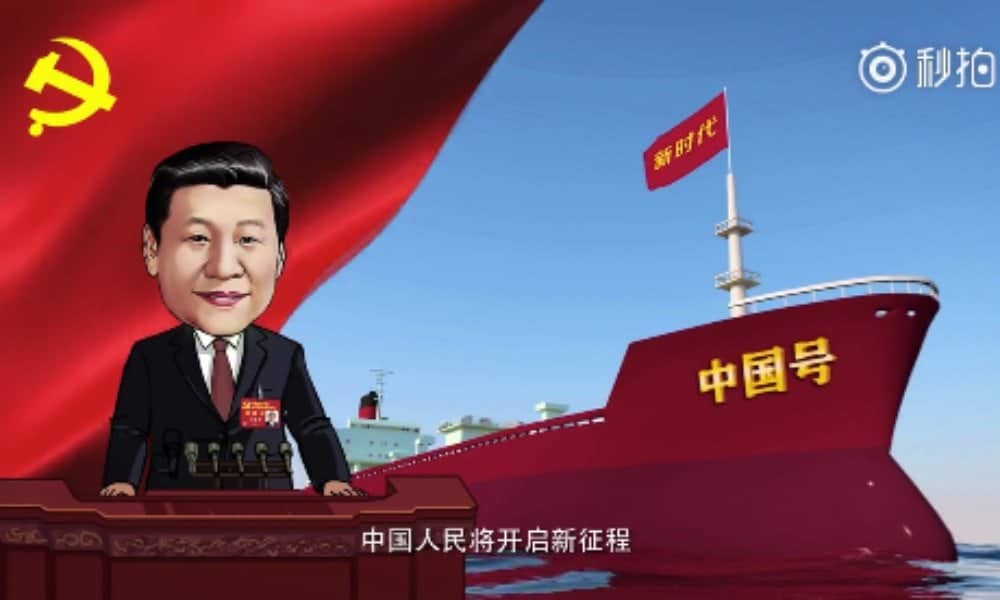
The animated cartoon version of the speech presents China as a leader in the region, with Xi as the main cartoon character. It was widely shared on Chinese social media by state media outlets for the past few days, at a time when cartoons and gifs seem to have become the new way of communicating Xi’s important visits and speeches to the online population.
Xi’s Animated Speech: China Leads the Way
The recent APEC cartoon that made its rounds on Weibo this week summarizes Xi Jinping’s speech in a 3,5 minute animation. It first shows a group of cranes, flying from China to the coastline of Vietnam’s Da Nang where Xi is holding his keynote speech.


As Xi talks about the development of China and the start of the PRC’s “New Era,” this concept is visualized through a boat that is going forward under the leadership of Xi Jinping (see featured image).
The short animation video then shows another vessel by the name of “APEC” that is in rough weather, passing icebergs of “terrorism,” “natural disasters,” or “food safety issues.” But luckily, there is a lighthouse standing up to the huge waves – and it is marked by the flag of China.

APEC: Asia-Pacific Economic Cooperation.


China is a stable lighthouse amidst the wild waves.
While the audio from Xi’s speech continues throughout the animation, talking about stability in the region, the cartoon presents the APEC group of leaders and Xi meeting with various leaders, leading to the final part that shows a world connected through boats, trains, airplanes, and the internet.


The very last fragment of the animation shows a fleet of boats going forward, “together building a better tomorrow for the Asia-Pacific,” with the leading boat carrying the Chinese flag.


The animation was shared on video platform Miaopai and Weibo by state media such as CCTV (@央视网), Global Times (@环球网), China Economy (@中国经济网), and others.
Xi Jinping the Cartoon
It is not the first time that the cartoon image of President Xi is propagated online by Chinese state media. Over the past years, various key political concepts, events, and ideological messages have been spread online through animations, with a central role for Xi Jinping.
This trend became particularly apparent earlier this year during the launch of the Belt and Road Initiative and during the 19th National Party Congress; both crucial moment for Beijing’s top leadership in 2017.
Xi Jinping was first launched as a cartoon image in 2013, when a video titled ‘How a Political Leader was Tempered’ (领导人是怎样炼成的) went viral online. At the time , Chinese state media reported that the identity of the video’s author “remained unknown.”

Xi first appeared as a cartoon in 2013.
But not long after this success, the first official release of a Xi Jinping cartoon followed. The series ‘Where did Xi’s Time Go?’ (习主席的时间都去哪了) was designed by media outlet Qianlong.com, and was propagated on major websites as well as new apps.
“More attractive than text news, the comic graphic news could reach readers’ heart and it suits modern reading habits,” the chief editor of Qianlong proudly said about the Xi cartoon.

‘Where did Xi’s time go?’ was issued in 2013.
In 2014, another cartoon series of Xi Jinping was released by Chinese state media. According to People’s Daily, the image of cartoon Xi, drawn by cartoonist Jiao Haiyang (焦海洋), made it possible for the media to depict the country’s leader in a “fun and vivid way”, showing the President as “modest,” “approachable,” and “in touch with the people.”

Xi Jinping by Jiao Haiyang for People’s Daily in 2014.

Xi eats baozi with the people. By Jiao Haiyang.

Xi Jinping meets a sanitation worker. By Jiao Haiyang.
In 2015, Xi made another return as a cartoon hero fighting corruption. The cartoon, uploaded to Youku by the mysterious ‘Chaoyang Studios,’ was widely shared by state media outlets such as People’s Daily (Gan 2015).
The exposure of Xi as a cartoon image increased thereafter in 2016 and 2017, with China Daily even launching a ‘cartoon commentary’ section. The ‘cartoon commentary’ section posts short animations of Xi Jinping during and after important political events, such as Xi’s Europe-Asia tour in June 2016, the Central Asia tour in June of 2017 or the Hong Kong visit in July.

‘Cartoon commentary’ from China Daily 2016: Xi’s Europe-Asia Tour.

China Daily ‘cartoon commentary’ during Xi’s visit to Hong Kong in July 2017.

Most of the animated Xi cartoons that are widely shared on Chinese social media over the recent two years, including the official media ‘cartoon commentaries’, have been credited to a cartoonist named Liao Tingting (廖婷婷).

Xi Jinping by Liao Tingting.
‘Liao’s’ cartoons have a distinct style that is different from that of Jiao Haiyang or the Qianlong designers; Xi always has the same friendly face, which is relatively big for his body. The cartoons have bright colors and often have a simplicity to them which is comparable to the drawings in children’s books.
‘Propaganda Poster’ in the Social Media Age
Colorful images depicting important events or developments, often with a special focus on Mao Zedong, have played an important role in Chinese state propaganda since the founding of the PRC in 1949. The propaganda poster was an especially relevant medium within this type of state-sponsored propaganda art. With bright colors and powerful images, posters could easily grab the attention of the people, and could also transmit messages to the many illiterate Chinese (Landsberger 2001, 541; Van der Heijden&Landsberger 2008).
But in an era of fast online media and smartphone-scrolling youth, Chinese leaders are changing their propaganda tactics. As noted by Chow (2017) in The Diplomat:
“China is hoping to reinforce belief in the Communist Party, Chinese nationalism, and socialist values through social media. The ruling party fears that it is losing the battle for hearts and minds – particularly among Internet-savvy millennials who have grown up with Western movies, music, and television.”
Besides other new ways to disseminate political messages (such as rap music, mobile games), short animated cartoons or gifs are now an important vehicle for propaganda; they can communicate strong audiovisual messages in bite-sized chunks, making it easy to digest for an audience that is overwhelmed by online information and is not interested in listening to hour-long speeches.
Although the step from propaganda poster to online animation seems big, the idea remains the same: using bright colors and simple design to attract people’s attention and communicate a strong message through a medium that can be easily placed in many locations, reaching a great number of people.

Besides communicating messages about China’s development and its role in the world today, state-sponsored Xi cartoons also convey a different message. Namely that Xi Jinping is a very likable and approachable leader.
The manner in which this message is conveyed matters greatly: the control should lie with Chinese authorities. When Chinese netizens compared President Xi to Winnie the Pooh, images of the friendly bear were censored soon after they went viral.

On Weibo, the animated cartoons of Xi’s speeches and important moments already seem to have become a normal part of the everyday social media landscape. While the reactions to the first series were generally positive, with netizens calling them “so cute” (好萌), the later videos seem to have become accepted as just another way for state media to communicate news to the people.
‘Xi the cartoon’ has become part of netizens’ daily online-scrolling routines. In this regard, propaganda departments have succeeded in bringing a likable and approachable Xi “in touch with the people.”
By Manya Koetse
Follow @whatsonweibo
References & Further Reading
Chow, Eugene. 2017. “China’s Propaganda Goes Viral.” The Diplomat, June 29 https://thediplomat.com/2017/06/chinas-propaganda-goes-viral/ [14.11.17].
Creemers, Rogier. 2017. “Cyber China: Upgrading Propaganda, Public Opinion Work and Social Management for the Twenty-First Century.” Journal of Contemporary China (26): 85-100.
Gan, Nectar. 2015. “Cartoon Xi Jinping Returns in New Animated Adventures.” South China Morning Post, February 21 http://www.scmp.com/news/china/article/1719881/cartoon-xi-jinping-returns-new-animated-adventures [14.11.17].
Landsberger, Stefan R. 2001. “Learning by What Example? Educational Propaganda in Twenty-first Century China.” Critical Asian Studies 33(4): 541-571.
Van der Heijden, Marien & Stefan Landsberger. 2008. Chinese Propaganda Posters. Amsterdam: International Institute of Social History. Available online at http://www.iisg.nl/publications/chineseposters.pdf [14.11.17].
Spotted a mistake or want to add something? Please let us know in comments below or email us.
©2017 Whatsonweibo. All rights reserved. Do not reproduce our content without permission – you can contact us at info@whatsonweibo.com.
Manya Koetse is a sinologist, writer, and public speaker specializing in China’s social trends, digital culture, and online media ecosystems. She founded What’s on Weibo in 2013 and now runs the Eye on Digital China newsletter. Learn more at manyakoetse.com or follow her on X, Instagram, or LinkedIn.
You may like
China Digital
How Chinese AI Videos Turned Foreigners into Villains
How viral AI videos turn racialized outsiders into threats and violent Chinese heroes into defenders of social order, China’s first nationally broadcast AI drama, and why a newspaper is being sold for 50 times its original price.
Published
5 days agoon
August 3, 2026
Over the past few weeks, a noteworthy amount of AI-related news has been trending on Chinese social media, which is reflected in this week’s edition.
Now that AI has entered every corner of media consumption and online life, related discussions seem to be reaching a new peak. While well-produced AI dramas are receiving more praise, low-effort AI slop is flooding video feeds and increasingly being used to stir controversy and generate clicks, fueling prejudice, hate, and cyber-nationalism. More about that further down in this newsletter.
🗞️ QUICK SCROLLS
🎬 A new AI-generated micro-drama has become all the rage on Chinese social media. While earlier AI dramas were criticized for being sloppy and repetitive, Laid-Off Girl (被裁掉的女孩) is praised for its quality and appealing protagonist, Fang Taozi (方桃子), a small-town woman pursuing her dream of becoming a model in Paris. She is so believable that viewers almost forget they are not watching a live-action production. This marks a real step up in quality for the industry, raising the bar for others. (If you want to get a taste of what it looks like, here’s a YouTube link).

Stills from the popular micro AI drama Laid-Off Girl (被裁掉的女孩).
📺 China’s national TV has now also aired its very first AI drama. While AI dramas mostly belonged to the realm of unofficial short-form online productions, the phenomenon has now made the leap to longer productions broadcast on national satellite television. Anhui TV is airing the Ming-dynasty drama The Tale of Peach Blossom Pool (桃花潭记), promoted as China’s first fully AI-produced medium-length drama centered on cultural heritage.
📱 China’s cheap & easy SIM-card era has ended. There was a time when you could get a SIM at any street corner in a Chinese city. That changed over a decade ago when real-name registration became strictly enforced. Now, as of 1 August, China Mobile, China Telecom and China Unicom will sell cards online only through their own apps and websites, cutting off all third-party internet sellers who have been the go-to source for cheap data plans. The move is meant to curb third-party SIM cards ending up in grey-market chains, being used for bulk account registration and telecom fraud. But most people just fear that plans are becoming less affordable.
🚇 “Half an hour queuing for a ten-minute ride” was a common complaint after Shenzhen Metro tightened its security checks on July 20. Much to the dismay of commuters, the stricter checks led to long lines, as all carry-on items must now pass through an X-ray machine, while every passenger is also subject to a handheld body scan. Some wondered why, in an era of AI-powered image screening, security couldn’t be handled more efficiently. Shenzhen is hosting the APEC Economic Leaders’ Meeting later this year, in November.
☀️ Summer childcare worries have been trending, as even dual-income families are reportedly struggling to arrange childcare during the school holidays. Summer programs often last only a month and still require pick-ups during hot afternoons, while private tutors sometimes charge around 200 yuan per hour ($30). More Chinese parents have therefore turned to hiring university students, offering 3,500 to 4,000 yuan per month ($520–$590) to look after their children during the summer break.
👁️ EXPLAINER
How Chinese AI Videos Turn Foreigners Into Villains
“I’m American! You can’t do anything to me!” says a young white man, moments before a strong Chinese man kicks him and throws him to the ground in a single move. A crowd of Chinese aunties standing nearby applauds as the foreigner hits the ground. “Don’t think we’re still the Chinese people of the past,” the Chinese man says. “You don’t want to mess with the Chinese people of today.”
This is just one example among hundreds of similar short videos flooding Chinese social media these days. Featuring various kinds of anti-foreign and racist content, they depict foreigners as threats to China’s social, moral, and national order. Strong, confident Chinese people confront, violently beat, and humiliate them in defense of their country.

Stills from AI videos showing Chinese men beating up misbehaving foreigners.
These videos, which often last between ten seconds and half a minute, are posted by online creators across platforms such as WeChat, Kuaishou, and Douyin. Many of these creators run content-farming accounts devoted entirely to this type of content, which attracts many likes and reactions: the videos are short, visually striking, emotionally powerful, and play into existing prejudices and racialized thinking.
Racist and anti-foreign content is nothing new on Chinese social media and dates back to the earliest days of China’s online video platforms. But the age of AI has brought new dynamics to such content. Last fall, Joshua Dummer reported in Foreign Policy on the growing popularity of AI-generated anti-Black videos presented as cautionary tales about Chinese women becoming involved with African men.
This time, it’s different.
The latest wave of anti-foreign content goes beyond gender dynamics and focuses more broadly on the negative influence foreigners supposedly have on Chinese people and society. Foreigners disrupt orderly Chinese public spaces or threaten the safety of Chinese women, security personnel, or lower-status workers, after which a morally upright Chinese person restores order through violence.
Four Types of Videos
In the dozens of AI videos I’ve analyzed, roughly four categories can be discerned, with different groups of foreigners performing different “narrative jobs.”
(See examples of these videos on my X here, or find them on Bluesky)
1️⃣ The Uncivilized Outsider
Roughly 40% of the videos show foreigners engaging in “uncivilized” behavior and disrupting China’s cleanliness, etiquette, and public order. In these scenes, foreigners are portrayed as dirty, smelly, and disorderly.
One example shows an entire plane of Chinese passengers holding handkerchiefs over their noses because of the smell from an Indian man’s bare feet. He refuses to comply with the flight attendant’s instructions, after which a strong Chinese man approaches and slaps him in the face.

AI video: An Indian passenger disrupts a Chinese flight with smelly feet.
Other examples include foreigners attempting to urinate in the street, occupying multiple seats on public transport, putting their bare feet up on a high-speed train, or otherwise disregarding public etiquette.
These videos predominantly feature Indian characters, but to a lesser extent also white/Western and Filipino characters.
2️⃣ The Entitled Foreign Bully
Roughly 30% of the videos depict foreigners as arrogant, entitled, and aggressive bullies who believe their nationality places them above Chinese rules.
Examples include foreign men and women skipping queues by invoking their foreign status or showing disrespect toward China’s vulnerable elderly or lower-status workers, until a Chinese person teaches them to “respect China’s rules.”

AI video: A Western woman is hit by a shop owner for using her foreign status as a reason to cut the line.
These videos mostly feature white people, but sometimes also Black, Indian, or Japanese characters.

AI video: entitled Indian man gets curry thrown in the face by waiter.
One scene shows an Indian man demanding that the Chinese waiter serving him curry kneel before him, after which the waiter scolds him and throws the curry in his face.
3️⃣ The Sexual and Demographic Threat
Roughly 20% of the videos fall into the category described in Foreign Policy last October, in which foreign men are portrayed as sexual and demographic intruders.
These videos often show Chinese women following foreign partners to Africa or India, only to end up living a nightmare of poverty, abuse, or infidelity. Some explicitly warn Chinese women not to marry foreigners.

AI video: A Chinese woman is first shown in a happy relationship with her African partner, and then shown in a state of desperation after she moved to Africa with him.
There are also many videos showing Chinese men as heroic protectors of women being harassed by foreign men. One recurring scenario shows a Black man harassing a Chinese woman in a shopping street before being beaten by a Chinese man who comes to her defense.

AI video: Chinese man saves Chinese woman from getting harassed by a foreigner.
Although these videos mainly feature Black African men, with Africa portrayed as a kind of dystopia, some also include white or Indian men.
4️⃣ The Undesirable/Dangerous Migrant
About 10% of the videos take place at airport immigration or border control, showing foreigners arriving without money, carrying drugs, or seeking to exploit Chinese hospitality.
One example shows Indian men arriving at the Chinese border and claiming that they want to “enjoy Chinese women.” They are refused entry after an official questions them about their finances.

AI video: Indians denied at the border.
The endgame is always the same: they are denied entry and sent back to their country. These stories predominantly feature Indian characters.
💡 To get a rough idea of which racialized groups appear most often, I analyzed a sample of 35 videos collected from my timeline: approximately 39% featured Indian characters, 28% White/Western characters, 24% Black/African characters, 6% Filipino characters, and 3% Japanese characters.
Reversed Humiliation
The xenophobic AI slop that we’re seeing is about more than just “foreigners behaving badly.” Besides the videos showing Chinese women moving to Africa, the basic formula running through most of them is:
Foreigners cross moral or social boundaries and violate rules → they victimize Chinese people or otherwise bring humiliation or inconvenience to others → forceful intervention by a morally upright Chinese person → punishment and restored order.
These videos do two things.
➡️ One important effect is that they produce a sense of “Chineseness” by constructing a threatening “Other” that is never Chinese (even though the foreigners all look different, they are never ethnically Chinese). In doing so, Chinese national identity is defined through contrast with how bad the Other is.
The foreign villain is deceptive, uncivilized, backward, and disruptive—a threat to women, public order, and social stability—whereas the Chinese characters are morally superior, embodying loyalty, civility, modernity, collective responsibility, and the protection of social and historical continuity. The foreigner therefore does more than play the villain: his imagined identity helps define who the Chinese are and what contemporary China is.
➡️ Another effect is that these videos offer a form of catharsis in China’s “new era.” They coincide with increasingly prominent narratives about China’s exceptional rise, its emerging superpower status, and the “decline of the West.” At the same time, they evoke the painful history of 19th China and the “century of humiliation”—a period portrayed in contemporary education as one in which foreign powers aggressively and violently imposed their rules on a weak China.
These AI fantasies symbolically reverse that history. The videos show that Chinese people are no longer passive victims, but strong and assertive defenders who fight back against foreigners who disrespect them or exploit Chinese hospitality. Through violence presented as morally justified, historical humiliation is transformed into national victory: China is no longer subjected to rules imposed by outsiders, but has become the country that sets the rules and possesses the strength to enforce them.
The Many Faces of Chinese Digital Nationalism
This recent trend shows that digital nationalism in China has many faces, and that this one in particular is not actively boosted by state media nor supported by official voices.
The timing of these videos does not just mark a new era of Chinese digital nationalism; it also coincides with a new wave of China tourism and a travel boom, with trips to China by foreign nationals rising sharply since the Covid era amid more lenient visa policies. This includes an increase in visas issued to Indians at a time when Indian and Chinese authorities have been working to normalize bilateral relations.
Earlier in July, Chinese newspaper The Paper published an article pushing back against growing online hostility toward Indians in China, arguing that individual misconduct should be addressed without stereotyping an entire nationality or turning it into xenophobic outrage. In a noteworthy move, the full article was republished on the website of the Chinese embassy in New Delhi—showing Chinese authorities pushing back against these trends and defending Indians to Chinese netizens.
At the same time, this is perhaps also a case of lead by example. An AI-animated video released by state media outlet China Daily which depicted the Philippines as a “ragged monkey” has also made international headlines recently, with the imagery called racist and unacceptable.
Even though the authorities might not be happy about the flood of racist or xenophobic AI videos at a time when state media are promoting just how welcoming China is to foreigners, official videos such as these can also fan the flames and provide examples for grassroots creators to draw on.
🔗 SEEN ELSEWHERE
🔹 Fresh “feet juice,” anyone? Chinese female cosplayers recently caused a stir at an anime convention in Guangzhou by selling cups of lemon water from the tubs in which they were soaking their feet. Read via SCMP.
🔹 China saw a new series of cyber crackdowns in July, including one targeting so-called companion bots—AI characters created to offer consumers emotional support as virtual friends. Having to bid farewell to these companions in light of the new ban has been really tough for users, with some even trying to “rescue” their virtual friends by downloading them. Read via Ginger River Review.
🔹 Earlier this year, Amsterdam-based cybersecurity researcher and journalist Marc Hofer came across a futuristic-looking dashboard that turned out to be an unsecured Zhangjiakou police dashboard, offering a rare window into how Chinese local authorities track foreigners by collecting and aggregating vast amounts of private data. Read via The New York Times.
🔹 People in China can now get paid US$15 to US$700 to license their faces for AI-generated entertainment productions. As the AI boom drives demand for an ever-wider range of human faces, Chinese companies have found a solution: buying the legal rights to people’s faces. Read via Rest of World.
🀄 ONLINE PHRASE OF THE WEEK
洛阳纸贵 Luòyáng zhǐ guì
Lit.:Paper has become expensive in Luoyang
Meaning:Flying off the shelves / selling like hotcakes

Who thought print media could still go viral in this digital age?
Just a few months ago, Chinese mathematician Wang Hong (王虹, b. 1991) from Guangxi became the first woman to win the top prize at China’s most prestigious math congress for her work on the three-dimensional Kakeya conjecture. On July 23, she was awarded the Fields Medal, also dubbed the “Nobel Prize of mathematics,” one of the highest and most prestigious international honors a mathematician can receive.
Together with fellow math talent Deng Yu (邓煜), she became one of the first two Chinese citizens to be awarded the Fields Medal and is only the third woman ever to win the prize.
After her win on July 23, the provincial Party newspaper Guangxi Daily (广西日报) featured her on its front page with a long article about her story and the headline “Wang’s Conjecture” (王的猜想, Wáng de Cāixiǎng). The article was praised for its “great title,” as it literally refers to her research but can also be read as “the conjecture of the king” (王 Wáng also means king), hinting at Wang’s ascension to the throne of mathematics.
Because of its unusual headline and prominent coverage—and because the Fields Medal wins were seen as confirmation of China’s status as a “strong mathematics country” (数学强国, shùxué qiángguó), especially since both mathematicians were educated in China until adulthood—the article went viral, turning that issue of Guangxi Daily into a must-have item.
This popular demand for physical copies created what Chinese commentators called a case of 洛阳纸贵 (luòyáng zhǐ guì), “paper has become expensive in Luoyang”—a classical idiom for a text so popular that it drives up the price of paper.
The idiom originated during the Western Jin dynasty (265–316 CE), when a work by writer Zuo Si (左思) became so popular that people across Luoyang rushed to make handwritten copies of it. The work’s popularity supposedly drove up the price of paper, giving rise to the expression 洛阳纸贵. It’s now an idiom used for written work that is in high demand.
Although a single copy of Guangxi Daily costs 1.35 yuan (about $0.19), the print edition’s resale price on e-commerce platforms initially jumped to 65 yuan ($9.60), with the going price now around 38 yuan ($5.60).

On apps like Xiaohongshu, showing off your own copy of the “Wang’s Conjecture” Guangxi Daily newspaper became a way for users to “check in” and show their support for Wang, Guangxi, and China’s mathematical talent. In doing so, Wang’s win unexpectedly also created one of the most viral moments in Chinese print media in a long time.
That’s a wrap! Thanks to Miranda Barnes, who contributed to topics discussed in this edition. Also thanks to Ed Sander for sending in some of the videos that have helped me in my research of the main topic.
Eye on Digital China, by Manya Koetse, is co-published on Substack and What’s on Weibo. Both feature the same new content — so you can read and subscribe wherever you prefer. Substack offers community features, while What’s on Weibo provides full archive access.
Spotted a mistake or want to add something? Please let us know in comments below or email us. First-time commenters, please be patient – we will have to manually approve your comment before it appears.
©2026 Eye on Digital China/Whatsonweibo. All rights reserved. Do not reproduce our content without permission – you can contact us at info@whatsonweibo.com.
China Digital
China Trend Watch: Takaichi’s Win, Olympic Tensions, and “Tapping Out”
From digital stress to “dangerous Japan,” here are the trends that stood out this week on Chinese social media.
Published
6 months agoon
February 12, 2026
🔥 China Trend Watch (week 6/7 | 2026) Part of Eye on Digital China by Manya Koetse, China Trend Watch is an overview of what’s trending and being discussed on Chinese social media. The previous newsletter was a chapter dive into the Becoming Chinese and Kill Line phenomena. This edition was sent to paid subscribers — subscribe to receive the next issue in your inbox.
In the first weeks of 2026, our news feeds have felt unusually heavy. From war, protests, and heightening geopolitical tensions, to the Epstein files and the sentencing of Jimmy Lai, there is so much competing for scroll space on our phones these days. The Winter Olympics and the start of the Chinese New Year travel season bring some light to otherwise darker feeds, but still add to the endless stream of TikTok trends and Temu/Tmall temptations that quickly move beneath our thumbs just before we switch off the screen and dim the nightlight for sleep.
It is hardly surprising that the mental health of many internet users is increasingly affected by media overload, closely tied to today’s never-ending news delivery & social media ecosystems accompanying us in busy lives, where our minds are also occupied with our own daily worries and pressures.
Lately, this became a topic of discussion in a digital group chat I share with my friends in Amsterdam. They found a practical way to distance themselves from the feeds on their phones: the Tap Out, an app blocker designed by two Dutch guys that only lets them access distracting apps by physically tapping a small “Tap Out Point,” a compact NFC-enabled puck available in different colors with fancy names like Sundried Limestone and Marbled Moon. By placing the puck in another room, or even leaving it at home while at work, a physical barrier prevents them from getting trapped in mindless doomscrolling and addictive swiping habits.

I found the sudden popularity of the tool somewhat bewildering, and vowed not to let anyone talk me into such a nonsensical hype. It made me uneasy that we have apparently reached a stage where we would pay $60 for a device to control something we should be able to control ourselves. We’re turning to a quick technological fix for a deeper problem created by technology, we’re buying a digital product to live less digitally, and we’re paying to escape social media through a device sold to us via targeted advertising on the very platforms we are trying to escape.
In China, superapps combine payment, utility, social, news, and e-commerce functions under one umbrella, making the Dutch “Tap Out” a product that would make little sense for the Chinese market — blocking yourself from WeChat would effectively mean locking yourself out of your phone and your wallet. Yet so-called temporary “mobile self-control tools” (手机自律神器) are still quite popular on Taobao these days, typically in the form of phone lockboxes with time-lock codes, mostly to help teenagers and students focus on their studies.
My friends in Beijing, however, were not discussing those tools. Earlier this month, instead, a photo of a fluffy toy with a cute face appeared in our WeChat group. Now that the success of Labubu is cooling down, the Pop Mart company has introduced another collectible blind-box toy: the “Pucky Tap Tap” series (PUCKY敲敲系列), also dubbed diànzǐ mùyú (电子木鱼), literally meaning “electronic wooden fish.”

A toy within the Pucky Tap Tap series.
The toy has nothing to do with actual fish, nor is it made from wood. A mùyú (木鱼) is a traditional percussion instrument, often carved from a single piece of wood and shaped like a fish. It is used in Buddhism during chanting, sutra recitation, or meditation to maintain rhythm, stay focused, and calm the mind.

The traditional muyu sold on Taobao and Amazon.
Although the Pucky Tap Tap series is inspired by the mùyú, it is essentially a battery-powered plush keychain that makes a soothing sound when you tap its head. The Pucky Tap Tap has become hugely popular as a stress-relief tool among young Chinese consumers who believe the sound can quickly ease anxiety.
On apps like Xiaohongshu, videos show people frantically tapping the toy’s head, while an official Pop Mart ad features a young woman whispering a small prayer before tapping for good luck. Another video shows a girl shutting her laptop to take a breather and tap her toy.

Video promoting the Pucky Tap Tap on Tiktok by Popmart US shop.
Some consider the toy tacky, but by now the keychain has become so wanted that resellers are asking more than double the original price, even helping to lift Pop Mart’s stock.
Another nonsensical hype, perhaps — tempting consumers to buy things they do not need by creating the illusion that peace of mind and happiness are products you can buy. A peaceful mind cannot be bought, though. It comes from within, and will not be attained through a $60 limestone “Tap Out,” nor a $25 Pop Mart “Pucky Tap Tap.” Since when did we all become so silly?
The only reason I ended up purchasing the Pucky Tap Tap is simple: it looks cute. And I am researching these trends for my work, am I not? Don’t mind me if I occasionally tap its head — just for fun. Or perhaps because it feels good to tap something other than a screen. And who knows, while I’m at it, it might bring me some good luck too. It is very different from “tapping out,” right?
Right?
Let’s dive into some of the other trends that have been especially noteworthy.
Quick Scroll
-
- 🚧 A road construction project in Wuxi, Jiangsu Province, has been halted after workers uncovered ruins dating back approximately 6000-7000 years. These are now the oldest known archaeological remains in the lower Yangtze region. The discovery rewrites the entire timeline of prehistoric civilization in the region, pushing it back by more than a 1000 years.
- 👶 “Is it worth spending the best 20 years of your life raising kids?” This ad on the back of a Shenzhen bus, part of a district-level campaign on marriage and child-rearing, raised eyebrows online. While it was likely meant to spark honest reflection on parenthood, it offered a rare contrast to the messaging typically seen in Chinese official communication encouraging people to have (more) children.
- 🚗 China is set to end the era of hidden door handles. Cars with concealed handles are popular in China, where EV makers have followed design trends popularized by Tesla. But amid growing safety concerns, including cases in which car doors couldn’t be opened in emergencies, China will now become the world’s first country to mandate mechanical backup systems for car door handles and ban fully hidden ones. The new standard will take effect on January 1, 2027.
- 🐆 The snow leopard in northwest China that recently mauled a tourist who approached it for a photo has now been captured, after it entered a local herder’s sheep pen and killed 35 sheep. The animal is now held at a wildlife rescue center and is expected to be released back into the wild once the weather warms and a scientific assessment is completed.
- 🎬 After 46 years, Stanley Kubrick’s The Shining made its debut on the Chinese mainland. Its first-ever theatrical release in China came just before the busy Spring Festival movie season, showing that old Hollywood classics can still draw new audiences (although not in their fully original form, as some scenes were still censored for violence).
- 🐍 Former Zhejiang Party Secretary Yi Lianhong (易炼红) is under investigation for suspected “serious violations of discipline and law.” This news comes about 2 weeks after probes into Zhang Youxia (张又侠) and Liu Zhenli (刘振立). Different roles (top military leadership vs. provincial governance), but together they point to an unusually aggressive purge cycle ahead of the 21st Party Congress. Some are calling Yi “the last tiger of the Snake Year.”
- x🎮 Time to start looking forward to Black Myth: Zhongkui (黑神话:钟馗), the sequel to Black Myth: Wukong (黑神话:悟空), the game that became a global sensation in 2024. Game Science, the Hangzhou-based studio behind the game, has just released a Chinese New Year trailer (link), offering a peek at the stunning visuals, colors, music, and narrative elements rooted in Chinese folklore.
What Really Stood Out This Week
Takaichi’s Win Seen from China: “A More Dangerous Japan”

Cartoon “Japan’s right wing on the rise” by Jin Ding 金鼎, China Daily. Feb 10, 2026.
After winning the Liberal Democratic Party leadership election in October, conservative politician and Shinzo Abe protégé Sanae Takaichi (高市早苗, in Chinese: Gāoshì Zǎomiáo) went on to secure a decisive victory in Japan’s lower house elections on Sunday, winning more than two-thirds of the seats in the snap election she called in January.
Sino-Japanese relations were a central theme in the campaign, as Takaichi’s leadership since October has already triggered one of the sharpest deteriorations in bilateral ties in recent years. This is not only due to her hardline stance on sensitive issues such as wartime history, but also because of her remarks in November on the possibility of military intervention in Taiwan-related matters. Those comments have had far-reaching consequences, ranging from import bans to Japanese performers seeing their China shows canceled.
Rather than weakening Takaichi, China’s pressure campaign appears to have boosted her popularity at home. She is not only the country’s first female prime minister, but it is also the first time the LDP — or any party in Japan, for that matter — has won such a large majority of the vote.
In China, the official response stressed that “the election is Japan’s internal affair” (“日本内政”), but reactions in state media and on social media told a different story. One general view on Takaichi’s win on Chinese social media is that it aligns with an overall decline of the center-left and a growing populism in Western societies.
Takaichi’s victory has been widely framed as a risky gamble, and her post-election comments about a possible visit to the controversial Yasukuni Shrine, where Japan’s war dead (including Class-A war criminals) are honored, further fueled online discussions portraying her not only as a threat to Sino-Japanese relations but also as a danger to Japan itself.
A political cartoon published by China Daily, in both its Chinese and international editions, depicts Takaichi rising above a field of graves belonging to war criminals, emphasizing how important wartime memory is in China’s official framing of her election win (see featured image).
From China’s perspective, Japan is a country that has never really reflected on its wartime aggressions, and Takaichi is viewed as particularly problematic in this regard for her previous remarks not just on Yasukuni, but also on other war-related topics, including denial of the comfort women issue and skepticism regarding the death toll of the Nanjing Massacre.
According to Niu Tanqin (牛弹琴), a Chinese veteran media commentator who posted on Zhihu, there are multiple risks associated with Takaichi’s win. Niu writes:
“Japan is no longer the Japan of the past. With an absolute two-thirds majority in the lower house, Takaichi has crossed the threshold required for constitutional revision. It cannot be ruled out that she may push to amend the pacifist constitution, transform the Self-Defense Forces into a “national defense army,” and accelerate Japan’s so-called “national normalization.””
“There are hidden dangers behind this path towards “normalization” for a country that has not fully reckoned with its history. Large-scale military expansion, sharply increased defense spending, and pursuit of offensive weapons may follow. It cannot be ruled out that Japan could abandon its “Three Non-Nuclear Principles” and seek to acquire nuclear weapons. On the Taiwan issue, Japan may become more provocative, and China–Japan relations will become more turbulent. What we face is a more dangerous (凶险) Japan.”
An Unfortunate Olympic Bump Between a Dutch and Chinese Athlete

The Winter Olympics have been a major topic of discussion this week, with many emotional moments being highlighted in the Chinese media.
One notable example that resonated with netizens is the interview given by the 32-year-old Chinese short track speed skater Fan Kexin (范可新). Coming from an impoverished background and dedicating years of her life to succeed in skating, now competing in her fourth Winter Olympics, Fan had an breakdown moment during an interview that suggested the end of two decades of competition when she tearfully said: “Everyone can see my hair is turning white, I’ve endured until the very end” (“大家看到我的头发已经白了,我已经熬到头了”).

Fan Kexin in her tearful interview with CCTV.
Another emotional incident specifically stood out. It was the dramatic moment during Wednesday’s men’s 1000 meter involving Dutch skater Joep Wennemars and China’s Lian Ziwen (廉子文). During the final lane change, Lian tangled with Wennemars even though the Dutch athlete, coming from the outside lane, had right of way during the exchange. The collision effectively ruined Wennemars’ medal chances. After reviewing the incident, officials disqualified the Chinese skater. Wennemars was given a re-skate thirty minutes later, but the fatigued and frustrated skater only recorded the ninth fastest time.
Lian Ziwen apologized to Joep Wennemars after the incident, according to his coach Jan Bos, who spoke to the Dutch press. Ziwen was reportedly devastated after his mistake and, according to Bos, “just cried” following his disqualification.
The topic became a major subject of discussion on Chinese social media and ranked number one on Kuaishou’s trending lists. What stands out in Chinese online reactions is that, although almost everyone seems to agree there was no intent involved, opinions clearly fall into three camps.
The first camp (most dominant) defends Lian and focuses mainly on the actions of an angry Wennemars after the finish, as the Dutch skater could be seen shouting at Lian and lashing out in his direction. In these reactions, Wennemars is insulted as an “uncivilized Dutch milk cow” or a “white pig” (or “Dutch pig”, which also means “guinea pig” in Chinese), and his reaction is framed as “anti-Chinese,” with the Nexperia affair being frequently mentioned. In these discussions, the Olympic moment takes on a clear nationalist tone and becomes symbolic of Dutch-Chinese relations at large.
The second camp views the situation primarily from an Olympic and sporting perspective and shows more understanding for Wennemars’ intense emotions. They consider Lian’s apology logical and Joep’s anger understandable. Some Douyin commenters wrote: “If you do something wrong, you should apologize. That the other person does not forgive you is perfectly normal,” and: “Whether intentional or not, four years of preparation were destroyed in an instant.” Some draw comparisons to a well-known Olympic incident in 1992, when Chinese skater Ye Qiaobo (叶乔波) also missed out on gold after being hindered by a Soviet skater during a lane change.
The third camp, a smaller but notable group, uses the discussion as a moment of reflection on Chinese social media itself, particularly on cyber-nationalism and the double standards of some internet users. As one Douyin comment put it: “When a foreigner commits a foul, people immediately start cursing. But when our own athlete makes a mistake, the foreigner gets blamed instead. That is how distorted it can be.”
An interesting detail: on Weibo, comment sections under some news posts about this incident appear to be heavily filtered. Possibly, too much geopolitics was beginning to overshadow the Olympic mood.
On the Feed
Draco Malfoy as the Lucky Chinese New Year Charm

The Year of the Horse is almost here, and celebrating the new year comes with a lot of red, a lot of ornaments, and a lot of lucky language. This year, it all came together in some surprising Spring Festival celebratory decorations focused on Draco Malfoy, the fictional villainous character from the Harry Potter series, which is also popular in China.

Malfoy in Chinese is phonetically rendered as Mǎ’ěrfú (马尔福), containing the characters 马 meaning “horse” and 福 meaning “luck” or “good fortune.” With Malfoy’s name thus associated with good luck in the new year, decorations featuring his face have shown up on front door banners and fridge magnets.
By now, the original lucky decorations have been picked up by international media, and Tom Felton, the actor who plays Malfoy in the movies, is now also more than aware that he became the most unexpected mascot of the Chinese New Year , as he himself reposted an image that highlighted his new status.
Seen Elsewhere
• In a China where pursuing an abundant career and life in the city has become increasingly competitive and stressful, embracing “ugly things” sparks empathy, humor, and nostalgia for simpler times. (BAIGUAN)
• Anti-Chinese sentiments are on the rise in South Korea. What makes the current wave of Sinophobia in South Korea different is not just its intensity, but the social media infrastructure through which it circulates. (THE DIPLOMAT)
• One year ago, an American couple discovered a peculiar typewriter in boxes cleared out from an Arizona basement. They later discovered that it was the long-lost prototype of the MingKwai typewriter, an invention that fundamentally redefined the logic of typing Chinese characters. (SIXTH TONE)
• Their most intimate moments had been captured by a camera hidden in their Chinese hotel room, and then “Eric” found out that the footage was made available to thousands of strangers when he logged in to watch p*rnography on the very same channel he was exposed in. (BBC)
—That’s a wrap. Keep an eye on the next newsletter, which will be all about the Chinese New Year!
See you next edition.
Best,
Manya
Eye on Digital China, by Manya Koetse, is co-published on Substack and What’s on Weibo. Both feature the same new content — so you can read and subscribe wherever you prefer. Substack offers community features, while What’s on Weibo provides full archive access. If you’re already subscribed and want to switch platforms, just get in touch for help. If you no longer wish to receive these newsletters, or are receiving duplicate editions, you can unsubscribe at any time.
Subscribe
Eye on Digital China is a reader-supported publication by
Manya Koetse (@manyapan) and powered by What’s on Weibo.
It offers independent analysis of China’s online culture, media, and social trends.
To receive the newsletter and support this work, consider
becoming a paid subscriber.

Get in touch
Have a tip, story lead, or book recommendation? Interested in contributing? For ideas, suggestions, or just a quick hello, reach out here.
How Chinese AI Videos Turned Foreigners into Villains
“God Won’t Save Us, but the PLA Will”: Floods, Faith, and Kung Fu Soccer Nostalgia
“Even Pigs Have AC”: The European Heatwave Through Chinese Eyes
China’s CITIC Tower Crash: The Story That Never Trended
Quack Like a Goose: Why Beijing Street Vendor “Auntie Goose Legs” Sparked a Nationwide Debate
Comrade Trump Returns: The 2026 Trump–Xi Summit on Chinese Social Media
Auntie Goose Legs, China’s Shrinking Condom Market, and DeepSeek’s AI Blind Spot
China’s CITIC Tower Crash: The Story That Never Trended
Quack Like a Goose: Why Beijing Street Vendor “Auntie Goose Legs” Sparked a Nationwide Debate
“Even Pigs Have AC”: The European Heatwave Through Chinese Eyes
Popular Reads
-
China Arts & Entertainment10 months agoThe Wong Kar-wai Scandal Explained: The Dark Side of ‘Blossoms Shanghai’
-

Chinese New Year6 months agoInside Chunwan 2026: China’s Spring Festival Gala
-

China Society12 months agoThe Rising Online Movement for Smoke-Free Public Spaces in China
-
China World11 months agoFrom Schadenfreude to Sympathy: Chinese Online Reactions to Charlie Kirk Shooting