
China Insight
No Champagne & Caviar: China’s 2015 Parliamentary Sessions
China’s Parliamentary Sessions will commence in Beijing this week. This year, cutting costs on the event itself has become a priority.


Trending all over China’s internet are the ‘Two Meetings” (‘lianghui’, 两会), the annual sessions of China’s parliament and its advisory body, commencing in Beijing this week. This year cutting costs on the event appears to have become a priority: no red carpets, no flowers and no bottled water. The frugality measures seem to suit Xi Jinping’s campaign against the malfeasance of public officials. How different things were in Mao’s time.
The National People’s Congress (NPC) is the legislative body of China’s government, consisting of 2987 members. Its political advisory body, the Chinese People’s Political Consultative Congress (CPPCP), holds 2237 members (Chuan 2015). During the so-called lianghui, congress members will review government work and discuss reforms of the judicial system, tax matters and regional development (Caixin 2015).
The annual gathering of the NPC and CPPCP is a major political happening that is closely followed by local and international media. Frugality was already promoted during the events over the recent years, but it is especially advocated this year.
The promotion of frugality involves the elimination of fresh fruit or flowers in congress members’ hotel rooms. Since the stay of these members is relatively long (the meetings end on March 15), disposable toiletries will also be exchanged for reusable items, such as non-disposable slippers and toothbrushes.
A special corner will be set up at every floor where congress members can polish their own shoes. Guests arriving at the hotel will no longer receive assistance in carrying luggage to the room. Provided dinners will be ‘home-cooked’ and simple, with a selection of ten warm dishes and five different staple foods. Instead of bottled mineral water, there will be plain boiled water. There will also be lemonade and apple juice from beverage dispensers (Tencent 2015; You 2015).
 No disposable items in congress members’ hotel rooms. Instead, reusable items (Tencent 2015).
 Frugality meets congress meeting: polish your own shoes (Tencent 2015).
 No fresh fruit, no flowers (Tencent 2015).
In the Tencent article “How Mao Zedong Received Lianghui Committee Members“, author You Youfang goes back in time to the parliamentary sessions of 1954, the first year of the National People’s Congress in Bejing. NPC representatives Xu Zhucheng and Song Yunbin wrote about these lianghui sessions in their respective diaries.
During the event, that lasted throughout September, they describe the lavish banquets, wine-filled dinners and theater performances, including those of top opera stars Ma Lianliang and Li Yilan. Entertainment was provided every night- members could see every play they wanted to see. Even during lunch, there was a selection of local drinks, beer and wine. At the end of the event, Mao Zedong proposed a toast to the health of the party members, which resulted in toasting at least twenty times, according to the diary of Song Yunbin.
 Model workers applauding at the National People’s Congress ceremony on Tiananmen, 1954.
This year, China’s congress members might have to do without the twenty-something toasts, lavish banquets, and glamorous plays. No champagne or caviar. At least they will get to take their slippers home.
– by Manya Koetse
References
Caixin. 2015. “Closer Look: What to Expect from This Year’s ‘Two Sessions.'” Caixin Online, 3 March http://english.caixin.com/2015-03-03/100787411.html [4.3.15].
Chuan Guanjun 川观君. 2015. 全国两会的代表委员共多少人?四川有多少?Sichuan Online, March 2 http://sichuan.scol.com.cn/dwzw/201503/10037806.html [4.3.15].
Tencent News. 2015. “节俭两会:宾馆不设鲜花 洗漱用品非一次性.” Tencent, 2 March http://news.qq.com/a/20150303/010747.htm#p=1 [4.3.15].
You Youfang 游有方. 2015. “毛泽东如何招待两会代表委员.” Tencent Dajia, 4 March http://dajia.qq.com/blog/431368037182979 [4.3.15].
Image used: Tencent Dajia, 4 March http://dajia.qq.com/blog/431368037182979 [4.3.15].
[box]This is Weiblog: the What’s on Weibo short-blog section. Brief daily updates on our blog and what is currently trending on China’s biggest social medium, Sina Weibo.[/box]
– Appreciate this article and want to help us pay for the upkeep costs of What’s on Weibo? You can do so here! Every penny helps.

©2014 Whatsonweibo. All rights reserved. Do not reproduce our content without permission – you can contact us at info@whatsonweibo.com.


China Insight
Mbappé, Mao, and the Joke That Shall Not Be Named
Mbappé’s favorite Mao meme sparked major backlash in China. More on what the controversy reveals about political red lines, online humor, and censorship.
RESOU 热搜 | What’s Trending in China, Explained
Here, I briefly unpack the stories making waves on Chinese social media and share what stands out to me. Don’t miss an update: become a subscriber to Eye on Digital China today.
Oh oh oh, Mbappé, all those goals, yet you lost so many points on Chinese social media over the past 48 hours.
Following his 100th goal for Real Madrid during El Clásico and finishing second on Ballon d’Or night, French football player Mbappé is all the talk on Chinese social media — not for his achievements, but for what is seen as crossing a major red line in an online interview.
On Tuesday night, a text came in from Ruixin: “I am wide awake tonight and somehow witnessed live how the footballer Kylian Mbappé was getting blocked and totally canceled on Chinese social media for his comments about Mao Zedong over the past, like, three hours 😅”
I quickly grabbed my phone and saw the flood of Mbappé posts rapidly coming in, and it was clear that people were very cross with him.
Although it was already clear that this might not blow over any time soon, by early Wednesday morning it became painfully clear how the controversy had snowballed. Dongpeng Beverage Group (东鹏), one of the many Chinese companies that signed the famous sportsman as its brand ambassador, publicly stated that it was cutting all commercial ties with Mbappé. Soon, others followed.
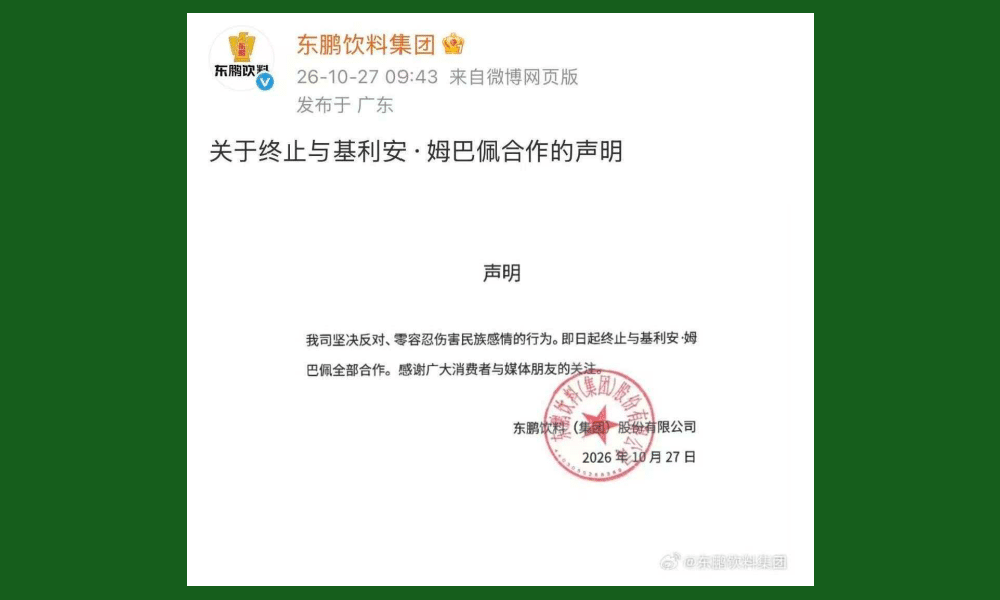
Dongpeng Beverage Group (东鹏): the first in a string of companies to cut ties with French footballer Kylian Mbappé.
Mbappé’s fall from grace in China has been sudden and spectacular, like a major avalanche of backlash that unfolded in one night, and it can all be traced back to one segment of an interview the footballer previously did on a French YouTube show (The Bridge) that resurfaced online — initially through Reddit and X, and then on Chinese social media apps, like football platform Dongqiudi (懂球帝).
In that segment, when asked about his favorite meme, Mbappé replied that one of the memes he finds funniest is:
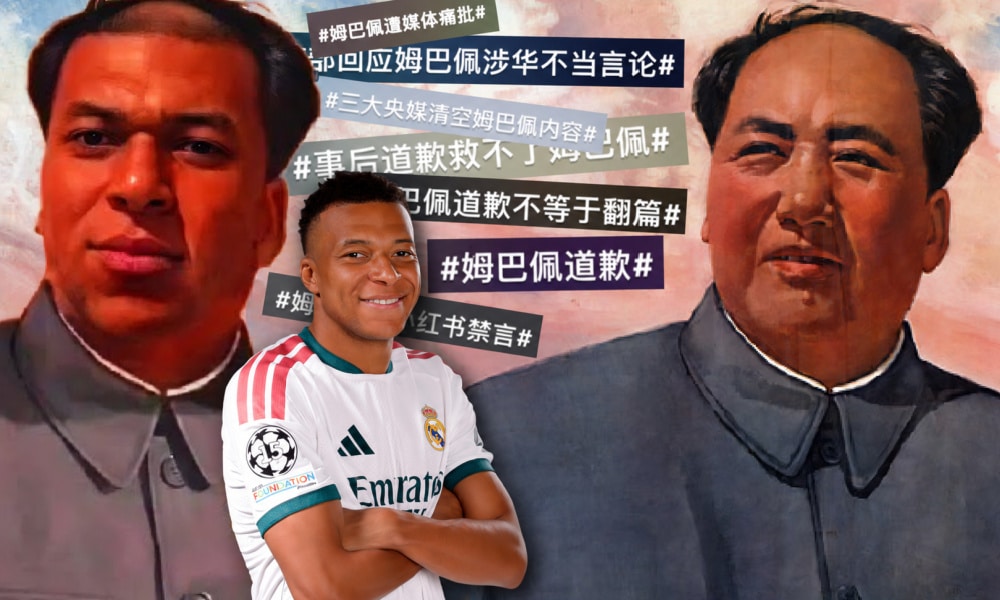
🗣️ “the one where they put my face on some guy, a Chinese dictator. That really makes me laugh, I use it with my friends all the time.”

The interview segment where Mbappé shares his favorite meme: his face photoshopped onto the face of a “Chinese dictator.”
The show, created by Mbappé’s Real Madrid teammate Aurélien Tchouaméni, added the image Mbappé referred to: his face photoshopped on a Mao propaganda visual. It’s part of a series of memes that emerged in 2024 in which Mbappé’s face is edited onto the faces of dictators.1
Chapter Dive
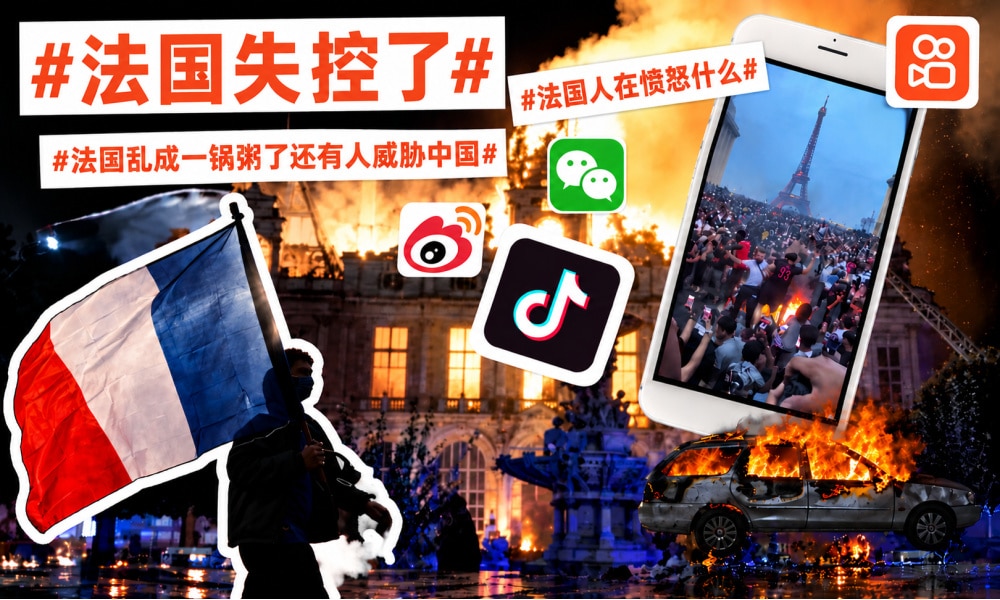
The French Protests, Viewed from China: Five Narratives on Chinese Social Media
From the decline of Europe to historical karma: these 5 narratives reveal how Chinese social media discusses the recent unrest in France.
Eye on Digital China is a reader-supported publication by
Manya Koetse (@manyapan) and powered by What’s on Weibo.
It offers independent analysis of China’s online culture, media, and social trends.
To receive the newsletter and support this work, consider
becoming a paid subscriber.

From “Pure Love Warrior” to Political Victim: Jensen Huang’s Fall on Chinese Social Media

China Trend Watch: Digital Dementia and Why Everyone Says ‘Li Na’

Mbappé, Mao & the Backlash on Chinese Social Media

Mbappé, Mao, and the Joke That Shall Not Be Named

The French Protests, Viewed from China: Five Narratives on Chinese Social Media

Why Japan Has So Many Surnames, China’s Back-to-School Shifts & Taiwan Pavilion Trouble

The Rise of “Shuaqi-ism,” Taking Starbucks to the Fields, and Pretending to Go to Work

Blame Games & Bad Signs: Nepal–Tibet Floods, Huawei’s Toilet Trouble, “Screwed” Graduates

Starbucks Goes Xinjiang & The Kardashians in China

Red Carpet, Pandas, and Power: How China Read the Trump-Xi Summit
-
 Chinese New Year9 months ago
Inside Chunwan 2026: China’s Spring Festival Gala
-

 Chapter Dive9 months ago
Inside the Great Chinese Debate Over the Iran War
-

 Chapter Dive10 months ago
Chinamaxxing and the “Kill Line”: Why Two Viral Trends Took Off in the US and China
-

 China Memes & Viral9 months ago
Two Sessions, a Celebrity Meltdown, and the Rise of China’s “Forget It” Mindset