
China Celebs
Billionaire Bachelor Wang Sicong’s Desperate Unrequited Love Drama Exposed Online
Wang Sicong is one of China’s wealthiest and most eligible bachelors, but this love interest wasn’t interested at all. She has now shared their erratic chat conversations with the public.


Wang Sicong (王思聪), the son of one of the richest men in China, has become the most popular gossip topic on Weibo this week after his love interest leaked their WeChat conversation records online.
Wang Sicong, who has over 41 million followers on his Weibo account (@王思聪), is one of China’s most famous fu’erdai (富二代, the ‘second generation rich’). Wang is the son of Chinese tycoon Wang Jianlin (王健林), one of the richest persons in Asia.
Wang Sicong is a 33-year-old businessman, and he is known as a playboy who has had many girlfriends but never settled down, turning him into one of China’s most wealthy eligible bachelors. But despite so many women being interested in Wang, the girl he has been chasing for the past few years, internet celebrity and livestreamer Sun Yining (孙一宁), is just not into him at all.

Sun and Wang first met four years ago, and apparently, Wang never stopped pursuing her ever since. In the screenshots of the WeChat conversations between the two that leaked online, Wang is very blunt in expressing his interest in Sun and doesn’t shy away from using cheesy pick-up lines and repeating how much he misses her.
At times, he is rude and pushy, telling Sun he needs to see her: “Can’t you just make me feel better? My mood has been bad for days.” He sometimes also keeps sending Sun belligerent messages, even if she does not respond at all.

Wang keeps talking to Sun (in a patronizing way), even if Sun doesn’t respond at all.
Sun, however, again and again, keeps shutting him down by changing the topic, ignoring his cringy phrases, or making fun of him.
At one point during the four-year-long ‘charm offensive,’ Sun tells Wang that she is attracted to women and not to men – but even that doesn’t stop his ‘alpha male strategy’ to win her over: “Will you still say you’re a lesbian when you’re lying in my arms?”

Sun asks Wang if he realises how ridiculous he is after the ‘lesbian’ comment.
The conversations between the two become even more bizarre in April of 2021 when Wang unexpectedly tells Sun he has come to her hometown of Hangzhou to spend time with her, and then gets angry when she is not happy to meet him. He insists that they meet, even when Sun clearly indicates she has no interest in him.
Even after that, the billionaire keeps sending Sun desperate messages on how much he misses her and how he cannot believe that she is not a heterosexual woman. In the end, the conversation between the two gets so explosive that Wang threatens to expose Sun. But the tables were turned, and Sun was the one to first post the history of their WeChat messages online on June 15.
On her Weibo account, where the live-streaming star has over 720,000 fans, Sun shares how she has always been straightforward with Wang Sicong that she was not interested in becoming his girlfriend. She also makes it clear that Wang’s money and influence will not stop her from taking control over her own life.

Before posting the chat history, Sun appeared to be drunk and upset while live-streaming at night and scolding Wang Sicong.

On Weibo, the hashtag “Sun Yining / Wang Sicong” (#孙一宁 王思聪#) has received over 550 million views by now.
The drama further snowballed on Tuesday when Wang himself apparently also shared their WeChat chat records online, claiming Sun Yining had been misleading about their relationship and is not to be trusted. That hashtag page (#王思聪曝光和孙一宁聊天记录#) also attracted over 500 million views.
Many of the thousands of people commenting on this story find it entertaining and funny; who would have thought that the richest son in the country would be so poor when it comes to love? Others expressed disbelief that such a powerful man would be begging for this girl’s love for so many years.
There are those praising Sun Yining: “This offers new perspectives for online influencers. Rejecting Wang Sicong turns out to make you hotter than becoming Wang Sicong’s girlfriend!” But many people also do not sympathize with Sun at all, calling her a drama queen and an actress.
Even in the middle of the night, the Weibo discussions on ‘Wang versus Sun’ continue on Weibo. “I’m here enjoying this spectacle,” one commenter says: “I can’t wait to see what happens next.”
By Manya Koetse with contributions by Miranda Barnes
Spotted a mistake or want to add something? Please let us know in comments below or email us. First-time commenters, please be patient – we will have to manually approve your comment before it appears.
©2021 Whatsonweibo. All rights reserved. Do not reproduce our content without permission – you can contact us at info@whatsonweibo.com.
China Brands, Marketing & Consumers
Starbucks Goes Xinjiang & The Kardashians in China
Starbucks rebrands as “Star-Bazaar” in Urumqi—what does it say about shifting perceptions of Western brands in China? Also: a cheating sports influencer and the souvenirs that became most hated.
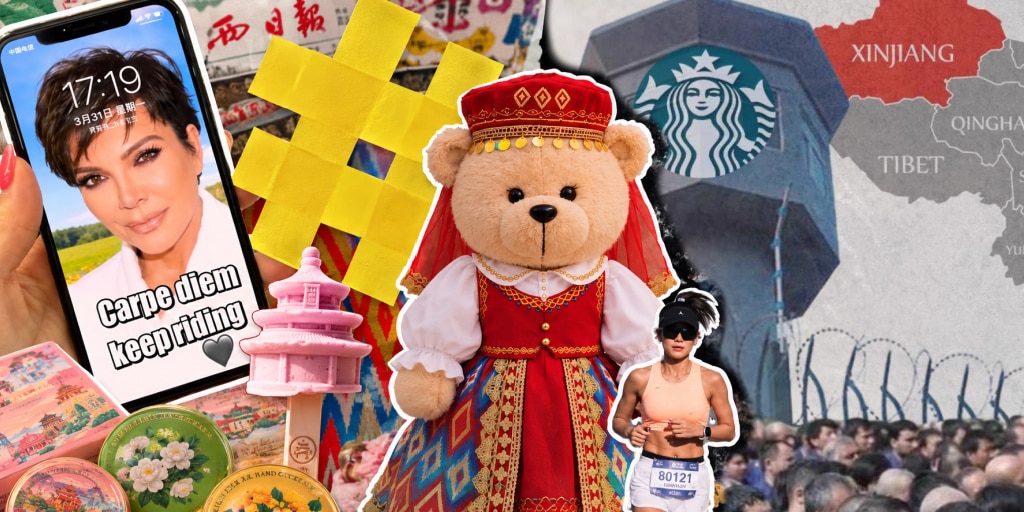
Originally published in the Eye on Digital China newsletter on Sunday, October 4, 2026.
In this edition:
- Quick scrolls: A Chinese athlete cheated her way to the Berlin Marathon’s finish
- Zooming in: When Localization Gets Political: Starbucks Goes Xinjiang
- On the Feed: The Kardashians in China
- Phrase of the Week: The 3 souvenirs sold everywhere, but nobody wants them
🗞️ QUICK SCROLLS
🇯🇵 The National Day holiday has begun, but nobody’s going to Japan. Although Japan was the number one outbound destination for Chinese travelers during last year’s October holiday, it has now dropped out of the top ten destinations entirely. According to data from Chinese tour operator Tuniu (途牛), Indonesia, Turkey, and South Korea are among this year’s most-booked overseas destinations.
🚲 Chinese fitness influencer “Abeeeer” was caught cheating during the Berlin Marathon after she posted about running her “personal best.” The sport-blogger (530k+ followers on Xiaohongshu) was photographed riding on the back of a bicycle around the 38-kilometer mark. On Saturday, she publicly apologized and admitted that she had broken the rules and that she was “feeling unwell.”
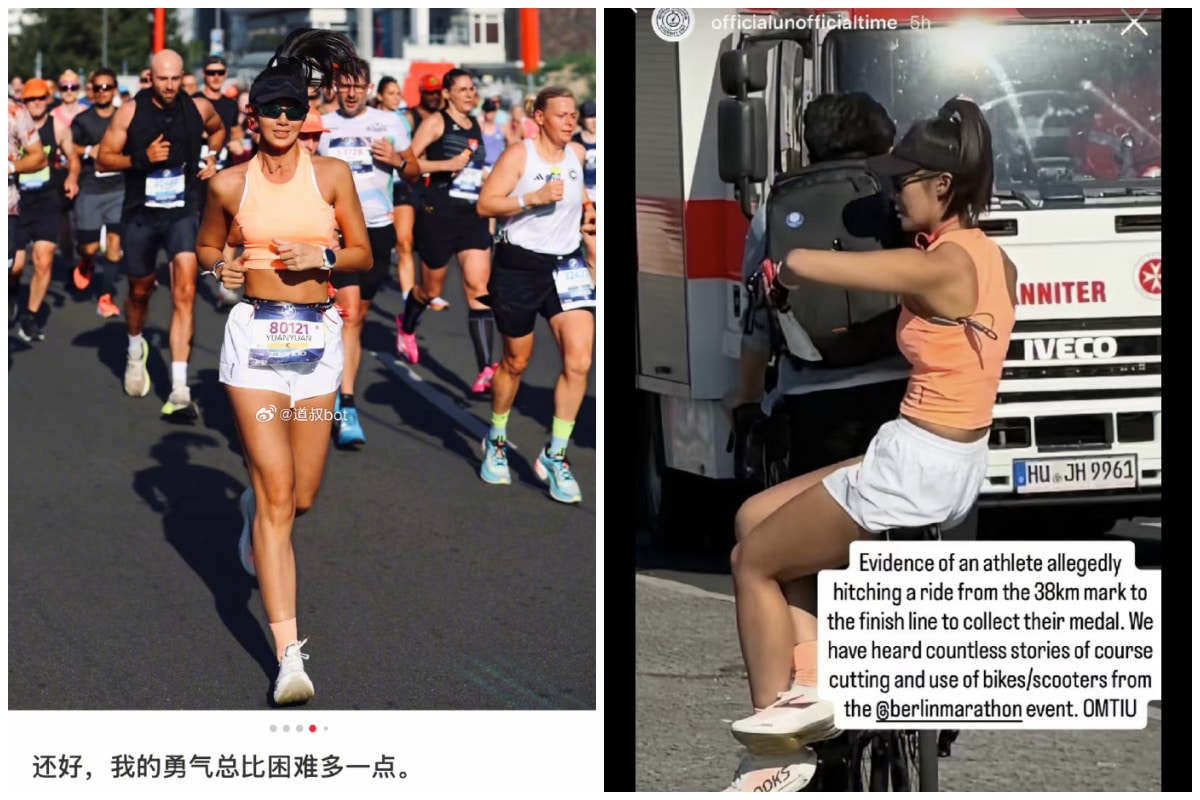
The sports influencer was caught hitching a ride to the finish line.
🏳️🌈 Japanese volleyball player Rui Takahashi came out as gay on Tuesday, saying he wanted to help others struggling with their sexuality by coming out publicly. On Douyin, many Chinese fans and commenters praised Rui for his bravery.
🤖 Former Global Times editor-in-chief Hu Xijin (胡锡进) published a National Day essay praising the country’s achievements but forgot to delete the AI chatbot’s closing follow-up question (”Would you like me to read through the whole text again and check it for omissions?”). Hu quickly deleted the AI prompt, but “Hu Xijin’s National Day AI ghostwriting fail” had already gone trending.
⚽ Chinese football produced its best and worst result of the year nineteen hours apart. On Friday, the senior men’s national team lost 0–5 to Palestine – a first-ever loss to that opponent – in a friendly in Chongqing. On Saturday, the under-23 team China took the men’s football bronze medal at the 2026 Asian Games, beating Uzbekistan 4-3 on penalties.
🎵 One of China’s most influential singers, composers and music educators has passed away. Liu Huan (刘欢) died of illness in Shanghai on September 25. Internationally, he is best remembered for singing “You and Me,” the official theme song of the 2008 Beijing Olympics.
📱 Chinese internet users now spend more time watching mini-dramas than scrolling social media. Bytedance’s Hongguo app, the short-drama platform, reports 168 million daily active users and an average of 125 minutes per user per day, exceeding Douyin (which itself overtook WeChat for the first time in July).
👁️ ZOOMING IN
Starbucks Goes Xinjiang: When Localization Gets Political
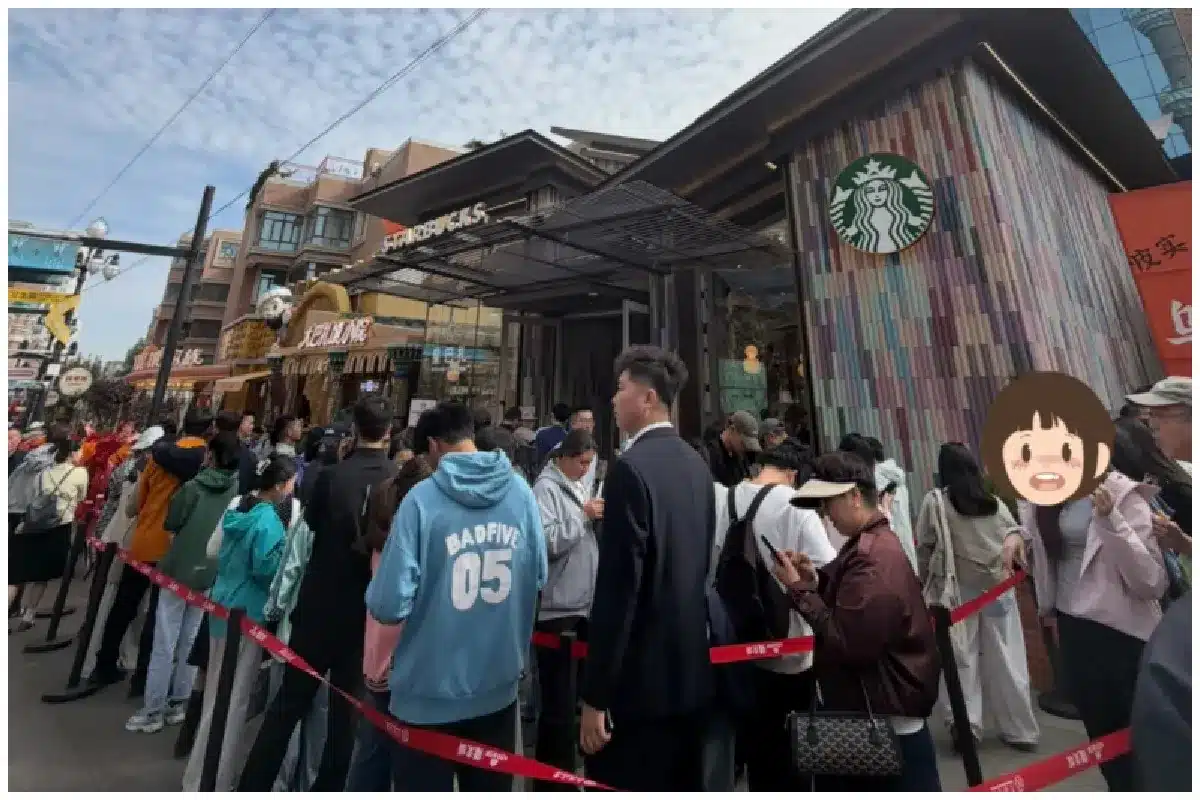
Just ahead of the National Day holiday, Starbucks opened in Xinjiang. The opening of the two stores in the capital, Urumqi, became a big topic of discussion both in China and across English-language social media, but for very different reasons, and viewed through very different lenses.
The brand’s Urumqi debut marks its first expansion into the region since entering the Chinese market over 26 years ago. Back then, Starbucks mostly targeted white-collar workers, focused on first- and second-tier cities, and, for many, symbolized cosmopolitan, urban life.
Starbucks’ move into Xinjiang comes as part of the company’s new Chinese investment and ownership structure: in April of this year, Chinese company Boyu Capital (博裕资本) became 60% owner of Starbucks’ China operations.
Starbucks Becomes ‘Starbazaar’
On Chinese social media, on the opening days of September 28–29 and in the days that followed, conversations were largely consumer-focused. The new stores, long queues, special menu, and merchandise created online excitement surrounding Starbucks’ Xinjiang debut.
The promotion of the new stores — particularly the Xinjiang International Grand Bazaar flagship store (the second store is located at Tianshan International Airport) — has also taken a distinctly local approach. Rather than emphasizing the arrival of a foreign brand in a new frontier market, Starbucks has presented itself as a brand adapting to, and becoming part of, its new local surroundings.
The flagship store incorporates Xinjiang elements throughout its design and marketing, from local patterns and music to a special menu featuring items such as baklava and lamb pastries, along with limited-edition merchandise. Its mascot is a Starbucks bear dressed in stylized Uyghur traditional attire.
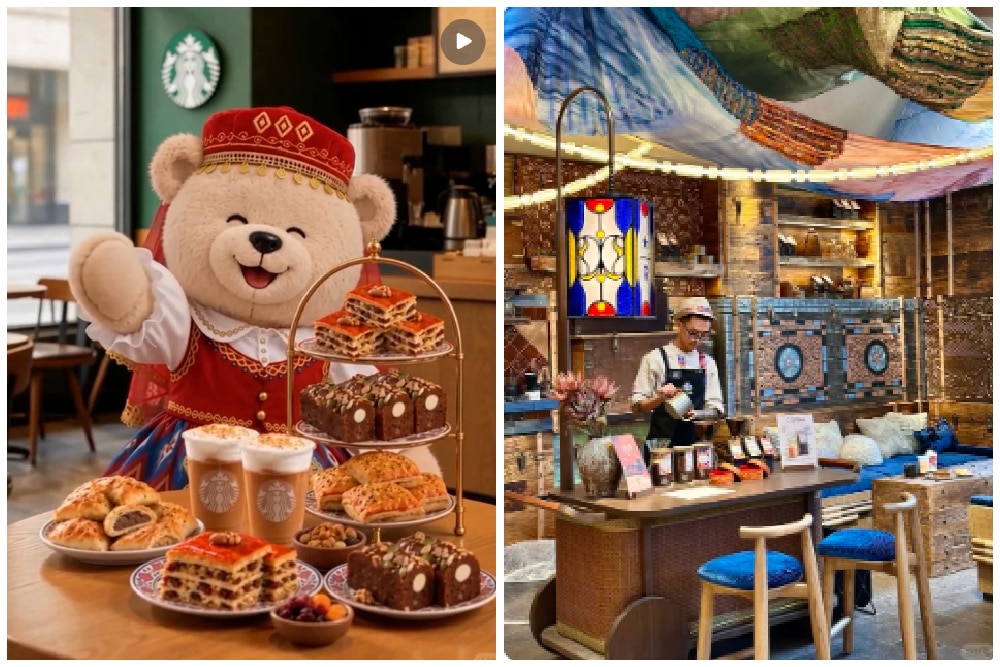
Promotional visuals by Starbucks
The Urumqi Starbucks even has a unique store name: “Star-Bazaar” (星巴扎, Xīng Bāzhā), a play on Starbucks’ Chinese name, 星巴克 (Xīngbākè), and 巴扎 (bāzhā), “bazaar.” The nickname captures this broader marketing approach: not simply bringing Starbucks to Xinjiang, but giving Starbucks a distinctly Xinjiang identity.
This distinct approach resonates with Chinese consumers, who have been posting photos of the enormous lines in front of the stores and showing off their online “check-ins” at the new local hotspot.
Over the past years, Xinjiang has acquired positive associations in various Chinese consumption contexts. At one point, “made with Xinjiang cotton” even generated a buycott and became a popular slogan among online sellers sourcing cotton from the region.
Starbucks in China apparently has a lot of confidence in the positive appeal of Xinjiang-themed products: for the National Day holiday, it is rolling out Xinjiang-themed menu items to more than 2,700 Starbucks stores across 41 Chinese cities.
From Coffee to Controversy
On X and in Western media, however, reactions to the Xinjiang Starbucks have been far less positive. The opening was framed primarily as a political and human-rights story and faced much criticism.
Among these critical voices is US Congressman John Moolenaar, who chairs the House Select Committee on China. He called it a “morally bankrupt decision” to open stores in Xinjiang amid ongoing concerns about human rights abuses in the region, and called on Starbucks to close the cafes, arguing that “every cup sold in these stores ties an iconic American brand to the CCP’s brutal campaign against the Uyghurs.”
“There is no justifiable reason for an American company to do business in a region where the Chinese Communist Party has detained more than a million Uyghurs and is stripping them of their faith, language and culture,” he said.
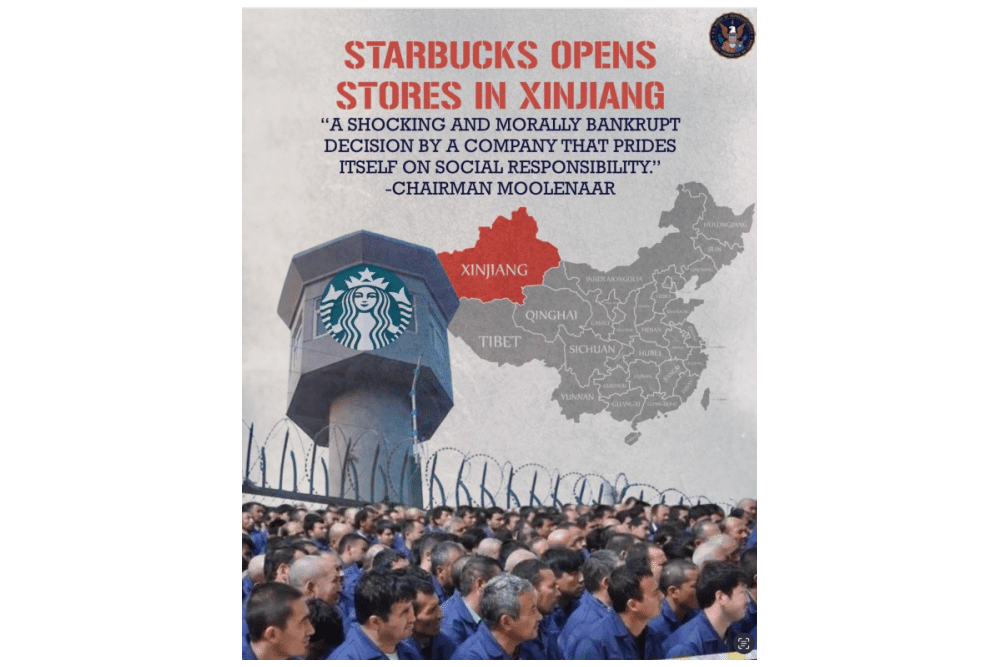
Image spread by US lawmakers
American criticism of Starbucks in Xinjiang soon reached Chinese social media, becoming a number-one trending topic on Weibo on Sunday, October 4.
“Xinjiang” used to be a highly sensitive and heavily censored word on Chinese social media, but since around 2018–2021, when the region increasingly became part of the ordinary national development agenda, online discussions have been allowed and steered in different directions.
The controversial internment camps widely reported on in Western media were officially described as “vocational skills education and training centers” (职业技能教育培训中心): “people-oriented” facilities intended to “fundamentally eliminate the environment and soil that breeds terrorism and religious extremism.”
Following the 2021 sanctions on Chinese officials over alleged human rights abuses and the Xinjiang cotton controversy — when Western brands distanced themselves from Xinjiang cotton over forced-labor concerns — Chinese online narratives surrounding the region shifted further.
A major “support Xinjiang cotton” social media campaign, launched by state media and official channels, symbolized a defense of China’s sovereignty against Western interference. International criticism was cast as an attack on China’s dignity, rallying the public around national pride. Since then, foreign criticism of policies in Xinjiang has often not been censored, but instead published and reframed as another attack on China.
This time, too, these dynamics unfolded, although in a different form. The criticism was discussed in the context of America, once again, “digging up its tired old lies about Xinjiang” (#美方又翻出老掉牙的涉疆谎言#). China’s Ministry of Foreign Affairs spokesperson Guo Jiakun said that US institutions habitually fabricate accusations and attack and smear China for political purposes, “without any credibility whatsoever.”
Netizens blamed critics for being hypocritical and for “denying the people of Xinjiang the chance to drink Starbucks.” Many others also pointed out that ‘Starbucks China’ is no longer quite the same thing as ‘Starbucks.’
Meanwhile, netizens also seem to appreciate the fact that Starbucks had not responded to the controversy — at least, not at the time of writing. Instead, its response has simply been to keep posting promotional material and videos about the Xinjiang stores, an approach some described as “defiant.”
The Starbucks opening in Xinjiang brings two very different sides of the same discussion into view. On one side, there is a consumer perspective; on the other, a human-rights angle. One emphasizes local culture, while the other focuses on international politics. And while one side stresses the responsibility of a Western multinational operating in Xinjiang, the other appreciates precisely how much this foreign company is localizing itself.
It also shows how Western rejection of Xinjiang-linked business can actually increase the symbolic value of Xinjiang-linked consumption in China. People may appreciate the local flavors, ethnic elements, colors, and design, but there is another layer to it, too: consuming Xinjiang can become an expression of national solidarity, especially when foreign criticism turns an otherwise ordinary consumer choice into something political.
In the end, perhaps the most striking thing is the shift in how Starbucks itself is perceived. When Starbucks first entered China, part of its appeal was precisely how foreign it was, offering access to an imagined Western, cosmopolitan way of life. More than two decades later, in Urumqi, Starbucks is being appreciated for almost the opposite reason: for how local it is becoming, selling an imagined Xinjiang experience back to Chinese consumers.
📱ON THE FEEDS
The Kardashians in China: “Manifesting” and Magic Mushrooms
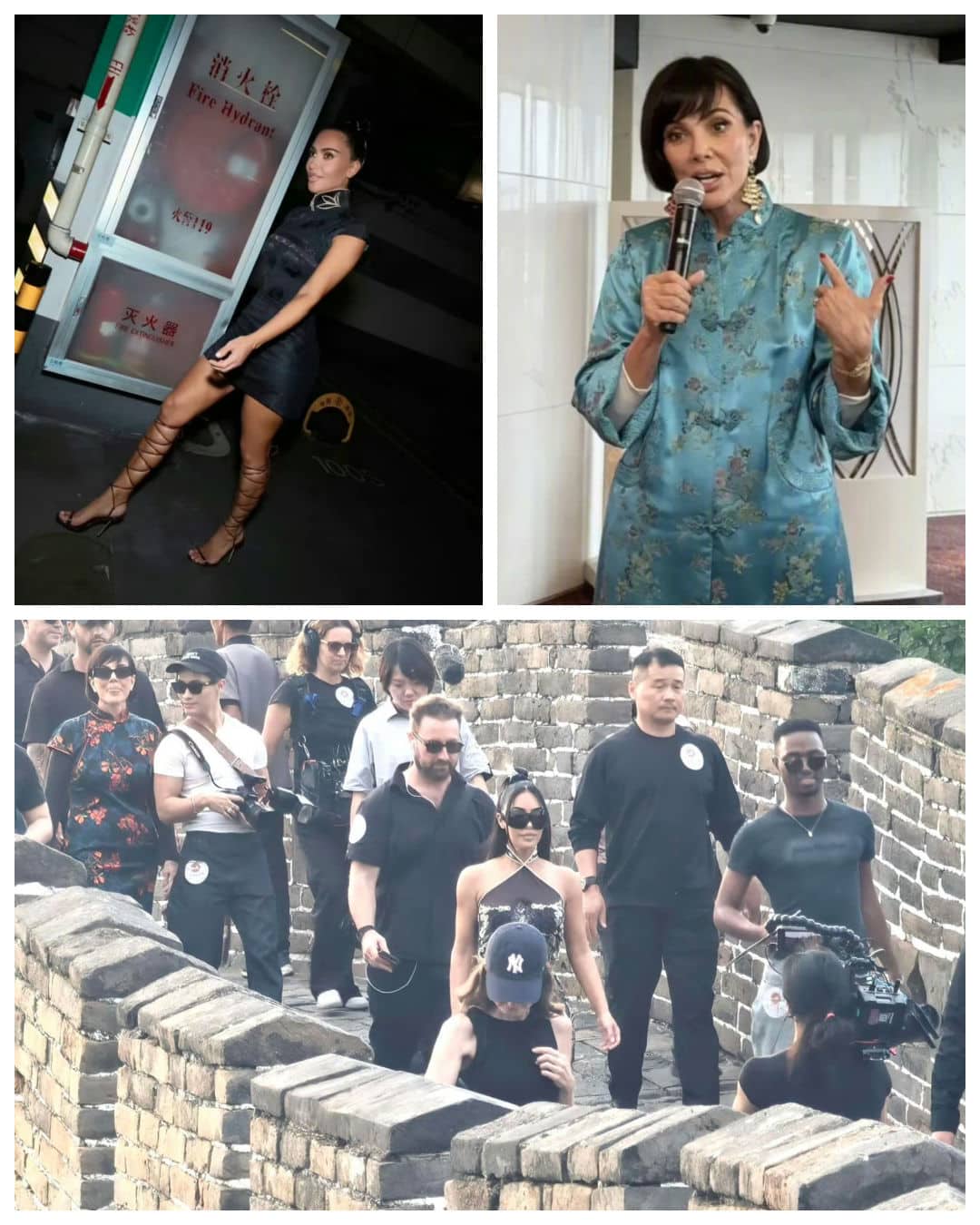
The Kardashians have been on my feeds this week due to their recent China visit.
First: the Kardashians in the US are not what they are in China. Many people in China have never heard about them, but they did reach many people in corners of the internet due to fan-subtitled uploads of Keeping Up With the Kardashians or through clips cirulating online. What also matters: Kim Kardashian was one of the first major Western celebrities to open an official Xiaohongshu account back in 2018, and also one of the first to sell products directly from there.
What attracted attention in their China visit is that, after doing sightseeing and visiting the Great Wall, Kim Kardashian – who came to China for the NikeSKIMS sportswear event in Shanghai – went for dinner with her entire entourage at the well-known Yunnan restaurant In & Out (Yī zuò Yī wàng 一坐一忘).
That is the same restaurant where US secretary Yellen had her “magic mushrooms” back in 2023. The Kardashians had those same mushrooms with their orders.
They are called jiànshǒuqīng (见手青), which literally means “see hand blue”, in reference to turning blue when handled. It is the lanmaoa asiatica mushroom species that grows in China’s Yunnan region and is considered hallucinogenic (nothing happens when properly prepared though).
The restaurant quickly tapped into the buzz by launching a “let’s manifest” or “Let’s 显化” set menu containing the dishes they had.
The Kardashians, but mostly mum Kris Jenner, is famous among netizens as a lucky charm for wealth. Jenner believes in the power of manifestation: focusing on what you want through visuals and prayer in order to actually get what you want.
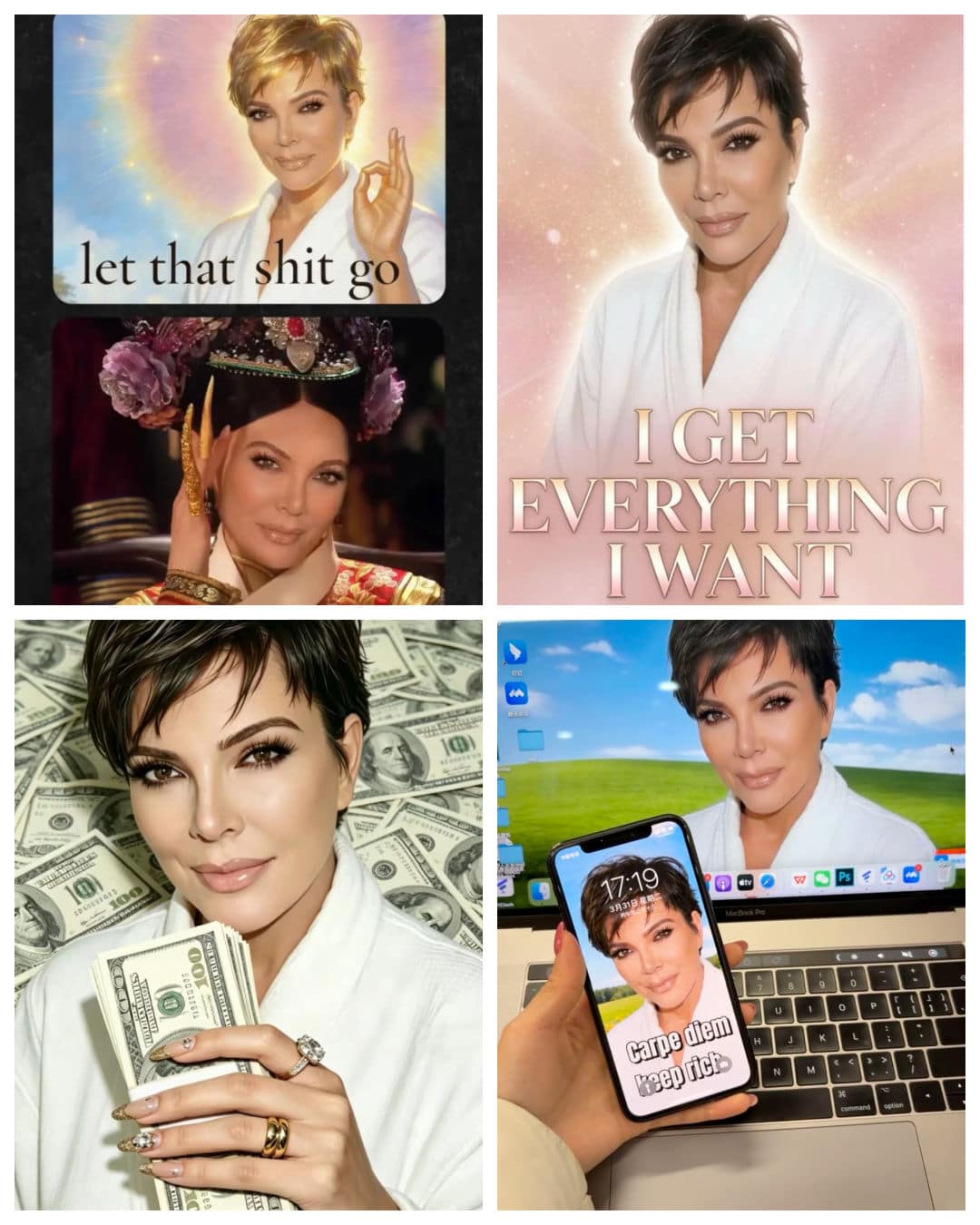
Some of the images used by Chinese netizens to “manifest” good luck through Kris Jenner visuals
The fact that mum Kris Jenner, more than Kim herself, became popular in China has to do with the perception of her as the driving force behind the family’s success, pushing everyone to where they are today and coordinating their careers. In doing so, she is the one who’s seen as the “symbol of wealth” and — through her own belief in the power of manifestation — became the perfect image for Chinese netizens to make their own wishes visible, like a digital good luck charm.
Kris wore a blue Tang suit (唐装, tángzhuāng) to the Shanghai launch event, which Chinese commentators read as a friendly gesture toward the Chinese market.
For In & Out, the “manifesting” formula seems to work. Their “Let’s Manifest” menu is popular and resonates online, where people mostly find it funny to see the restaurant capitalizing on its VIP guests so quickly.
🀄 WORD OF THE WEEK
Sucker’s Souvenirs Starter Pack: The Three Things Everyone Sells and Nobody Wants
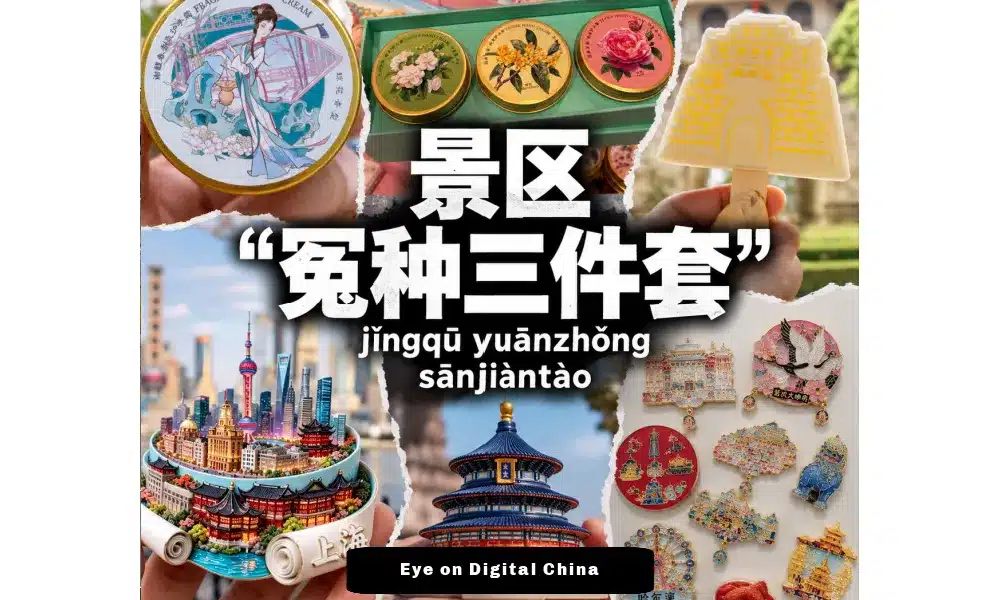
景区”冤种三件套” jǐngqū yuānzhǒng sānjiàntào
Lit.: Scenic Area Sucker’s Three-Piece Set
Meaning: The “Tourist-Trap Trio”: generic souvenirs you see everywhere
During this National Day holiday, when so many Chinese are traveling all over the country, one phenomenon being discussed (also on Zhihu) is the scenic site’s 冤种三件套 (yuānzhǒng sānjiàntào), roughly “the sucker’s three-piece set,” or more loosely, the “tourist-trap trio.”
This refers to those three things that every Chinese tourist site sells nowadays, yet nobody really wants: scenic-spot hand creams, fridge magnets, and cultural-themed ice cream.
The formula is the same everywhere, repeated in the same kinds of shops, and is part of China’s wénchuàng (文创 – culturally creative) boom that started in the 2010s, where local cultural elements and symbols are turned into commercially attractive products that aren’t even produced locally. Even though the landmarks and texts may change, they all follow the same cookie-cutter model reproduced across the country.
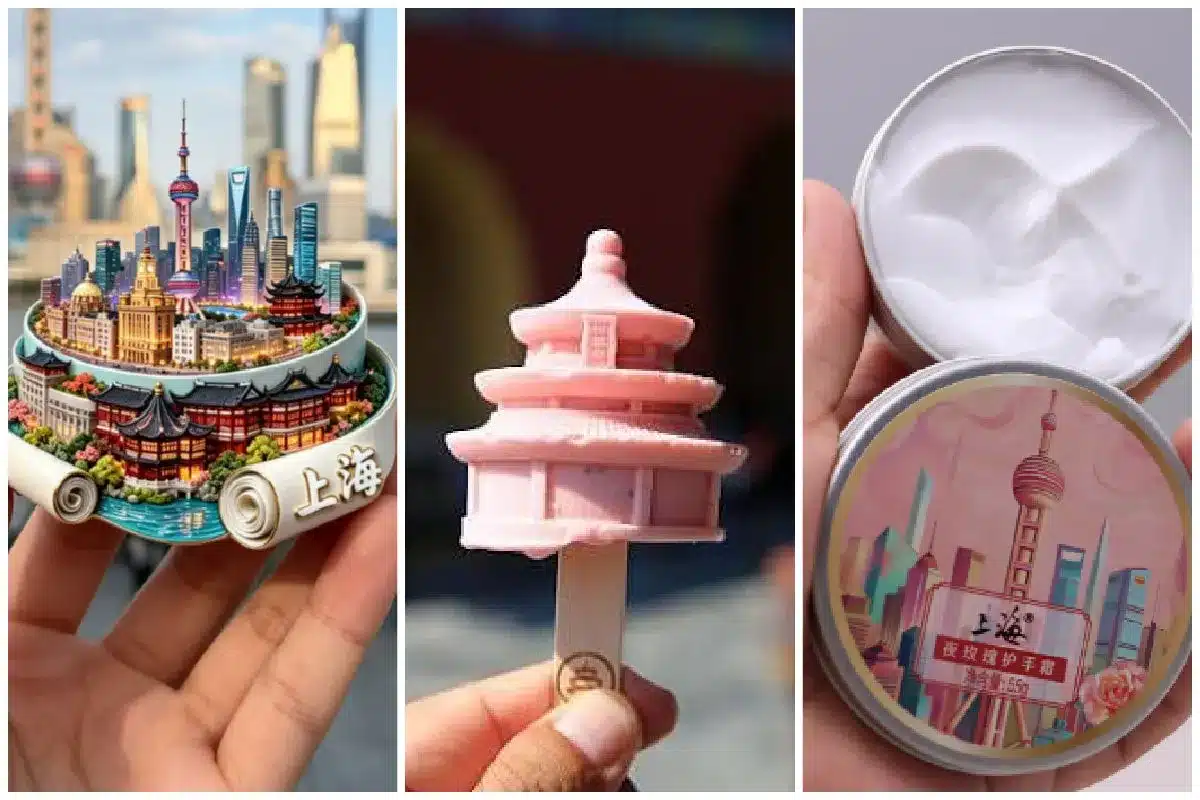
Examples of the same souvenirs sold at every scenic site.
But these kinds of common tourist-attraction purchases are becoming less popular among younger Chinese. One reason is that they are more critical of overconsumption and unwilling to buy overpriced stuff they don’t need anyway. They are willing to spend money on more genuine, locally made items, like pottery or DIY products.
Another reason is that these products have also become the ultimate sign of the lamentable homogenization of Chinese tourist sites (景区同质化), where you’ll find the same shops, foods, signs, and souvenirs whether you’re up north or down south.
Another reason is that online shopping has become so mainstream that most shoppers now recognize they can buy the same products for much less on sites like Taobao.
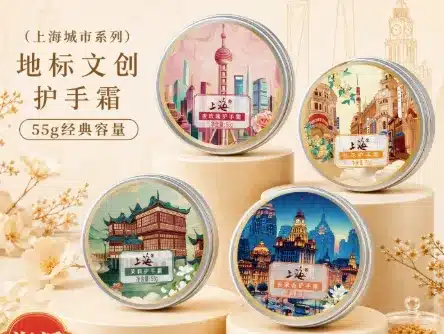
Tourist hand cream sold on Taobao.
💬 On Xiaohongshu, one commenter wrote: “A fridge magnet that costs 9.9 yuan with free shipping online suddenly sells for 28 yuan once you’re inside a tourist attraction. And the ice cream is the funniest one: five seconds to take a photo, ten seconds to melt, and whether it actually tastes good is anyone’s guess.”
💬 Another commenter on Zhihu wrote: “Really good cultural-creative products should try to put the place into the product, rather than simply putting the name of the place onto the product. Because what people really want to take home when they travel is some small connection that existed between themselves and that place. When your product can achieve that, then it truly becomes a souvenir.”
That’s a wrap!
Best,
Manya
🔚
Eye on Digital China, by Manya Koetse, is co-published on Substack and What’s on Weibo. Both feature the same new content — so you can read and subscribe wherever you prefer. Substack offers community features, while What’s on Weibo provides full archive access.
Spotted a mistake or want to add something? Please let us know in comments below or email us. First-time commenters, please be patient – we will have to manually approve your comment before it appears.
©2026 Eye on Digital China/Whatsonweibo. All rights reserved. Do not reproduce our content without permission – you can contact us at info@whatsonweibo.com.


🗞️ QUICK SCROLLS
📈 Is China’s AI price war over? After a period of offering as much as possible to users at relatively low prices, Chinese AI (LLM) companies are now raising their prices. Last week, DeepSeek – known as the cheapest LLM model around – announced a raise in its API prices, showing that LLM models in China, like food delivery platforms, follow a clear strategy of first attracting users and subsidizing growth, then monetizing once users are locked in.
🐸 “Antibiotic bullfrogs” are a new cause for concern. Bullfrogs sold through e-commerce channels, popularly used in various dishes (like bullfrog hotpot), have been found to contain excessive antibiotic residues after being tested by an independent Shanghai investigation team. Antibiotics are widely used in bullfrog farming.
🌾 A 67-year-old farmer from Anhui ruined 25 acres of crops after following a chatbot’s advice on which pesticides to use. The AI tool recommended a strategy including fomesafen, which killed the farmer’s entire sesame plant crop. Chinese state media highlighted the story as a warning to the growing number of senior citizens who are relying on AI a bit too much.
👁️ A Chinese ad campaign for contact lenses has been taken offline because it starred an AI actress who doesn’t actually have eyes. Last week, I reported on the success of this AI actress, Fang Taozi (方桃子), in the AI micro drama “Laid-Off Girl” (被裁掉的女孩). After a Chinese cosmetic contact-lens brand paid a large sum to feature the actress in its commercial, regulators flagged it because the virtual actress claimed the contact lenses were “comfortable.” Because she doesn’t physically have eyes, this suggests false advertising, and the company could face an additional fine.
🎭 The famous Chinese actor Qin Yan (秦焰) has passed away at the age of 72. The veteran actor was a familiar face on Chinese TV since 1991 and was known for his many roles in TV series like Ruyi’s Royal Love in the Palace, The Knockout, and Joy of Life 2. While fans and colleagues are posting tributes online, the actor’s Baidu (Baike) page has turned black-and-white to mourn his death. The actor suffered from an illness that hasn’t been specified.
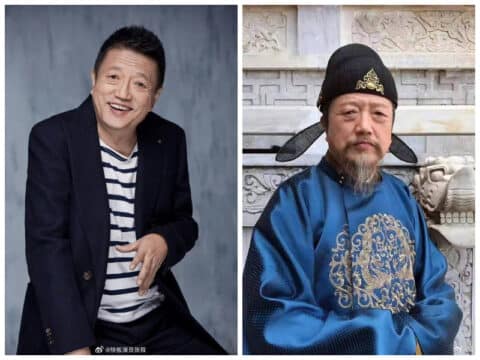
Images via Weibo, showing Qin Yan’s press photo on the left and on the right him portraying the role of Eunuch Dai, the corrupt director of the vegetable and food supply department in the popular historical drama series Joy of Life Season 2 (2024).
🏆 China’s animated film Ne Zha 2 was the biggest winner at the 38th Hundred Flower Awards, China’s most prestigious film awards. The movie grossed 15.9 billion yuan ($2.35 billion) and currently ranks as the world’s fifth highest-grossing film, right in between Titanic and Star Wars. Notably, director Jiaozi (real name Yang Yu 杨宇, b. 1980) was absent from the ceremony, as he always is. The director has a strong dislike for pointless socializing. 😂
🕯️ Remembered as a “Communist Warrior” (共产主义战士), the passing of former Chinese Premier and electrical engineer Zhu Rongji (朱镕基) became a top trending topic on Wednesday after an official obituary announced his death. Zhu is mostly remembered for his efforts to help transition from a planned economy to a socialist market economy, including his tax reform implementations, restructuring of state-owned enterprises, and creation of the mass home-ownership market. Zhu died of an illness in Beijing. He was 98 years old.
👁️ ZOOMING IN
1. Typhoon Baihaitun Brings Record Rainfall to Shanghai

Image via Weibo user @粗茶大白饭
Typhoon Baihaitun (白海豚 “White Dolphin”) has been one of the biggest keywords dominating Chinese social media this week as severe weather affected eastern China.
In Shanghai and surrounding areas, the typhoon caused major disruptions on August 9–10 due to strong winds and extreme rainfall. In Xujiahui, nearly 316 mm of rain fell within 24 hours, the highest amount recorded in Shanghai since observations began over 150 years ago. (The highest total was recorded at Lantian Station in Linhai, Taizhou, where rainfall surpassed a staggering 630 mm; that’s like buckets of water simply being poured down from the sky.)
Many roads, homes, and entire parking lots were completely flooded (video on X / Bluesky). Thousands of people were evacuated, flights were canceled, and metro lines were suspended. In some neighborhoods, residents reported that the water had reached all the way up the stairs.
The typhoon coincided with the Monday morning rush. Despite official guidance encouraging working from home, online complaints made it clear that many companies still expected their employees to show up at the office.
Shanghai Disneyland also remained open despite the severe weather. Videos show park visitors riding attractions in the pouring rain, and cast members in costumes needing help to navigate the rain and wind. The happiest place on earth has never looked so sad (see various videos in my thread here on X / Bluesky).
The impact of the typhoon is expected to last until at least Sunday.
2. Streisand Effect: Huawei Gets Bugged by Bamboo Cicada Toy
If the past week had one soundbite, it would be the rasping, buzzing cicada-like sound you get by spinning the traditional handmade “bamboo cicada” (竹知了 zhúzhīliǎo) wooden toy.
It became a viral sensation after netizens used its sounds to accompany videos of a Huawei event where Chairman Richard Yu (余承东) announced a new car. He described the AITO M9 as “the best SUV under 10 million yuan” (一千万以内最好,没有之一), prompting “wawaa” sounds and cheers from the audience. Soon, a meme was born in which social media users mixed the footage with the toy’s sound – not just because of the audience, but also because of Yu’s distinctive way of speaking.
That cicada toy meme would never have become as big if Huawei’s legal department hadn’t intervened. The company submitted complaints to social media platforms, and videos were removed. But this triggered a chain reaction – when people found the sound was being censored, it blew up in popularity. By now, not only is the sound used everywhere, but the toy itself has become a summer must-have (even though its origins are contested – some say it’s traditionally Japanese and not Chinese at all).
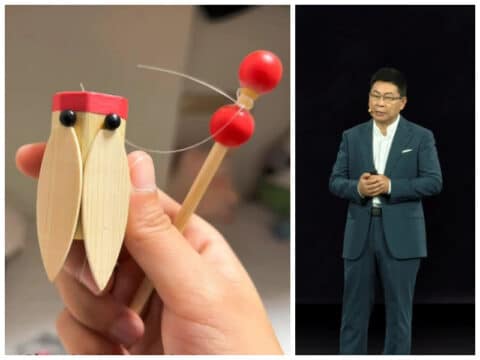
The American term “Streisand Effect” (in Chinese: 史翠珊效应 Shǐcuìshān xiàoyìng) has been used online to describe how Huawei’s reaction backfired.
The response by Huawei – or, more precisely, HIMA, the company’s smart-vehicle alliance brand – was criticized not only by netizens but also by official voices. The official account of Zhejiang Province was among many posting critiques, saying that “the stronger a company is, the greater its capacity to accept discussion” – in other words, calling Huawei weak for its reaction.
This makes it one of those rare moments when, especially when it’s about censorship, official and grassroots voices seem to agree, for once, on the limits of the kind of content that should and should not be controlled. In this way, the cicada sound has come to represent something much more than mocking Huawei, with netizens protecting their rights to criticize & ridicule China’s most powerful business players.
3. Japanese K-Pop Fan’s Death Shows Dark Side of Fan Culture

Miki Chan on the right, posing together with ENHYPEN group member NI-KI. Image via Weibo.
A tragic suicide livestreamed on TikTok became a trending topic across Chinese platforms over the past week, sparking discussions about toxic fan cultures and online bullying.
The 26-year-old Japanese K-pop influencer Mina Chan experienced an acute mental health crisis while livestreaming from her home in Seoul on August 5. This happened after she suffered weeks of severe online bullying stemming from an incident at the US concert of her favorite pop group, the boy band ENHYPEN.
During the concert, Mina tried to give sunflowers to her favorite singer, Nishimura Riki, better known as NI-KI, by throwing them onto the stage. When another group member picked them up instead, she appeared upset. When NI-KI later criticized fans for seeking personal attention rather than enjoying the concert, many fans felt he was referring to Mina.
In the following weeks, Mina received so much online harassment, doxxing, and hate that she first apologized on X and withdrew from the fan club before eventually broadcasting her final livestream, in which she died by hanging. Mean comments continued throughout the livestream.
Online discussions in China have largely framed the incident in terms of online aggression (网暴, wǎngbào) and problematic fan circles (饭圈, fànquān). Although Mina was a Japanese fan of a South Korean band, K-pop fandom is also enormous in China.
Both online aggression and toxic fan culture have been repeatedly targeted by Chinese cyberspace authorities in recent years, undoubtedly contributing to greater public awareness of these problems. Against this backdrop, Mina’s death has prompted widespread calls to end online bullying, while thousands of Chinese netizens have expressed their sorrow over the young woman’s death.
Notably, just one day before Mina’s livestream, American celebrity blogger Perez Hilton became a global trending topic after self-harming during a TikTok livestream that remained online for approximately fifteen minutes, allowing a large audience to watch the disturbing events unfold – similar to what happened with Mina’s livestream. In the United States, the incident sparked further discussion about platform moderation and TikTok’s failure to end livestreams quickly when signs of self-harm or an acute mental health crisis emerge.
📱ON MY FEED
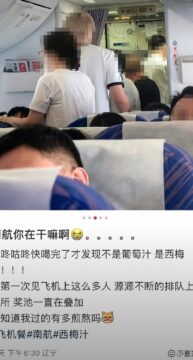
This post reads:
“China Southern, what on earth are you doing? I gulped it all down, only to realize it wasn’t grape juice, it was prune juice!!! This is the first time I’ve seen such a long, never-ending line of people waiting to use the restroom on a plane; the prize pool just kept growing.
Do you have any idea how much I suffered? #InFlightMeal #ChinaSouthern #PruneJuice”
After passengers on a China Southern Airlines flight from Wuhan to Urumqi were served prune juice with their meal, the queues for the plane’s only two toilets kept growing as dozens of passengers felt the high urge to go.
One other review said:
“What were you thinking, serving prune juice? China Southern, please answer me. You nearly made me shit myself.”
🔗 SEEN ELSEWHERE
🔹 “Grandma Economy” (“姥姥经济”) fills a void for urban Chinese Gen Z and millennial consumers who are increasingly projecting their nostalgia for the warmth of grandmothers onto the brands they buy, the content they consume, and the creators they follow. Read at Baiguan / by Amber Zhang.
🔹 Toddler twins are at the center of a very messy custody case involving a surrogate mother from Florida and a Chinese father who might never be allowed to enter the US. Born in November 2024, the twins are biologically not connected to the surrogate mother, but after the Chinese legal father never came to collect them, she and her husband want to adopt them. A new Florida law has now placed the case at the center of conservative outrage over Chinese parents allegedly exploiting the state’s lax surrogacy rules. Read at Wall Street Journal / by Katherine Long.
🔹 A Chinese state media correspondent has been accused of being a spy by the Czech Security Information Service, which identified Yang as an operative of China’s Ministry of State Security, alleging he used his cover as a journalist to collect compromising information on Czech politicians, particularly those supportive of closer ties with Taiwan. Read at Reporters Without Borders.
🔹 “What I feared to be my lifelong search has unexpectedly come to an end. Yesterday, I got a message from my family searcher in China on WeChat that I have a positive DNA match with my biological parents.” In late 2024, I wrote about how the Dutch adoptee Fengli Bottema had come to China in search of her biological family after she was left in front of an Anhui police station as a baby back in 2001. There’s now an update to her story, which echoes that of thousands of Chinese girls adopted abroad. Her search has finally come to an end. Read Fengli’s Instagram post here.
Thanks to Miranda Barnes for helping me curate topics for this edition.
Eye on Digital China is a reader-supported publication by
Manya Koetse (@manyapan) and powered by What’s on Weibo.
It offers independent analysis of China’s online culture, media, and social trends.
To receive the newsletter and support this work, consider
becoming a paid subscriber.

Mbappé, Mao, and the Joke That Shall Not Be Named

The French Protests, Viewed from China: Five Narratives on Chinese Social Media

What Does 20 Yuan ($3) Mean Anymore? China’s Disappearing Living Rooms & the Great Laundry Debate

Starbucks Goes Xinjiang & The Kardashians in China

Red Carpet, Pandas, and Power: How China Read the Trump-Xi Summit

Why Japan Has So Many Surnames, China’s Back-to-School Shifts & Taiwan Pavilion Trouble

The Power of Ugly: Why Niu Lai Became China’s Unlikeliest Box-Office Hit

The Rise of “Shuaqi-ism,” Taking Starbucks to the Fields, and Pretending to Go to Work

AI Actress Ad Pulled, Baihaitun Disrupts Shanghai and Cicada Meme Bugs Huawei

Blame Games & Bad Signs: Nepal–Tibet Floods, Huawei’s Toilet Trouble, “Screwed” Graduates
-
 Chinese New Year9 months ago
Inside Chunwan 2026: China’s Spring Festival Gala
-
 China Brands, Marketing & Consumers12 months ago
Hasan Piker’s China Trip & the Unexpected Journey of a Chinese School Uniform to Angola
-

 Chapter Dive8 months ago
Inside the Great Chinese Debate Over the Iran War
-

 China Trend Watch12 months ago
Japan Tensions, Nexperia Fallout, Yunnan’s ‘Wild Child,’ & “Modern Opium”