
Weiblog
Bold Breastfeeding Photos of Kyrgyzstan’s President’s Daughter Spark Debate on Weibo
The daughter of President Atambayev of Kyrgyzstan, Aliya Shagieva, recently sparked controversy for posting photos of breastfeeding her newborn son on Instagram. On Sina Weibo, Chinese netizens applaud Aliya for breaking taboos around breastfeeding in public – a recurring topic of debate on Chinese social media.


Photos of the 20-year-old daughter of Kyrgyzstan President Almazbek Atambayev, Aliya Shagieva, breastfeeding her baby are being widely shared and discussed on Chinese social media this weekend.
Aliya Shagieva made headlines earlier this month after she posted multiple revealing photos on her Facebook and Instagram (@homesickbluess), sparking a storm of criticism in Kyrgyzstan, where an estimated 80 percent of the population is Muslim.
Aliya Shagieva is the youngest daughter of the leader of Kyrgyzstan. She got married last year and revealed her pregnancy in March, when she posted a picture of her baby bump.


After she gave birth to her son, Tagir, she posted multiple photos of her breastfeeding her baby.


The photos sparked controversy in Kyrgyzstan, with many saying it is wrong for a woman to show off her body and with people calling Aliya “shameless” and a “disgrace to her father.”

Aliya’s father, President Almazbek Atambayev, made international headlines last year when he attacked people who are critical of women who wear more revealing outfits. At a press conference, he stated that women are more prone to become radicalized if they put on Islamic dress, saying: “Women in mini-skirts don’t become suicide bombers.”
According to a report published by the Forum of Women’s NGOs of Kyrgyzstan, the influence of religious ideology in Kyrgyzstan “substantially contributes to discrimination against women.” Bermet Stakeeva, programme officer at the forum, previously told The Guardian: “Islam has a strong influence on women, how to dress and act and it’s now being discussed widely, in mosques and on television, that women should live moral lives.”
Aliya responded to the criticism online saying that it is not right to sexualize breasts this way and that “the most important purpose of female breasts is to breastfeed” and that it is “nothing to be ashamed of.” She emphasized that women’s breasts are not men’s pleasure objects.
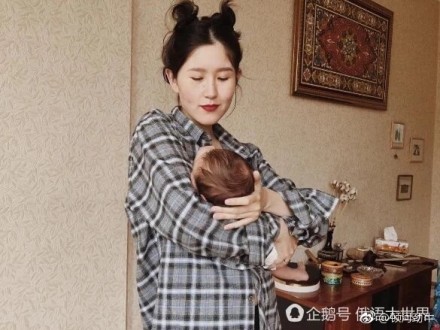
Sina Hubei and other Chinese media accounts posted the photos and Aliya’s statements on Weibo on April 21, soon triggering thousands of reactions. The majority of netizens supported Aliya, saying that breastfeeding is nothing to be ashamed of and applauding her for her stance and braveness.
“Kyrgizstan is a country where the majority of people are Muslim (..),” one person commented: “It’s good that she’s the daughter of the President, otherwise she could’ve been killed for this,” one netizen wrote.
“I saw these photos on WeChat and I really admire Aliya’s bravery,” one girl wrote.
“Only human thoughts are dirty, not any part of the body,” a popular comment said.
Many Weibo users wrote comments such as: “She is completely right. Breasts are for feeding your baby, there’s nothing offensive about it.”
Breastfeeding is a recurring topic on Chinese social media. In 2015, an incident where a mother was shamed for breastfeeding on the Beijing subway caused huge controversy on Weibo, even attracting the attention of UNICEF and Beijing authorities.
One Weibo user at the time said the mother should “pay attention to her manners in public place” and that she should not “expose her sex organ.” Weibo netizens collectively responded to the issue; some agreeing that breastfeeding in public is inappropriate, while others defended the woman.
Although the majority of Weibo netizens show their support for Aliya Shagieva in normalizing breastfeeding, not all netizens were supportive: “It’s great that your motherly love is so big, but why do you need to show it off like this?”
Others agreed with this stance, saying: “We all know how mothers feed their babies, but you’re the daughter of the president, why do you want to show us? I don’t want to see it.”
“What is she doing not wearing any pants,” one female commenter said: “She’s shameless.”
As for the young mother Aliya Shagieva herself – it seems that she is no longer active on social media after her photos attracted the attention of national and international media. On April 23, her Instagram account @homesickbluess was no longer available.
– By Manya Koetse
Follow @WhatsOnWeibo
©2017 Whatsonweibo. All rights reserved. Do not reproduce our content without permission – you can contact us at info@whatsonweibo.com.


China Memes & Viral
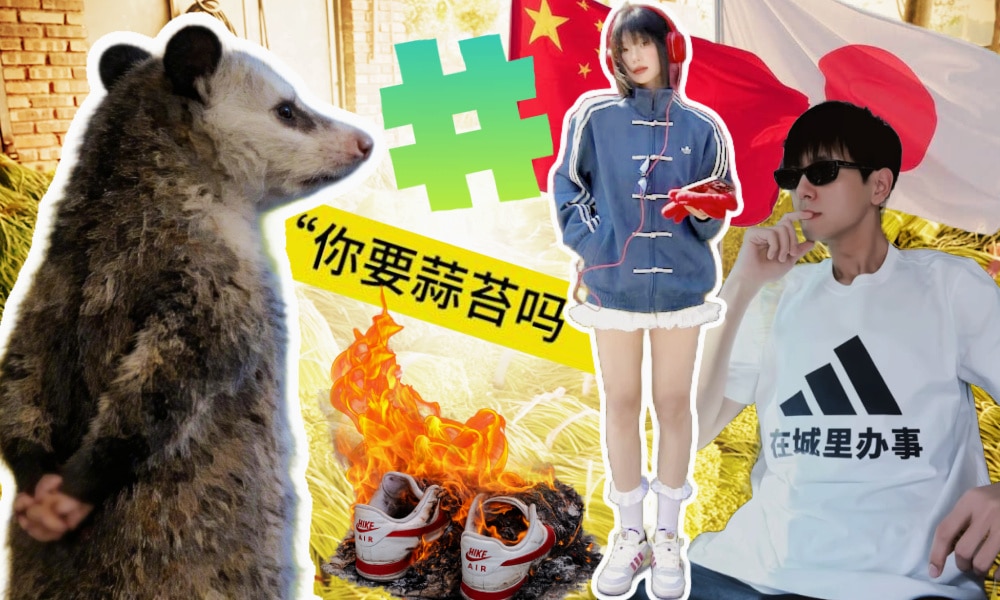
A Chinamaxxing Brand, a Stressed-Out Possum, and Japan’s Lost Decades
How Adidas won and Nike lost, Japan’s lost decades as a mirror for China, and why a possum is the new workplace spirit animal.
🔥 China Trend Watch (week 23-24 | 2026) Part of Eye on Digital China by Manya Koetse. Here I track and explain the stories, memes, debates, and viral moments shaping online conversations in China, so you don’t have to. This edition was sent to paid subscribers — subscribe to receive the next issue in your inbox.
What’s in this newsletter?
- How Adidas turned a translation mistake into one of China’s most successful marketing campaigns.
- Nike is trending for all the wrong reasons.
- 10 quick scrolls: summer snow, a hidden-camera scandal, and the goose leg lady who sold duck legs all along.
- Why Chinese readers are looking to Japan’s “Lost Decades” for answers.
- Meet China’s newest workplace spirit animal.
- Why Henan’s farmers are begging thieves to steal their crops.
Just five years ago, Adidas was one of the most criticized foreign brands in China. Now, it seems to have become one of the most celebrated. Ironically, the brand’s biggest China success yet started out with a mistake it made last month.
In 2021, Adidas – along with Nike and other foreign brands – faced severe backlash and boycotts in China for participating in the Better Cotton Initiative (BCI) move to stop sourcing cotton from the Xinjiang region, which Chinese consumers viewed as a hostile anti-Chinese political stance (and was framed that way by state media and official channels).
Chinese livestreamers for the brands were scolded online, Adidas employees were brought to tears, and stores across the country saw their sales drop. People began posting videos of themselves burning their Nike Air Jordans on Weibo. For the brands involved, it became a marketing nightmare.
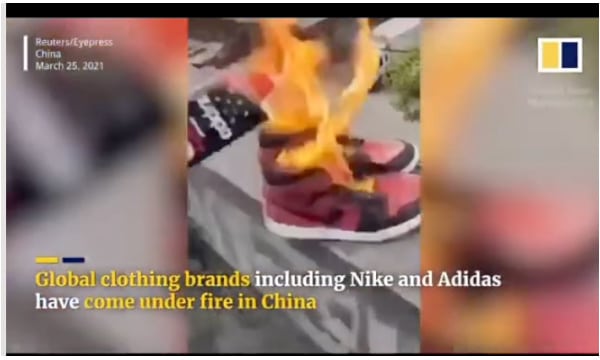
Screenshot of SCMP report about the Nike sneakers being burnt, Adidas employees facing backlash back in 2021.
But now, Adidas has managed to completely turn its image around in mainland China, where it is being praised for its top-of-game PR skills.
Adidas: Heading to Town to Take Care of Business
Over the past few years, Adidas has increasingly embraced “New Chinese Style” (新中式), a design direction that blends Chinese aesthetics with contemporary fashion. The October 2025 launch of its “Chinese New Year Jacket”—combining tang suit-inspired elements with classic Adidas sportswear—became a huge hit, not just in China but globally.
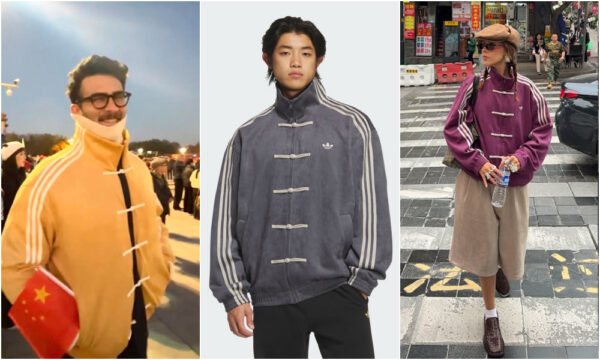
The Adidas Chinese New Year that became a huge hit in 2025. On the left: American influencer Hasan Piker wearing the jacket while visiting Tiananmen Square in Beijing.
But that was only the beginning of Adidas’s social media success in China.
In late May, some netizens spotted a machine-translated text on the Adidas website that immediately went viral for its unintentional humor.
A jacket promoted in English with the unremarkable phrase “pair it with jeans for errands around town“ appeared on the Chinese website as the clunky “pair it with jeans to handle business in the city“ (搭配牛仔裤,在城里办事 zài chénglǐ bàn shì).
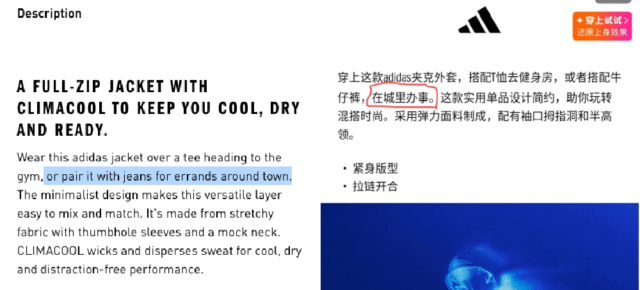
The original English text and the clunky machine translation on the right.
More than a simple mistake, it was a cultural mistranslation. Running some errands is not the same as 办事 bàn shì in Chinese, which is more formal, bureaucratic language for handling affairs, such as going to the bank, notary, or police station—not a quick run to buy some eggs and milk.
For many Chinese netizens, the phrase evoked an image of an old villager cycling into the county town for official business, all while wearing an Adidas jacket.
Although the website was quickly adjusted, the meme was already snowballing and evolved into the more playful “off to town to take care of business” (进城办事 jìn chéng bàn shì).
One popular comment played on the rural-to-city associations of the phrase:
💬 “While you’re back in the village talking trash about me, I’m already wearing Adidas and heading into town to take care of business.”
Adidas responded with surprising speed and wit.
Instead of apologizing for the mistake, they posted a video showing their own “off to town to do business” T-shirt, which quickly became available for sale online and at flagship stores in Beijing, Shanghai, and Chengdu.
Chinese actor and Adidas ambassador Li Xian (李现) was later spotted wearing a “handling business” T-shirt, and the comment sections exploded.

Adidas read the room and went on to launch a marketing campaign featuring China’s popular possum meme wearing one of its jackets alongside slogans such as “Wear Adidas, Handle Serious Affairs” and “Wear Adi, Handle Big Things“—a nod to the original mistranslation and a series of viral wordplays built around the brand’s Chinese name (including “穿Adi办大事” and “穿Adi, 办das”, with das meaning dàshì 大事, “important business” here).
They also put up signs labeling some of their stores as “Adidas Errands Office” (阿迪办事处).
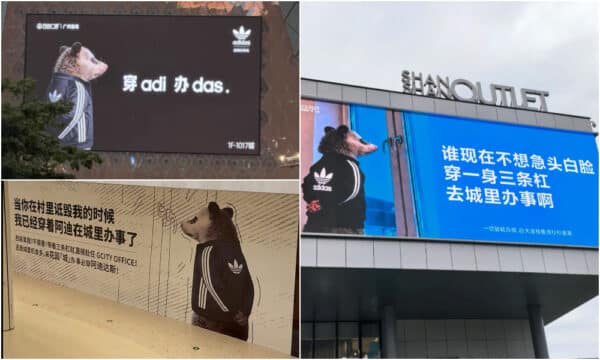
Rather than distancing itself from the joke, Adidas amplified it, becoming even funnier than the netizens themselves. Other brands even jumped in on the hype and referenced Adidas in their campaigns.
Because the response felt effortless, authentic, and on-brand, it greatly boosted Adidas’s popularity and appeal among young Chinese consumers.
Nike’s Grass is No Longer Greener
Sportswear giant Nike also became a major trending topic in China over the past week, but for entirely different reasons. Nike hasn’t been doing all that well recently, and the brand’s decline went viral in the same week that Adidas’s success was evident.
Nike became a top trending topic under the hashtag “Chinese consumers are abandoning Nike faster than anyone expected” (中国消费者抛弃耐克比想象中更快) after reports that a pair of sneakers originally sold for 899 yuan (US$132) are now selling for 429 yuan ($63) and still failing to attract buyers.
Nike’s decline is noteworthy because the brand was once booming in China. As with many other Western brands, it symbolized quality, prestige, and a cosmopolitan future for much of the 1990s and 2000s.
In a 2011 study of Chinese consumer aspirations, one respondent imagined a future in which she would drive a Mercedes-Benz, wear Nike, and eat KFC—a vision of modernity built around foreign brands. Another person dreamt of wearing “Nike clothes and Nike shoes (…) on the green grass, swinging golf clubs under the golden sunshine.”[1]
But Nike’s grass is no longer greener. Chinese commenters largely agree that much of the trust and desire surrounding the brand has eroded.
Many former Nike consumers now prefer Chinese brands such as Anta, Li-Ning or ERKE. Multiple posts on Chinese social media cite the Xinjiang cotton controversy as a turning point from which Nike never fully recovered.
The Localization Dilemma: A Strategic Catch-22?
The contrasting fortunes of Nike and Adidas reveal something important about the position of foreign brands in China today.
As domestic brands improved and narratives of national rejuvenation and the “Chinese Dream” gained prominence under Xi Jinping, consumer sentiment toward Western brands shifted dramatically, especially amid a growing number of controversies involving them.
From a Dolce & Gabbana campaign deemed racist to a witch hunt for Western brands listing Hong Kong and Taiwan as separate countries, international brands increasingly started struggling to find their place between politics, patriotism, and consumers who are choosing “Made in China” over global consumer culture.
As Zhihong Gao[2] observed as early as 2012, the rise of cultural confidence and renewed appreciation for Chinese traditions created a dilemma for foreign brands.
They find themselves caught in a strategic catch-22: if they localize too much, they risk losing the distinctiveness that made their brands attractive in the first place, while also reinforcing consumer preference for local cultural elements; yet if they remain too foreign, they risk appearing culturally tone-deaf and disconnected from Chinese consumers.
This is where Adidas appears to have found a sweet spot.
Unlike Nike, which seems to be living off its past success while showing little urgency in adapting to the Chinese market, Adidas has fully embraced Chinese digital culture, local humor, wordplay, and youth trends without abandoning its own identity.
Rather than pretending to be Chinese, Adidas is participating in Chinese culture as a distinctly foreign brand. By celebrating the unique elements of Chinese culture, both in tradition and modernity, it is boosting both its own image and the cultural pride it is tapping into. That is Chinamaxxing in a nutshell.
[1] Kelly Tian and Lily Dong, Consumer-Citizens of China: The Role of Foreign Brands in the Imagined Future China (London: Routledge, 2011), 70–71.
[2] Zhihong Gao, “Chinese Grassroots Nationalism and Its Impact on Foreign Brands,” Journal of Macromarketing 32, no. 2 (2012): 184–185.
10 Quick Scrolls
🎓 Gaokao. From June 7-9, the Chinese 2026 Gaokao (高考, national college entrance exams), took place and dominated every major Chinese platform. One viral joke reflected a growing fear among young Chinese that a university degree no longer guarantees meaningful employment: “If you fail the exams, you could be a delivery driver in four days. If you pass the exams, you could be a delivery driver in four years.”
❄️ Snow. One day it’s air conditioning; the next it’s snow. Beijing saw a rare case of “summer snow” on June 6, when a cold front and rain sent temperatures tumbling, leading to unexpected snowfall in the Yanqing Olympic Park area.
📸 Voyeurism. A hidden camera was discovered by students in a women’s restroom at the Shanghai University of Political Science and Law. The camera, pointed at a toilet stall, was linked to an account livestreaming footage to illegal voyeuristic groups. Police have detained a suspect: a 33-year-old male student at the university.
🐯 Corruption. Wei Xiaodong (魏小东), a veteran official whose career spanned more than four decades and included top positions in Beijing’s political establishment, is now under investigation for suspected serious violations of Party discipline and law. He is the seventh full ministerial-rank official placed under investigation so far in 2026.
🏢 Real Estate. A man in Xi’an who bought a presale apartment on the 34th floor was shocked to discover, when it came time to take possession, that the building had only been constructed up to the 32nd floor. Despite winning in court, he still has not recovered all of his money because the developer reportedly has no assets left.
🍔 Fast Food. Is there room for another player in China’s crowded fast-food market? The US chain Wendy’s is planning a major expansion into China, with a reported target of 1,000 stores over the next ten years.
📱 Extravagance. A Chinese man who paid 297,000 yuan ($43,900) for a luxury Vertu phone back in 2015 has gone viral after revealing it no longer works in mainland China because it only supports 2G. The alligator leather-and-diamond phone has effectively become a very pricey paperweight. “If I’d bought gold instead, it’d be worth five times as much today,” he lamented.
💙 Awkward. Blued (蓝色), China’s largest gay dating app, was temporarily down on June 9. As the app’s name appeared on Weibo’s trending charts, people were cracking up over the comments from women innocently asking what kind of app it is, since their husbands seem to be on it all the time.
🚀 Space Diplomacy. During Xi Jinping’s welcome banquet in Pyeongyang, images of Chinese astronauts were displayed on a giant screen. With every single moment orchestrated, the prominent display of China’s space achievements got some Chinese commentators talking about the possibility of a North Korean astronaut one day joining a mission to China’s Tiangong space station.
🦆 Duck legs. “Goose Leg Auntie” (鹅腿阿姨), the Beijing street vendor who went viral in 2023 for her mouthwatering roasted goose legs, has run into trouble with local regulators. Turns out she was selling duck legs all along.
What China’s Reading
Japan’s “Lost Decades” as China’s Mirror

As slower economic growth becomes the new normal in China, and anxieties about the future, employment, and AI disruption increasingly shape everyday conversations, many Chinese are looking back at the period following Japan’s economic bubble burst and asking what lessons China can learn from it.
This is why Japan as a Mirror: A Survival Guide for the Economic Downturn (以日为镜:经济下行期穿越指南) by author Wang Xiwei (王熙威) has become so popular. The non-fiction work, first published on WeRead on May 21, quickly climbed into the platform’s top rankings.
Wang, a China-born graduate of Peking University and the University of Tokyo who has lived in Japan for more than twenty years, uses a series of narrative case studies to explore how ordinary Japanese people navigated the country’s post-bubble stagnation, from the early 1990s onward.
The book zooms in on personal stories: elite university graduates working in convenience stores, a salaryman who becomes an internet café drifter, families trapped by decades-long mortgages, housewives embracing minimalism, and professionals forced to reinvent themselves after career setbacks.
By focusing on individual experiences during Japan’s so-called “Lost Decades,” Wang seeks to offer Chinese readers perspectives on coping with uncertainty and adapting to economic change. The book presents Japan as a mirror for contemporary China, which is also facing economic slowdown, demographic pressures, and reduced social mobility, and widespread online discussions about neijuan (”involution”), tangping (”lying flat”), and consumption downgrading.
One 5-star review on Weibo said:
💬 “Many feel that, as individuals, we can’t change the broader environment. But what we can do is look at how different industries in Japan changed during periods of economic decline—and the new opportunities that emerged from those changes—and use those experiences as a reference when making our own plans. In doing so, we may be able to prevent our own lives from slipping into a “downturn period” of their own (下行期).”
On the Feed
Possum Staring Out Window: China’s New Meme Spirit Animal
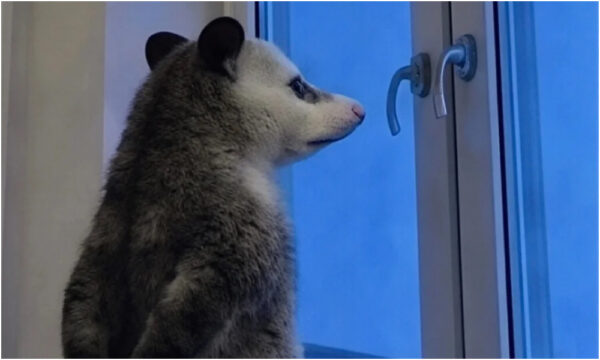
Chinese social media has been taken over by a little opossum staring out of a window with its hands behind its back. Standing there, the little creature seems to be contemplating life. The image is often accompanied by self-deprecating one-liners such as:
– “I may not have made any money, but at least I exhausted myself.”
– “When I handle something, you definitely shouldn’t feel reassured.”
The “hands-behind-back opossum” (背手负鼠) has become an unexpected social media star and emotional spokesperson for young people in China. They appreciate the ugly-cute animal because, although it looks calm and collected on the outside, they imagine it is actually exhausted and anxious on the inside (appropriately enough, the opossum’s most famous defense mechanism is pretending to be dead). They relate because it’s how many of them feel in their daily lives and at work.
It’s unclear where the original photograph came from, but since it was first adapted as a meme, it has exploded from WeChat to Xiaohongshu and beyond.

By now, its use has become highly versatile, and the opossum itself has become a mood—especially when it comes to frustrating workplace dynamics:
– “Received. Cannot be done.”
– “This matter is not urgent, but it definitely needs to be done fast.”
– “As for tomorrow’s matters, you’ll know the day after tomorrow.”
The Online Phrase to Know
“Want Some Garlic Scapes?”

· 你要蒜苔吗?Nǐ yào suàntái ma?
· or: 要蒜苔不? Yào suàntái bù?
Henan’s meme of the year started because farmers have so many garlic scapes, they’re practically begging people to take them away.
Since May, “Want some garlic scapes?” has become a local joke and alternative greeting in China’s Henan province — and a sign of the sympathy many people feel for struggling farmers.
Garlic scapes, the curly green shoots of the garlic plant that are eaten as a vegetable, have seen such an oversupply that prices fell below the cost of harvesting them. Yet farmers couldn’t simply leave them in the fields, because that would reduce the yield of the garlic bulbs themselves.
In other words: farmers didn’t want the garlic scapes, but they couldn’t afford not to harvest them either.
The situation quickly became meme material. One Henan farmer went viral on Douyin after saying: “I hope 50 thieves come today and steal all my garlic scapes. If you don’t know how to steal, I’ll teach you…”

Image: A meme showing two sad-looking dogs standing in farm fields, each trying to attract garlic-scape thieves. One dog shouts, “Come steal from my field first!”
Another running joke is that people have started secretly hanging bundles of garlic scapes on their neighbors’ door handles before running away. Home security cameras, one article joked, are no longer being used to catch thieves. Instead, they’re being used to identify anonymous garlic-scape givers so the vegetables can be returned.
The memes keep coming, with AI-generated images imagining garlic-scape fashion, garlic-scape artwork, and even questionable inventions such as garlic-scape-flavored lattes or beer.
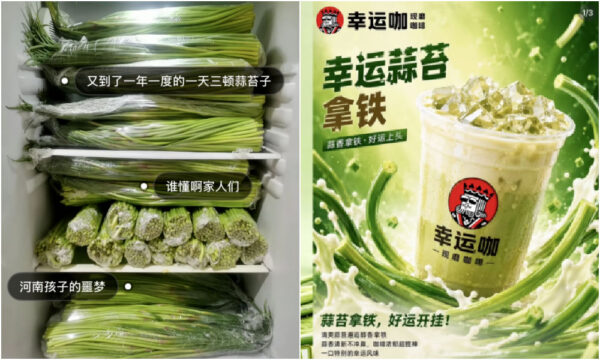
Behind the humor lies a harsher reality. According to Lanjing News, many farmers can no longer afford to hire workers to harvest the crop. Some families that previously earned around 30,000 yuan (US$4,200) a year from garlic scapes alone may make only a third of that this year.
Part of the problem is that strong garlic prices encouraged farmers to increase production. But bumper harvests across multiple regions all reached the market during the same April–May period, worsening the oversupply and pushing prices down even further.
The situation is an economic nightmare for many farmers. On the bright side, besides having plenty of garlic scapes, Henan now also has plenty of online jokes.
That’s a wrap!
Chapter Dive
“Going to Town to Handle Business”: How Adidas Went from Hated in China to a Chinamaxxing Brand
Why has Adidas regained cultural relevance in China while Nike is struggling despite its global strength?

My premium newsletter covering the stories, memes, debates, and viral moments shaping online conversations in China. Subscribe here to receive future editions.
Just five years ago, Adidas was one of the most criticized foreign brands in China. Now, it seems to have become one of the most celebrated. Ironically, the brand’s biggest success in China yet started with a mistake it made last month.
In 2021, Adidas – along with Nike and other foreign brands – faced severe backlash and boycotts in China for participating in the Better Cotton Initiative (BCI) move to stop sourcing cotton from the Xinjiang region, which Chinese consumers viewed as a hostile anti-Chinese political stance (and was framed that way by state media and official channels).
Chinese livestreamers for the brands were scolded online, Adidas employees were brought to tears, and stores across the country saw their sales drop. People began posting videos of themselves burning their Nike Air Jordans on Weibo. For the brands involved, it became a marketing nightmare.
Screenshot of SCMP report about the Nike sneakers being burnt, Adidas employees facing backlash back in 2021.
But now, Adidas has managed to completely turn its image around in mainland China, where it is being praised for its top-of-game PR skills.
Adidas: Heading to Town to Take Care of Business
Over the past few years, Adidas has increasingly embraced “New Chinese Style” (新中式), a design direction that blends Chinese aesthetics with contemporary fashion. The October 2025 launch of its “Chinese New Year Jacket”—combining tang suit-inspired elements with classic Adidas sportswear—became a huge hit, not just in China but globally.

The Adidas Chinese New Year collection became a huge hit in 2025. On the left: American influencer Hasan Piker wearing the jacket while visiting Tiananmen Square in Beijing.
But that was only the beginning of Adidas’s social media success in China.
In late May, some netizens spotted a machine-translated text on the Adidas website that immediately went viral for its unintentional humor.
A jacket promoted in English with the unremarkable phrase “pair it with jeans for errands around town“ appeared on the Chinese website as the clunky “pair it with jeans to handle business in the city“ (搭配牛仔裤,在城里办事 zài chénglǐ bàn shì).
The original English text and the clunky machine translation on the right.
More than a simple mistake, it was a cultural mistranslation. Running some errands is not the same as 办事 bàn shì in Chinese, which is more formal, bureaucratic language for handling affairs, such as going to the bank, notary, or police station—not a quick run to buy some eggs and milk.
For many Chinese netizens, the phrase evoked an image of an old villager cycling into the county town for official business, all while wearing an Adidas jacket.
Although the website was quickly adjusted, the meme was already snowballing and evolved into the more playful “off to town to take care of business” (进城办事 jìn chéng bàn shì).
One popular comment played on the rural-to-city associations of the phrase:
💬 “While you’re back in the village talking trash about me, I’m already wearing Adidas and heading into town to take care of business.”
Adidas responded with surprising speed and wit.
Instead of apologizing for the mistake, they posted a video showing their own “off to town to do business” T-shirt, which quickly became available for sale online and at flagship stores in Beijing, Shanghai, and Chengdu.
Chinese actor and Adidas ambassador Li Xian (李现) was later spotted wearing a “handling business” T-shirt, and the comment sections exploded.
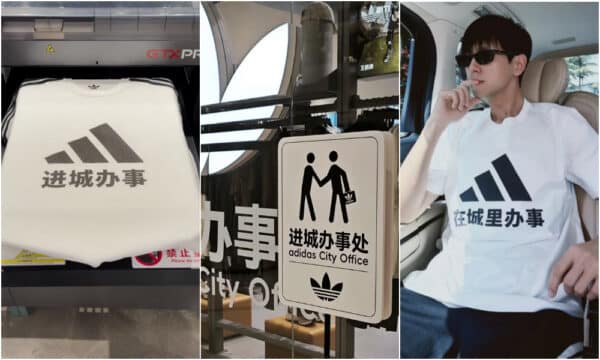
Adidas read the room and went on to launch a marketing campaign featuring China’s popular possum meme wearing one of its jackets alongside slogans such as “Wear Adidas, Handle Serious Affairs” and “Wear Adi, Handle Big Things“—a nod to the original mistranslation and a series of viral wordplays built around the brand’s Chinese name (including “穿Adi办大事” and “穿Adi, 办das”, with das meaning dàshì 大事, “important business” here).
They also put up signs labeling some of their stores as “Adidas Errands Office” (阿迪办事处).
Rather than distancing itself from the joke, Adidas amplified it, becoming even funnier than the netizens themselves.
Other brands in China, from Lays to Alipay, saw the hype surrounding the meme and also started incorporating the “handle business” phrase into their online campaigns, referencing Adidas.
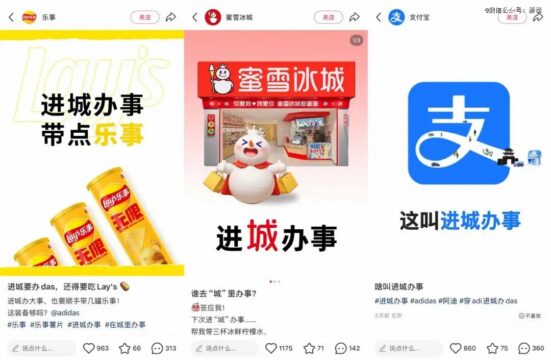
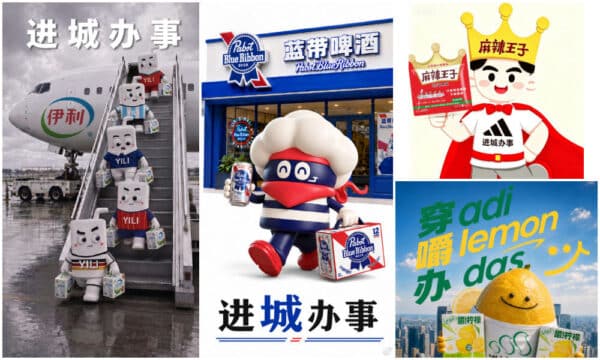
Various Chinese brands incorporated the Adidas meme into their own campaigns.
Because Adidas’s response felt effortless, authentic, and on-brand, it greatly boosted the brand’s popularity and appeal among young Chinese consumers.
Nike’s Grass is No Longer Greener
Sportswear giant Nike also became a major trending topic in China over the past week, but for entirely different reasons. Nike hasn’t been doing all that well recently, and the brand’s decline went viral in the same week that Adidas’s success was evident.
Nike became a top trending topic under the hashtag “Chinese consumers are abandoning Nike faster than anyone expected” (中国消费者抛弃耐克比想象中更快) after reports that a pair of sneakers originally sold for 899 yuan (US$132) are now selling for 429 yuan ($63) and still failing to attract buyers.
Nike’s decline is noteworthy because the brand was once booming in China. As with many other Western brands, it symbolized quality, prestige, and a cosmopolitan future for much of the 1990s and 2000s.
In a 2011 study of Chinese consumer aspirations, one respondent imagined a future in which she would drive a Mercedes-Benz, wear Nike, and eat KFC—a vision of modernity built around foreign brands. Another person dreamt of wearing “Nike clothes and Nike shoes (…) on the green grass, swinging golf clubs under the golden sunshine.”[1]
But Nike’s grass is no longer greener. Chinese commenters largely agree that much of the trust and desire surrounding the brand has eroded.
Many former Nike consumers now prefer Chinese brands such as Anta, Li-Ning or ERKE. Multiple posts on Chinese social media cite the Xinjiang cotton controversy as a turning point from which Nike never fully recovered.
The Localization Dilemma: A Strategic Catch-22?
The contrasting fortunes of Nike and Adidas reveal something important about the position of foreign brands in China today.
As domestic brands improved and narratives of national rejuvenation and the “Chinese Dream” gained prominence under Xi Jinping, consumer sentiment toward Western brands shifted dramatically, especially amid a growing number of controversies involving them.
From a Dolce & Gabbana campaign deemed racist to a witch hunt for Western brands listing Hong Kong and Taiwan as separate countries, international brands increasingly started struggling to find their place between politics, patriotism, and consumers who are choosing “Made in China” over global consumer culture.
As Zhihong Gao[2] observed as early as 2012, the rise of cultural confidence and renewed appreciation for Chinese traditions created a dilemma for foreign brands.
They find themselves caught in a strategic catch-22: if they localize too much, they risk losing the distinctiveness that made their brands attractive in the first place, while also reinforcing consumer preference for local cultural elements; yet if they remain too foreign, they risk appearing culturally tone-deaf and disconnected from Chinese consumers.
This is where Adidas appears to have found a sweet spot.
Unlike Nike, which seems to be living off its past success while showing little urgency in adapting to the Chinese market, Adidas has fully embraced Chinese digital culture, local humor, wordplay, and youth trends without abandoning its own identity.
Rather than pretending to be Chinese, Adidas is participating in Chinese culture as a distinctly foreign brand. By celebrating the unique elements of Chinese culture, both in tradition and modernity, it is boosting both its own image and the cultural pride it is tapping into. That is Chinamaxxing in a nutshell.
- Read more about Chinamaxxing here.
- Read more about the rise of ‘proudly made in China’ here.
- Read more about Nike vs ERKE here.
[1] Kelly Tian and Lily Dong, Consumer-Citizens of China: The Role of Foreign Brands in the Imagined Future China (London: Routledge, 2011), 70–71.
[2] Zhihong Gao, “Chinese Grassroots Nationalism and Its Impact on Foreign Brands,” Journal of Macromarketing 32, no. 2 (2012): 184–185.
By Manya Koetse
(follow on X, LinkedIn, or Instagram)
Spotted a mistake or want to add something? Please let us know in comments below or email us. First-time commenters, please be patient – we will have to manually approve your comment before it appears.
©2026 Eye on Digital China/Whatsonweibo. All rights reserved. Do not reproduce our content without permission – you can contact us at info@whatsonweibo.com.
Eye on Digital China is a reader-supported publication by
Manya Koetse (@manyapan) and powered by What’s on Weibo.
It offers independent analysis of China’s online culture, media, and social trends.
To receive the newsletter and support this work, consider
becoming a paid subscriber.


A Chinamaxxing Brand, a Stressed-Out Possum, and Japan’s Lost Decades

“Going to Town to Handle Business”: How Adidas Went from Hated in China to a Chinamaxxing Brand

Look Only at the Ugly Sides, and You Won’t See China

The Reunification with Taiwan is Hitting Chinese Cinemas This Summer

Comrade Trump Returns: The 2026 Trump–Xi Summit on Chinese Social Media

“Auntie Mei” Captured After 20 Years, China’s Train-Stain Scandal, and Zhang Xuefeng’s Final Lesson
Comrade Trump Returns: The 2026 Trump–Xi Summit on Chinese Social Media

Chinese Postdoc Death Raises Questions as Key Details Remain Missing

My Mum Has Two Husbands: The OPPO Mother’s Day Fiasco and 7 Other Gender Marketing Fails in China

The AI Actor Debate, Tragedy in China’s “Fireworks Capital,” and the Viral Labubu Fridge
-

 Chapter Dive11 months ago
Hidden Cameras and Taboo Topics: The Many Layers of the “Nanjing Sister Hong” Scandal
-

 China Insight11 months ago
“Jiangyou Bullying Incident”: From Online Outrage to Offline Protest
-

 China Arts & Entertainment9 months ago
The Wong Kar-wai Scandal Explained: The Dark Side of ‘Blossoms Shanghai’
-

 Chapter Dive12 months ago
The Next Labubu: What the Rise of Wakuku Tells Us About China’s Collectible Toy Wave