SubscribeLog in
Connect with us

China Insight

China’s Cruise Ship Generation

Trending on Sina Weibo this week is the capsized cruise ship and its senior passengers. Tuesday’s tragedy uncovered existing problems of senior citizens traveling under dangerous conditions.

Published

on

Trending on Sina Weibo this week is the topic “How To Guarantee A Safe Tour For Senior Tourists” (如何保证”夕阳红”旅行团平安). The tragedy with the capsized Chinese cruise ship, with a majority of passengers over the age of 50, uncovered existing problems of senior citizens traveling under dangerous conditions.

This week the whole nation was shocked when the “Eastern Star” ship sank in the Yangtze River. According to a Xinhua News   report, the ship was designed to carry over 540 passengers. Prior to this week’s disaster, it was known as one of the best passenger ships in China; equipped with hi-tech navigation devices and entertainment facilities. The ship was once praised by the Chinese Transport Ministry for its good performance and services. Preliminary statistics show that the Eastern Star carried 456 passengers; 406 of them are tourists from Shanghai between the ages of 50 and 80 years old.

The Eastern Star tragedy has triggered discussions on the safety of senior tourists. The supposedly luxurious Eastern Star cruise turned out to be of low quality, with inferior accommodation, a tight and hasty schedule, and a staff with bad service attitude.

Along with the rapid economic development of China, more and more senior citizens are spending money on travel. At present, the main means of market competition in tourism is price competition. Senior citizens will pay more attention to the price when they choose their travel agency. Because of its low price and the all-in comfort, a cruise ship tour is a popular choice for many elder travelers in China.

As a special social group, senior tourists often need more attention. Although doctors are necessary for large-scale senior group travel, travel agencies will not hire doctors as it will raise their operation costs. Ironically, their low price is exactly how they lure senior citizens into booking with them.

Another problem is compensation when things go wrong. Theoretically speaking, if the insurance system is good enough, senior travelers will obtain three types of insurance compensation: the ship’s insurance, travel agency liability insurance, and traveler’s accidents injury insurance. The Yangtze ship tragedy revealed a problem that is common in China’s insurance industry: most insurance companies refuse to accept the insurance policy of senior tourists over 70 years old.

On Weibo, many netizens called for improvements in the safety and compensation system for senior travelers in particular. Some call for the banishment of cheap travel groups, while others say that the government should protect senior citizens more.

“It’s better not to join cheap travel groups,” one Weibo user said: “They should be blocked. If the prices aren’t that competative, then the means of transport will also be better.” Another user said: “Most of these senior citizens have children who are all grown-up and too busy to accompany their parents. To fight loneliness, these people choose to travel together. But because they live off their retirement pay, which is low, they cannot afford a lot. The state should be concerned of this generation.”

According to the latest reports, only 14 people are confirmed to have survived the disaster thus far. The confirmed death toll stands at 75, leaving more than 360 people, many of them in their 60s and 70s, still unaccounted for.

– by Zichao Liang

About the author: Liang Zichao is a graduate from Changchun University of Science and Technology, who is now a Shenzhen-based working professional and translator from Shenzhen.

Continue Reading
Click to comment

Leave a Reply

Your email address will not be published. Required fields are marked *

China Insight

Mbappé, Mao, and the Joke That Shall Not Be Named

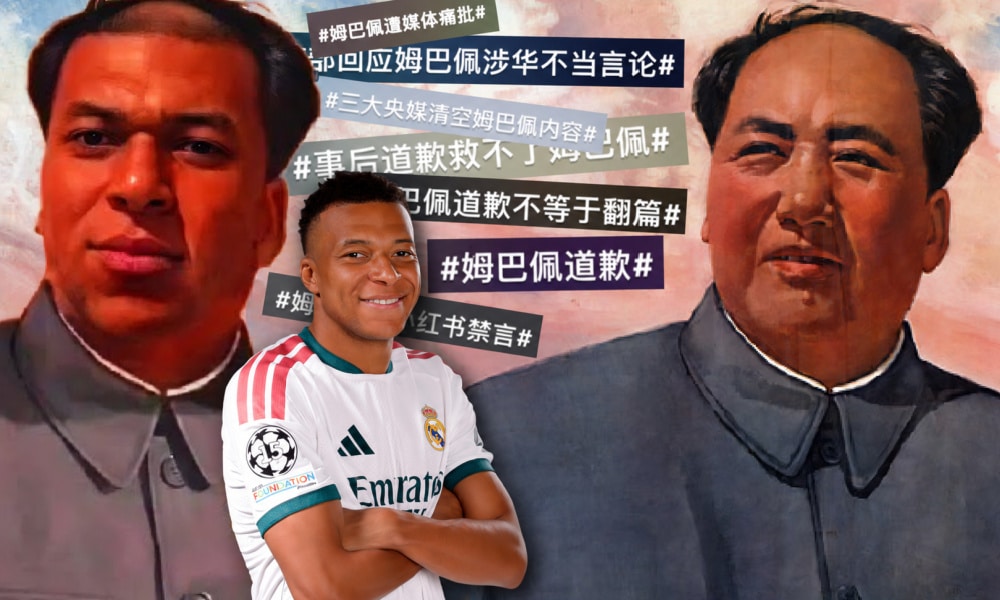
Mbappé’s favorite Mao meme sparked major backlash in China. More on what the controversy reveals about political red lines, online humor, and censorship.

Manya Koetse

Published

on

RESOU 热搜 | What’s Trending in China, Explained

Here, I briefly unpack the stories making waves on Chinese social media and share what stands out to me. Don’t miss an update: become a subscriber to Eye on Digital China today.

Oh oh oh, Mbappé, all those goals, yet you lost so many points on Chinese social media over the past 48 hours.

Following his 100th goal for Real Madrid during El Clásico and finishing second on Ballon d’Or night, French football player Mbappé is all the talk on Chinese social media — not for his achievements, but for what is seen as crossing a major red line in an online interview.

On Tuesday night, a text came in from Ruixin: “I am wide awake tonight and somehow witnessed live how the footballer Kylian Mbappé was getting blocked and totally canceled on Chinese social media for his comments about Mao Zedong over the past, like, three hours 😅”

I quickly grabbed my phone and saw the flood of Mbappé posts rapidly coming in, and it was clear that people were very cross with him.

Although it was already clear that this might not blow over any time soon, by early Wednesday morning it became painfully clear how the controversy had snowballed. Dongpeng Beverage Group (东鹏), one of the many Chinese companies that signed the famous sportsman as its brand ambassador, publicly stated that it was cutting all commercial ties with Mbappé. Soon, others followed.
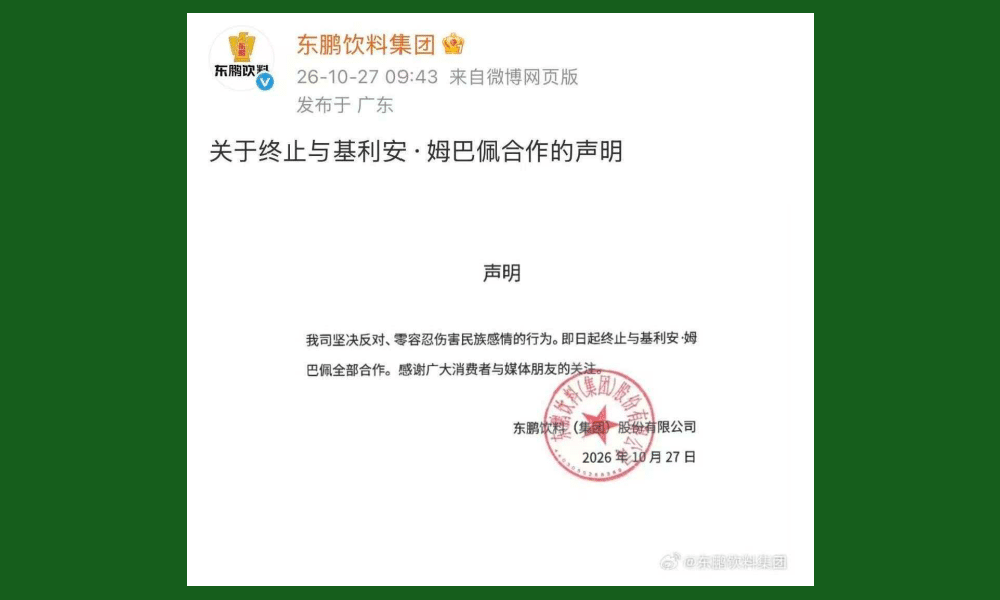
Dongpeng Beverage Group (东鹏): the first in a string of companies to cut ties with French footballer Kylian Mbappé.

Mbappé’s fall from grace in China has been sudden and spectacular, like a major avalanche of backlash that unfolded in one night, and it can all be traced back to one segment of an interview the footballer previously did on a French YouTube show (The Bridge) that resurfaced online — initially through Reddit and X, and then on Chinese social media apps, like football platform Dongqiudi (懂球帝).

In that segment, when asked about his favorite meme, Mbappé replied that one of the memes he finds funniest is:

🗣️ “the one where they put my face on some guy, a Chinese dictator. That really makes me laugh, I use it with my friends all the time.”

The interview segment where Mbappé shares his favorite meme: his face photoshopped onto the face of a “Chinese dictator.”

The show, created by Mbappé’s Real Madrid teammate Aurélien Tchouaméni, added the image Mbappé referred to: his face photoshopped on a Mao propaganda visual. It’s part of a series of memes that emerged in 2024 in which Mbappé’s face is edited onto the faces of dictators.1

Continue Reading

Chapter Dive

The French Protests, Viewed from China: Five Narratives on Chinese Social Media

From the decline of Europe to historical karma: these 5 narratives reveal how Chinese social media discusses the recent unrest in France.
Manya Koetse

Published

on

Originally published in the Eye on Digital China newsletter on Sunday, October 25, 2026.

The protests in France have been trending in China all week. The ways in which they are being discussed perhaps reveal more about Chinese views of France and Europe—and about China’s own place in the world today—than about the protests themselves. Here are five of the main narratives shaping the discussion.

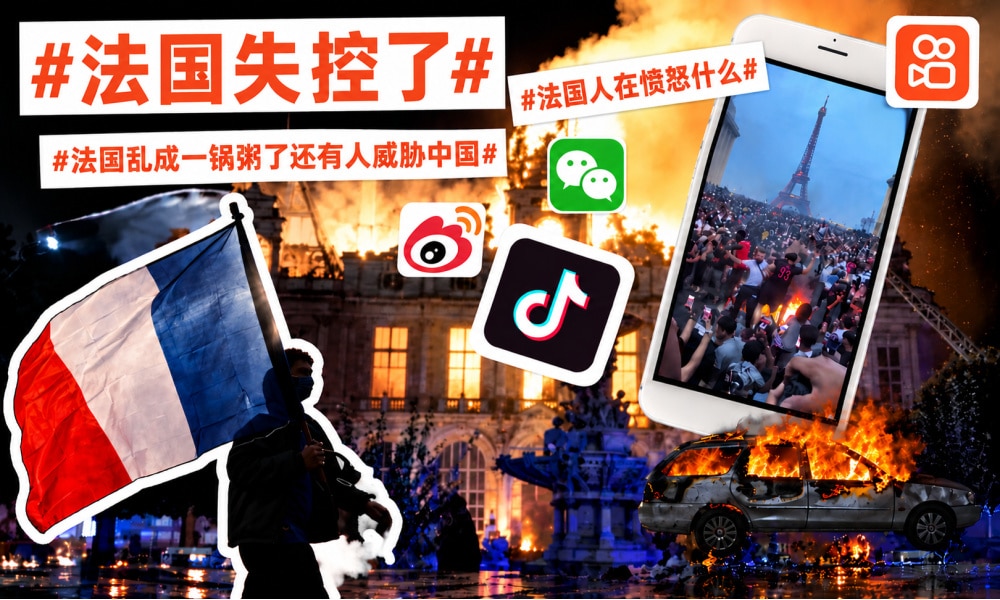
Over the past week, the widespread protests and unrest in France have been trending on Chinese social media. From October 18 to today, turmoil in Paris and other cities consistently appeared in the top trending lists on Weibo, Kuaishou, and other apps, with Chinese netizens and commentators discussing the situation in various ways under numerous hashtags.

The topic remained trending all week not only because of the October 17–18 riots and their aftermath, but also because of the new round of protests on October 24, for which French authorities deployed 70,000 police officers and the Chinese embassy in France issued new warnings.

Here, we’ll take a closer look at five dominant narratives surrounding the protests in France on Chinese social media, and what this says about Chinese perceptions of France and Europe, from common ideas about the decline of Europe to the protests being a form of “historical karma.”[1]


1. “France Has Lost Control”: A Nation in Crisis


How can a developed country like France fail to maintain basic order? One dominant framing of the recent protests on Chinese social media is that they demonstrate the French state’s inability to keep the situation under control, indicating a crisis of governance and security.

One of the highest-ranking hashtags among more than 300 trending topics on Chinese social media apps related to the unrest in France is: “France is out of control” (法国失控了). Along with hashtags like “France is in chaos again,” that hashtag first came up last Sunday on Weibo during a weekend filled with looting, arson, destruction, and violence by groups of rioters in Paris, Marseille, Lyon, Lille, and elsewhere.

The perceived weakness of President Macron’s leadership was highlighted on Chinese social media through memes and jokes mocking the leader for attending a Celine Dion concert right before the situation escalated. A commentary on Sina compared the concert to company executives holding a celebration banquet and handing out bonuses just before the firm collapses, framing the riots as a “run on…

Continue Reading

Subscribe

Eye on Digital China is a reader-supported publication by
Manya Koetse (@manyapan) and powered by What’s on Weibo.
It offers independent analysis of China’s online culture, media, and social trends.

To receive the newsletter and support this work, consider
becoming a paid subscriber.

Manya Koetse's Profile Picture

Get in touch

Have a tip, story lead, or book recommendation? Interested in contributing? For ideas, suggestions, or just a quick hello, reach out here.

Popular Reads