SubscribeLog in
Connect with us

China Food & Drinks

Adapted to the Desert: This Yurt-Style KFC Opened in Inner Mongolia

Special KFC in Inner-Mongolia: “Is home delivery done by camelback?”

Manya Koetse

Published

on

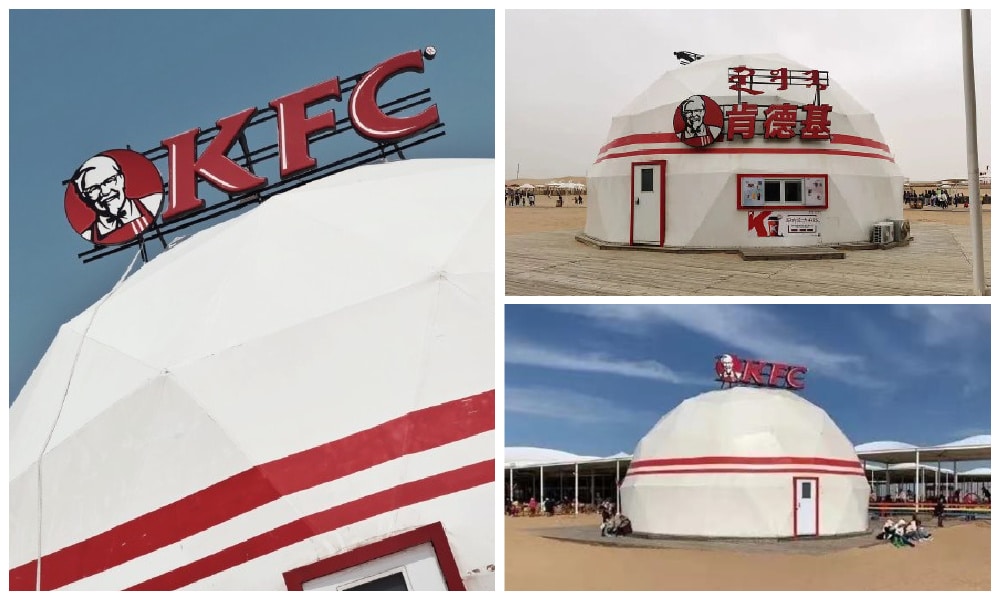
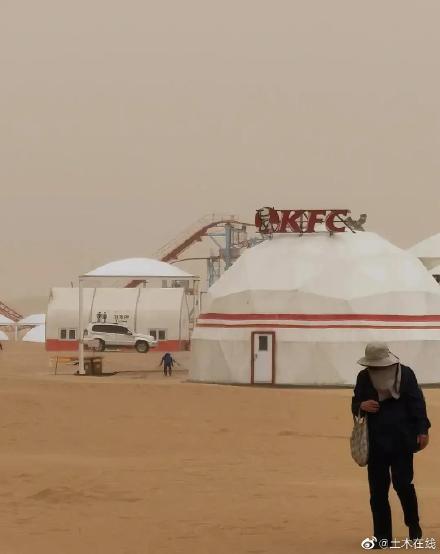
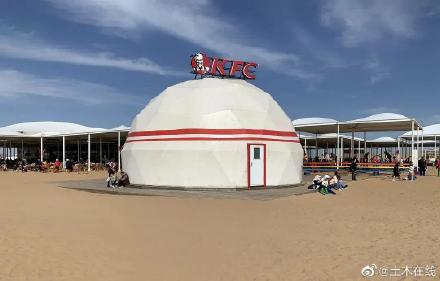
A KFC restaurant that has opened up in Ordos Prefecture, Inner-Mongolia, is attracting online attention in China for its yurt-style building.

The KFC restaurant is located in Xiangshawan, also known as Whistling Dune Bay, a tourist area – China’s first desert-themed tourism resort – in the Kubuqi Desert.

Some web users praise the fast-food giant for “following local customs” (“入乡随俗”). Others jokingly wonder if their home delivery services are also done by camelback.
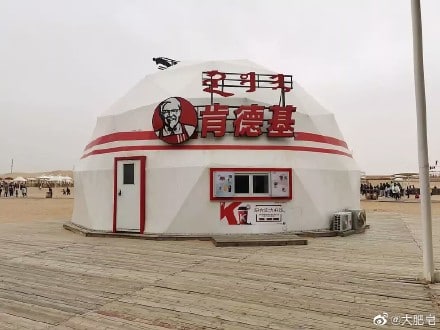
Although KFC is not China’s first fast-food restaurant, it is one of the most popular ones. Nowhere else outside of the US has KFC expanded so quickly as in China. Since the first KFC opened in Beijing in 1987, the chain had an average of 50% growth per year.

With thousands of locations across the country, KFC often adapts its restaurants’ style to the local environment. On Weibo, web users share various examples of local KFCs.

A KFC sign at a Fuzhou branch, by Weibo user @渭城朝雨玉清宸.

A KFC in Shanxi province, shared by Weibo user @sheep加水饺.

KFC in Suzhou, by Weibo user @是宜不是宣呀.

KFC in Pingyao, by Weibo user @车谦渊

KFC in Orange Isle, Hunan, by Weibo user @DzDanger_

One Weibo user (@阳山花非花) points out that KFC is not the only chain to adapt to the local environment in Ordos. Chinese fast-food chain Dicos (德克士) apparently also has a special restaurant in the area.

Besides adapting its buildings, KFC is also known to be quite localized in its product offerings. KFC China offers products such as Chinese-style porridge, Beijing chicken roll, and youtiao (deep-fried strip of dough commonly eaten for breakfast).

In 2019, KFC also made headlines in China for adding, among other things, hot and spicy skewers (麻辣串串) to its menu.

For now, the KFC yurt-style location is bound to gain more visitors who are coming to check it out. Already, various Weibo users are sharing their own pics of their KFC visit.


You might also like to read:


By Manya Koetse (@manyapan)

With contributions by Miranda Barnes

Spotted a mistake or want to add something? Please let us know in comments below or email us. First-time commenters, please be patient – we will have to manually approve your comment before it appears.

©2021 Whatsonweibo. All rights reserved. Do not reproduce our content without permission – you can contact us at info@whatsonweibo.com.

Manya Koetse is a sinologist, writer, and public speaker specializing in China’s social trends, digital culture, and online media ecosystems. She founded What’s on Weibo in 2013 and now runs the Eye on Digital China newsletter. Learn more at manyakoetse.com or follow her on X, Instagram, or LinkedIn.

Continue Reading
Click to comment

Leave a Reply

Your email address will not be published. Required fields are marked *

China Brands, Marketing & Consumers

Quack Like a Goose: Why Beijing Street Vendor “Auntie Goose Legs” Sparked a Nationwide Debate

After the first complaints surfaced, Auntie Goose Legs admitted the truth about her business: she ha been selling duck legs all along.

Manya Koetse

Published

on

🔥 Originally published in Eye on Digital China.
My premium newsletter covering the stories, memes, debates, and viral moments shaping online conversations in China. Subscribe here to receive future editions.

If it walks like a duck and quacks like a duck, it might still be a goose – or the other way around. That, at least, is the takeaway from two stories that recently went viral on Chinese social media.

The woman at the center of it all is Beijing street-food vendor Chen Xiufeng (陈秀凤), better known as “Auntie Goose Legs” (鹅腿阿姨). Over the years, she became something of a local celebrity in Beijing’s university district. Originally from Jiangsu, the migrant vendor had been selling her famous roasted goose legs to students since 2011.

She skyrocketed to national fame in 2023 , but became the target of widespread criticism last week after it was revealed that her celebrated goose legs – sold for 16 yuan ($2.20) per piece – were actually duck meat all along.

The controversy came up after the vendor ventured beyond the university area into Beijing’s business district. At the universities, she enjoyed a loyal customer base and dedicated WeChat groups. In her new market, however, customers proved more skeptical. Some noticed that the meat looked suspiciously duck-like; others complained that the color seemed off.

In the university district, Auntie Goose Legs she enjoyed a loyal customer base and dedicated WeChat groups.

After the first complaints surfaced, Auntie Goose Legs admitted the truth on WeChat on June 9.

“The ingredients I originally used were goose legs,” she wrote, “but they have been out of stock for more than fifteen years. The current ingredient is duck legs.”

It turned out that she had only sold goose legs, the product that made her famous, for two months back in 2011 before switching to the much cheaper duck. “Did geese become extinct without us knowing?” some netizens joked.

The revelation quickly exploded online. The hashtag “What Auntie Goose Legs is Selling Turns Out to be Duck Legs” (#鹅腿阿姨卖的是鸭腿#) became the top trending on Weibo for an entire day, with millions of people discussing the topic.


Why did millions of people become so outraged over a single Beijing street vendor selling duck instead of goose?


Piggybacking on the debate, Anhui-based commentators pointed out that a beloved regional specialty has the exact opposite ‘problem.’ Wuwei smoked duck (无为板鸭) is branded as duck, but is usually goose. According to local standards, however, goose products may be sold under this name, prompting discussions about “hanging up a goat’s head, while selling dog meat“ (挂羊头卖狗肉): advertising one thing while selling another.

Because geese are more expensive than ducks in China, and generally considered tastier, the Anhui duck-is-goose story, unlike the Auntie Goose Legs controversy, did not provoke online anger. Instead, many people saw it as an example of sellers prioritizing flavor over cost. Auntie Goose Legs is seen as doing the exact opposite.

But why did millions of people actually become so outraged over a single Beijing street vendor selling duck instead of goose, especially when there were no indications that anyone became ill? The answer has little to do with poultry and everything to do with trust.

Auntie Goose Legs during the prime time in Beijing’s University District in late 2023 (image via Lianhe Zaobao 联合早报).

Food fraud and mislabeling have been longstanding concerns in China. Earlier surveys found that food safety worries even outweighed concerns about public security and environmental issues, and while China’s food safety record has improved in recent years, public trust remains fragile.

Part of these concerns are immediate and practical. Major scandals in the past involving melamine-tainted infant formula or recycled “gutter oil” have posed serious risks to public health. But the issue goes beyond health risks alone.


If a goose can be a duck, then what exactly is the duck?


Whereas food safety concerns in many Western countries often focus on contamination, Chinese consumers are frequently just as concerned with economic deception. It is unfair to pay for a more expensive goose and receive a duck. Even if no one gets sick, Chinese consumer law still treats it as fraud.

More important, however, is what such deception does to confidence in the broader food system. If a goose can be a duck, then what exactly is the duck?

As a major 2023 college canteen scandal demonstrated, the build-up of deceit can reach a breaking point among the public. During that somewhat Kafkaesque “rat head or duck neck” (鼠头or鸭脖”事件) controversy, officials insisted a rat head found in a student’s rice was merely a “duck neck,” even though everyone could clearly see the snout and teeth of a rodent.

This kind of gaslighting shatters social trust and reinforces a generalized sense that, as a consumer, you are entirely on your own. When regulators fail to step in honestly, even a seemingly isolated incident comes to symbolize more dangerous forms of systemic food fraud.

And this is where the Auntie Goose Legs story stings the most.

People did not come to her simply because her food was good. Over the years, she had become part of local student life, and she felt safe and authentic. Her pink scooter helmet, which she continued to wear while working, became an iconic symbol of her no-nonsense and humble image. Her success was built on word of mouth and, above all, on the trust her customers placed in her.

That this particular “auntie” deceived her customers by selling a different product than the one she advertised is no longer really about her. If duck is goose, goose is duck, and your local auntie has deceived you for years, then who can you trust anymore?


  • Read more about how Auntie Goose Legs rose to fame in 2023 here.


By Manya Koetse
(follow on X, LinkedIn, or Instagram)

Spotted a mistake or want to add something? Please let us know in comments below or email us. First-time commenters, please be patient – we will have to manually approve your comment before it appears.

©2026 Eye on Digital China/Whatsonweibo. All rights reserved. Do not reproduce our content without permission – you can contact us at info@whatsonweibo.com.

Continue Reading

China Animals

China Faces Unprecedented Donkey Shortage Crisis

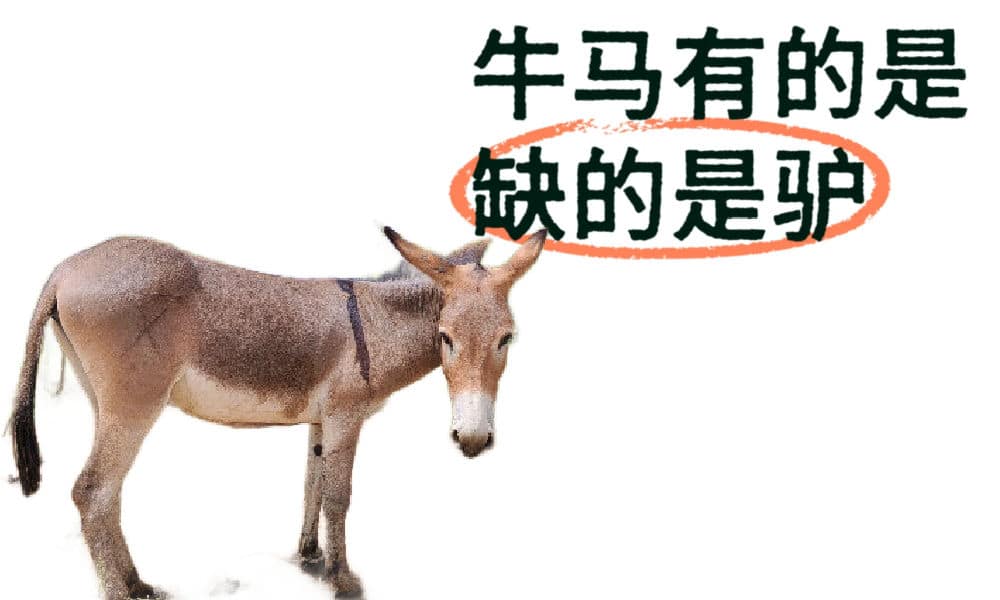
“We have plenty of cattle and horses in China now — just not enough donkeys” (“目前我国牛马都不缺,就缺驴”).
Manya Koetse

Published

on

China is facing a serious donkey shortage. China’s donkey population is far below market demand, and the prices of donkey-related products continue to rise.

Recently, this issue went trending on Weibo under hashtags such as “China Currently Faces a Donkey Crisis” (#我国正面临缺驴危机#).

The Donkey Branch of China’s Livestock Association (中国畜牧业协会驴业分会) addressed this issue in Chinese media earlier last week, telling China News Weekly (中国新闻周刊): “We have plenty of cattle and horses in China now — just not enough donkeys” (“目前我国牛马都不缺,就缺驴”).

China’s donkey population has plummeted by nearly 90% over the past decades, from 11.2 million in 1990 to just 1.46 million in 2023.

The massive drop is related to the modernization of China’s agricultural industry, in which the traditional role of donkeys as farming helpers — “tractors” — has diminished. As agricultural machines took over, donkeys lost their role in Chinese villages and were “laid off.”

Donkeys also reproduce slowly, and breeding them is less profitable than pigs or sheep, partly due to their small body size.

Since 2008, Africa has surpassed Asia as the world’s largest donkey-producing region. Over the years, China has increasingly relied on imports to meet its demand for donkey products, with only about 20–30% of the donkey meat on the market coming from domestic sources.

China’s demand for donkeys mostly consists of meat and hides. As for the meat — donkey meat is both popular and culturally relevant in China, especially in northern provinces, where you’ll find many donkey meat dishes, from burgers to soups to donkey meat hotpot (驴肉火锅).

However, the main driver of donkey demand is the need for hides used to produce Ejiao (阿胶) — a traditional Chinese medicine made by stewing and concentrating donkey skin. Demand for Ejiao has surged in recent years, fueling a booming industry.

China’s dwindling donkey population has contributed to widespread overhunting and illegal killings across Africa. In response, the African Union imposed a 15-year ban on donkey skin exports in February 2023 to protect the continent’s remaining donkey population.

As a result of China’s ongoing “donkey crisis,” you’ll see increased prices for donkey hides and Ejiao products, and oh, those “donkey meat burgers” you order in China might actually be horse meat nowadays. Many vendors have switched — some secretly so (although that is officially illegal).

Efforts are underway to reverse the trend, including breeding incentives in Gansu and large-scale farms in Inner Mongolia and Xinjiang.

China is also cooperating with Pakistan, one of the world’s top donkey-producing nations, and will invest $37 million in donkey breeding.

However, experts say the shortage is unlikely to be resolved in the short term.

The quote that was featured by China News Weekly — “We have cows and horses, but no donkeys” (“牛马有的是,就缺驴”) — has sparked viral discussion online, not just because of the actual crisis but also due to some wordplay in Chinese, with “cows and horses” (“牛马”) often referring to hardworking, obedient workers, while “donkey” (“驴”) is used to describe more stubborn and less willing-to-comply individuals.

Not only is this quote making the shortage a metaphor for modern workplace dynamics in China, it also reflects on the state media editor who dared to feature this as the main header for the article. One Weibo user wrote: “It’s easy to be a cow or a horse. But being a donkey takes courage.”

By Manya Koetse

(follow on X, LinkedIn, or Instagram)

Spotted a mistake or want to add something? Please let us know in comments below or email us. First-time commenters, please be patient – we will have to manually approve your comment before it appears.

©2025 Whatsonweibo. All rights reserved. Do not reproduce our content without permission – you can contact us at info@whatsonweibo.com.

Continue Reading

Subscribe

Eye on Digital China is a reader-supported publication by
Manya Koetse (@manyapan) and powered by What’s on Weibo.
It offers independent analysis of China’s online culture, media, and social trends.

To receive the newsletter and support this work, consider
becoming a paid subscriber.

Manya Koetse's Profile Picture

Get in touch

Have a tip, story lead, or book recommendation? Interested in contributing? For ideas, suggestions, or just a quick hello, reach out here.

Popular Reads