Newsletter
Weibo Watch: China’s Farm Fever
From Becoming a Farmer to Dopamine Dressing – these are the China trends to know this week from Weibo and beyond.
Published
3 years agoon
PREMIUM NEWSLETTER | ISSUE #5 | READING TIME: 7 MIN
This week’s newsletter:
◼︎ 1. Editor’s Note – China’s farm fever
◼︎ 2. What to Know – Highlighting hot topics
◼︎ 3. What Lies Behind – Spotted by news editor Miranda
◼︎ 4. What’s Trending – A closer look at the top stories
◼︎ 5. What’s Noteworthy – Small news with big impact
◼︎ 6. What’s Popular – The latest buzz in arts & pop culture by Zilan
◼︎ 7. What’s Memorable – Best reads from the archive
◼︎ 8. Weibo Word of the Week – The catchword to know by Slow Chinese
Dear Reader,
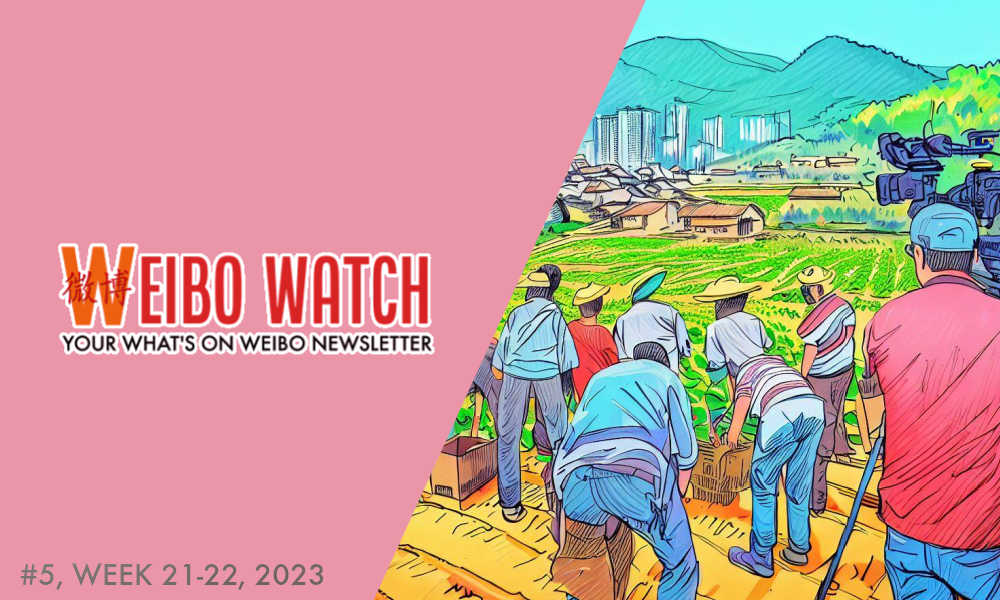
On Weibo, every day at 9:30 am, the official account of Become a Farmer starts their daily check-in livestream session. Just as China’s office workers are beginning their workday, they can tune in on social media to watch young men fertilizing farmlands, feeding cattle, or harvesting crops in Zhejiang province.
Become a Farmer is the latest hit TV show by iQIYI. Spanning 190 days, the series follows a “farming squad” of ten carefully selected male semi-celebrities in a rural village as they manage a 23-acre farm and experience the challenges of agricultural life. In addition to the daily show, there is a morning livestream, and viewers can also follow their favorite farmers through their social channels and daily vlogs.
The hit show is bringing the Chinese countryside closer to young, urban viewers, allowing them the chance to interact with the series and farmers. Getting a 8.9 rating on Douban and receiving over 4.7 billion views on Weibo, the show is harvesting success among netizens.

Image from Become a Farmer, via cyol.com.
Behind the scenes, Chinese propaganda departments must be delighted with the show’s success. Empowering China’s youth and revitalizing rural areas are both crucial themes for China’s leadership. Earlier this month, Xi Jinping encouraged students to contribute more to rural revitalization, suggesting that immersing oneself in rural areas to understand the well-being of the people embodies the desirable spirit of Chinese youth in the new era.
The message goes beyond ideology. As more Chinese youth find themselves without work in a highly competitive urban job market, they are encouraged to return to villages and help build and boost rural economies, which is especially important in light of China’s food security and a growing economic gap.
As these themes gain importance, they are playing an increasingly prominent role in China’s entertainment industry. While there have been other reality series and TV dramas focusing on the countryside before, Become a Farmer is particularly immersive and serves as an example for the youth. “The post-80s generation doesn’t want to farm, the post-90s generation doesn’t know how to farm, and the post-00s generation doesn’t even ask about farming,” wrote a Chinese media outlet on Weibo, using the hashtags “Who will cultivate China’s land in the future?” (#未来中国谁来种地#).
Meanwhile, on social media, some people admit that they have been learning more about ploughing devices and tractors since the start of the show. Others dream of exchanging their office jobs for the countryside, while some simply appreciate the show as a breath of fresh air in an online media environment filled with fast-food variety shows and quick videos. With the growing interest and excitement surrounding these shows, it’s safe to say that we can expect a bountiful harvest of more Chinese productions focused on farm work and rural life in the near future.
For more about the show, read the latest article by Wendy Huang. For all this and more, see our list of featured articles where we explore the major trends that have recently captured the attention of Chinese social media users. What’s on Weibo intern Zilan Qian, news editor Miranda Barnes, and Andrew Methven at Slow Chinese have contributed to this week’s newsletter.
Last week, I joined Yuval Weinreb’s China podcast, which is the most popular China-focused podcast in Israel. We spoke about the main social media platforms in China, the way they impact public discourse despite censorship, and discussed examples of their influence on Chinese society. Want to tune in? Listen on Spotify here, or on Apple Podcast here.
I always like to hear more about the China topics you’d like to know more about. Contact me via email or DM, or follow me on Twitter for the latest news and trends.
Best,
Manya
What to Know

◼︎ Cathay controversy. The biggest China social story of the past week started with one passenger exposing Cathay cabin crew mocking & discriminating against non-English speaking (Mainland) passengers. His complaint and this audio snippet led to them being fired, and a social media storm. (Hashtag: #国泰空乘歧视乘客录音曝光#).
◼︎ Second Covid peak. China is facing a new Covid wave. According to Chinese epidemiologist Zhong Nanshan, the end of this year’s Covid peak will be reached in late June. The number of infections could reach 65 million a week. The XBB variant of Covid is the dominant strain in the second wave of Covid that is trending on Chinese social media. (Hashtag: #钟南山称6月底或是今年疫情高峰#).
◼︎ China’s C919. On Sunday, China celebrated an aviation milestone as its first domestically manufactured passenger jet completed its maiden commercial flight from Shanghai to Beijing. With the successful launch of the COMAC C919, China is positioning itself to challenge industry giants like Boeing and Airbus. (Hashtag: #C919商业首飞成功#).
◼︎ Yunnan protests. Violent clashes erupted between protesters and a substantial police force over the weekend in Nagu, a predominantly Muslim town in Yunnan Province. The unrest was allegedly triggered by the authorities’ plan to demolish the dome of the ancient Najiaying Mosque. The topic is censored on Weibo, Douyin, and beyond, but videos of the clashes circulated on Twitter (link).
◼︎ Baidu dethroned. Baidu, often referred to as ‘the Chinese Google’, is no longer China’s no 1 search engine. Bing has now surpassed Baidu to become the largest desktop search engine in mainland China. As the top went trending, commenters expressed that they started to disliked the messy lay-out of Baidu and how users are ‘getting bombarded’ with ads and news content. (Hashtag: #百度已不是中国第一大桌面搜索引擎#).
◼︎ Shenzhou XVI launch. On Tuesday afternoon, May 30, the crew of China’s Shenzhou 16 space mission arrived at the Tiangong space station, marking the beginning of a five-month mission for the three astronauts – including the country’s first civilian team member. The topic received over 500 million views on Weibo. (Hashtag: #神十六发射圆满成功#/)
◼︎ Elon in Beijing. After the private aircraft of Elon Musk landed in Beijing, the Tesla CEO reportedly met with Chinese State Councilor and Foreign Minister Qin Gang on May 30. Earlier reports suggested that Musk is expected to meet with senior Chinese officials and visit Tesla’s Shanghai factory, marking his first visit to China in three years. (Hashtag: #马斯克私人飞机降落北京#).
◼︎ Death penalty for rapists. Three men convicted of raping minors were executed in China last week. The convicts, who were separately convincted in Hubei’s Xiaogan, Shandong’s Weifang, and Henan’s Anyang, reportedly targeted elementary and junior high school girls through online chat tools before raping them. The topic received over 680 million views on Weibo. (Hashtag: #3名强奸未成年人罪犯被执行死刑#)
What Lies Behind

2023 Population Falls Below 8 Million? Implications and Concerns
It all started with a post that supposedly quoted a source from the National Health Committee. According to the post, as of the fifth month of 2023, all expecting mothers who planned to give birth in this year have already registered with hospitals. Based on this data, it is anticipated that the number of babies born in 2023 will fall below 8 million, marking the lowest figure in recent decades. Although this number has not been officially confirmed by the authorities, the topic (#2023年出生人口跌破800万) has sparked widespread discussions as concerns over population decline intensify.
On social media, Chinese population specialist Huang Wenzheng (黄文政) painted a gloomy picture of how China’s further population decline could impact various industries. First and foremost, the formula and child care industries would be affected, followed by education, food, and clothing in the next 5-10 years. In the span of 20-50 years, industries such as property, the digital economy, vehicles, tourism, and entertainment would also experience decline. Looking even further ahead, in 50 years, declines are expected in healthcare, elderly services, and the funeral industry. Huang suggests that the government should mobilize nationwide resources to boost the population.
Many individuals have expressed their personal conundrum regarding the pressures of their own lives, let alone the decision to have children, and the population’s concern over the long-term impact on the nation. Some question whether they should continue paying into their pension, as there may not be a return on their investment in the future. Others mention facing intense competition in education, career development, and home ownership, which makes the issue of population decline seem distant and unrelated. As much as there is shared anxiety for the nation’s future, it apparently isn’t enough to convince China’s younger generations to overcome their challenges and have more children at an earlier age.
What’s Trending

1: Farmer Fever | With its focus on hard farm work and meeting actual targets, Become a Farmer is a fresh breeze of air for China’s variety show business, especially among young Chinese viewers who appreciate the show’s authenticity and the calmness of the rural scenes that pose a stark contrast with stressful urban life. These semi-celebrities have actually become farmers, and to legally sell the products grown on their farmland, they’ve registered as a company.

2: Carpet Pacific | Cathay Pacific flight attendants mocking non-English speaking passengers by saying, “If you can’t say blanket, you can’t have it,” have sparked a major controversy and caused a marketing catastrophe over the past week. The phrase now represents discriminatory treatment of mainland customers by a Hong Kong company, leading to further discussions on anti-Chinese sentiments in Hong Kong and the role of language in fostering (or hindering) Mainland-HK unity.

3: The G7 as “Failure” in China’s View | After the end of the G7, which was held in Hiroshima from 19 to 21 May, the summit remained a topic of discussion in Chinese online media, where the Group of Seven was criticized and accused of “smearing” and “attacking” China. Perhaps the most noteworthy criticism on the G7 summit came from Foreign Ministry Spokesperson Hua Chunying (华春莹), who suggested the G7 was like a “frog in the well,” a direct reference to the well-known fable by philosopher Zhuangzi about a frog in a well who does not believe it when a turtle tells him that the world is bigger than the view from the well.

4: The Viral Panda | Yaya has become the most talked-about panda of the year. This female panda resided in the Memphis Zoo in the United States for most of her life and attracted significant attention on Chinese social media platforms after netizens expressed concern about her seemingly thin and unhealthy appearance. The concerns surrounding Yaya prompted an online campaign, with netizens advocating for Yaya’s return to China. The 23-year-old panda’s return to China in late April became a true social media spectacle. Now, a month later, Yaya is trending again. This time, it is her move from Shanghai to Beijing that is hitting the trending lists. After twenty years in the US and one month in Shanghai quarantaine, Yaya’s new home will be the main zoo in Beijing, the place where she was born.
What’s Noteworthy

Extreme Celebrity Weight Loss Trends | On day one, you only drink soy milk; on day two, you only eat corn; on day four, you can have an egg and some boiled shrimp. Could you do it? Chinese actor Chen Hao (秦昊) recently attracted attention for losing a significant amount of weight in a short time for a role he played. After his wife shared his extreme diet, many people started following it and shared their progress. Qin is not the only Chinese celebrity whose weight loss journey has become an online hype. But behind the relentless pursuit of celebrity weight loss plans lies the issue of body anxiety, particularly among young Chinese women.
What’s Popular

Happy Hormone Fashion | While the concept of dopamine dressing, the art of wearing clothes that boost the happy hormone, has already gained attention from foreign media outlets and style blogs in mid-2022, it only recently captured the imagination of the Chinese fashion scene. Known as duōbā’àn chuāndā 多巴胺穿搭 (Chinese translation of dopamine dressing), this trend revolves around embracing boldly vibrant and saturated colors that often create striking contrasts. Some enthusiasts even liken this style to a spilled and mixed “human palette” (人间调色盘). The influence of dopamine dressing has even made its way into state media, with firefighters’ uniforms being playfully labeled as examples of “dopamine dressing” due to their eye-catching orange hue.
Many believe that wearing bright and saturated colors can infuse youthfulness, vitality, and create a positive attitude, fostering a good mood for the wearer. Additionally, this style is seen as a way to express strong personal characteristics, showcasing creativity and individual taste. It aligns with the aesthetic preferences of modern young individuals who value personalization, freedom, and fashion.
However, some offer a deeper perspective, shedding light on the less positive aspects of this trend. They argue that dopamine dressing arises as a reaction to the burdens faced by the younger generation, such as the concept of “involution” and the prolonged practice of wearing masks. As one Zhihu user wrote: “We need a window to experience pleasure, and dressing up in dopamine outfits becomes a window for us to experience pleasure amidst the challenges of life”
What’s Memorable

Keeping the School Open for Two Students | For this week’s throwback from the archives, and in light of the ‘rural revitalization’ trend, we’ve picked this article from 2017 about how small rural school in China are slowly disappearing amid rapid urbanization.
As children move out to the cities with their parents, some schools – once lively village institutions – become empty buildings. In the mountainous region of Youyang County, one teacher kept his school open for two remaining students. School teacher Yang Jinhua, then 54 years old, worked at the same school for 35 years. For the last remaining two pupils, he fulfilled the tasks of teacher, concierge, cook, and school principal. “I would do the same if there was just one child left,” he told reporters.
Weibo Word of the Week

Our Weibo Word of the Week is 二阳 èr yáng.
It directly translates as “second positive” and has been a phrase at the top of trending lists over the last week on Weibo and other social platforms. The character yáng 阳 means to test positive for a disease, such as COVID. The actual meaning of the phrase is “to get COVID for a second time.” That’s because there is much talk in China of an imminent second wave of COVID to peak in China over the next few weeks. So everyone is talking about getting COVID again. Expect 二阳 èr yáng to be a phrase you hear a lot if you are travelling to China over the summer!
Want to learn more Chinese? Subscribe to Andrew Methven’s super insightful Slow Chinese free newsletter here.
This is an on-site version of the Weibo Watch newsletter by What’s on Weibo. Missed last week’s newsletter? Find it here. If you are already subscribed to What’s on Weibo but are not yet receiving this newsletter in your inbox, please contact us directly to let us know.
Stories that are authored by the What's on Weibo Team are the stories that multiple authors contributed to. Please check the names at the end of the articles to see who the authors are.
Chapter Dive
Eye on Digital China: How Chinese Social Media Evolved from the Blog Era to the AI-driven Age
A look back at the three major phases of China’s social media — and why What’s on Weibo is evolving into Eye on Digital China.
Published
4 months agoon
November 12, 2025
This edition of the Eye on Digital China newsletter by Manya Koetse was sent to premium subscribers. Subscribe now to receive future issues in your inbox.
“Do you still remember going to the internet cafe, paying 2 yuan ($0.30) per hour during the day or 7 yuan ($1) for an all-nighter? Staying up playing games and surfing around?”
It’s the kind of content you’ll often see today on platforms like Douyin or Bilibili — nostalgic videos showing smoky internet cafes (wangba 网吧) from the early 2000s, where people chatted on QQ or played World of Warcraft on old Windows PCs while eating instant noodles. These clips trigger waves of nostalgia, even among internet users too young to remember that era themselves.

Internetcafe in 2005, image via 021zhaopin.com
The current nostalgia wave you see on Chinese social media is indicative of how China’s digital world has evolved over the past 25 years, shifting from one era to the next.
As I welcome a new name for this newsletter and say goodbye to ‘Weibo Watch’— and, in the longer run, to the ‘What’s on Weibo’ title, I’m feeling a bit nostalgic myself. It seems like a good moment to look back at the three major stages of Chinese social media, and at the reason I started What’s on Weibo in the first place.
1. The Blogging Boom (2002–2009): The Early Rise of Chinese Social Media
When I first came to China and became particularly interested in its online environment, it was the final phase of the early era of Chinese social media — a period that followed soon after the country had laid the foundations for its internet revolution. By 1999, the first generation of Chinese internet giants — Alibaba, Tencent, Baidu, and Sina — had already been founded.
China’s blogging era began with the 2002 launch of the platform BlogChina.com (博客中国), followed by a wave of new platforms and online communities, among them Baidu Tieba and Renren. By around 2005, there were roughly 111 million internet users and 16 million bloggers, and the social impact was undeniable. 2005 was even dubbed China’s “year of blogging.” 1
Chinese writer Han Han (韩寒, born 1982), a high-school-dropout-turned–rally car racer, became one of the most-read figures on the Chinese internet with his sharp and witty blogs. He was just one among many who rose to fame during the blog era, becoming the voice of China’s post-1980s youth.

The rebel of China’s blog era, Han Han, became of voice of his generation.
When I moved to Beijing in 2008, I had a friend who was always out of money and practically lived in an internet cafe in the city’s Wudaokou district, not far from where I studied. We would visit him there as if it were his living room — the wangba was a local hangout for many of us.
Not only online forums and blogging sites were flourishing at the time, but there was also instant messaging through QQ (腾讯QQ), online news reading, and gaming. Platforms like the YouTube equivalents Tudou (土豆) and Youku (优酷) were launched, and soon Chinese companies began developing more successful products inspired by American digital platforms, such as Fanfou (饭否), Zuosa (做啥), Jiwai (叽歪), and Taotao (滔滔), creating an online space that was increasingly, and uniquely, Chinese.
That trajectory only accelerated after 2009, when popular Western internet services, including Twitter, Facebook, and YouTube, became inaccessible from within mainland China.
⚡ The launch of Sina Weibo in 2009 came at a crossroads for China’s social media landscape: it was not only a time when many foreign platforms exited China, but also when internet cafes faced major crackdowns.
As a foreigner, I don’t think I ever visited internet bars in Beijing anymore by that point — internet use had largely shifted to home connections. Laptop ownership was rising, and we all had (pre-smartphone) mobile phones, which we used to text each other constantly, since texting was cheaper than calling.

Some of the mobile phones in China’s 2009 top 10 lists.
Weibo came at just the right time. It filled the vacuum left by the online crackdowns across China’s internet while still benefiting from the popularity of blogging. Weibo (微博), after all, literally means “micro-blog” — micro because the number of characters was limited, just like Twitter, making short-form posts the main way of communication.
Weibo quickly became hugely successful, for many more reasons than just timing. Its impact on society was so palpable that its trending discussions often seeped into everyday conversations I had with friends in China.
In English-language media, I kept reading about what was being censored on the Chinese internet, but that wasn’t necessarily what I wanted to know — I also wanted to know what was on Weibo, so I could keep up with my social circles.
That question planted the seed for What’s on Weibo: the simple curiosity of “What are people talking about?” What TV series are popular? What jokes and controversies are everyone discussing (but that I never fully grasped)? I wanted to get a sense of an online world that was, in many ways, intangible to outsiders — including myself. As I had moved back to Europe by then, it was also a way for me to stay connected to those everyday conversations unfolding online in China.
With scissors, glue, and some paper, I started sketching out what a future website might look like.

Papercrafting the idea for a website named ‘What’s on Weibo’ in 2012.
And in March 2013, after doing my best to piece it together, I launched What’s on Weibo and began writing — about all kinds of trends, like the milk powder crisis, about China’s many unmarried “leftover men” (shengnan 剩男), and about the word of the moment, “Green Tea Bitch” (lǜchá biǎo 绿茶婊) — a term used to stereotype ambitious women who act sweet and innocent while being seen as calculating or cunning.
2. From Weibo to the Taobao Moment: China’s Mobile Social Era: (2010–2019)
Around 2014–2015, people started saying Weibo was dead. In fact, it hadn’t died at all — some of its most vibrant years were still ahead. It had simply stumbled into the mobile era, along with China’s entire social media landscape.
As mobile internet became more widespread and everyone started using WeChat (launched in 2011), new mobile-first platforms began to emerge.2 In 2012–2013, for example, apps like Toutiao and Xiaohongshu (小红书, RED) were launched as mobile community platforms. With the rapid rise of China’s new tech giants — Bytedance, Meituan, and Didi — a new mobile era was blossoming, leaving the PC-based social media world far behind.
Spending another summer in Beijing in 2014, I called it the “Taobao Moment” — Taobao being China’s most successful online marketplace, a platform for buying and selling practically everything from clothes and furniture to insurance and even Bitcoins. At the time, I thought Taobao captured everything Beijing was at that moment: a world of opportunities, quick decisions, and endless ways to earn and spend money.
On weekends, some of my friends would head to the markets near the Beijing Zoo to buy the latest dresses, purses, jeans, or shoes. They’d buy stock on Saturday, do a photo shoot on Sunday, and sell the goods online by Monday. You could often spot young people on the streets of Beijing staging their own fashion shoots for Taobao — friends posing as models, Canon cameras in hand.
During that period, What’s on Weibo gradually found its audience, as more people became curious about what was happening on Chinese social media.
Around 2016, Weibo entered another prime era as the “celebrity economy” took off and a wave of “super influencers” (超级红人) emerged on the platform. Papi Jiang stood out among them — her humorous videos on everyday social issues made her one of China’s most recognizable online personalities, helping to drive Weibo’s renewed popularity.

Witty Papi Jiang was a breath of fresh air on Weibo in 2016.
People were hooked on social media. Between 2015 and 2018, China entered the age of algorithm- & interest-driven multimedia platforms. The popularity of Kuaishou’s livestreaming and Bytedance’s Douyin signaled the start of an entirely new era.
3. The New Social Era of AI-fication and Diversification (2020–Current)
China’s social media shifts over the past 25 years go hand in hand with broader technological, social, and geopolitical changes. Although this holds true elsewhere too, it’s especially the case in China, where central leadership is deeply involved in how social media should be managed and which direction the country’s digital development should take.
Since the late 2010s, China’s focus on AI has permeated every layer of society. AI-driven recommendation systems have fundamentally changed how Chinese users consume information. Far more than Weibo, platforms like Douyin, Kuaishou, and Xiaohongshu have become popular for using machine-learning algorithms to tailor feeds based on user behavior.
China’s social media boom has put pressure on traditional media outlets, which are now increasingly weaving themselves into social media infrastructure to broaden their impact. This has blurred the line between social media and state media, creating a complex online media ecosystem.
At the same time, it’s not just AI and media convergence that are reshaping China’s online landscape — social relationships now dominate both information flows and influence flows. 3 Not everyone is reading the same headlines anymore; people spend more time within their own interest-based niches. It’s no longer about microblogging but about micro-communities.
China now has 1.12 billion internet users. Among new users, young people (aged 10–19) and the elderly (60+) account for 49% and nearly 21%, respectively. The country’s digital environment has never been more lively, and social media has never been more booming.
As a bit of a dinosaur in China’s social media world, Weibo still stands tall — and its trending topics still matter. But the community that was once at the heart of the Chinese internet has dispersed across other apps, where people now engage in more diverse ways than ever.
In China, I notice this shift: where I once saw the rise of Weibo, the Taobao boom, or the Douyin craze, I now see online and offline media increasingly converging. Social media shapes real-life experiences and vice versa, and AI has become integrated into nearly every part of the media ecosystem — changing how content is made, distributed, consumed, and controlled.
In this changing landscape, the mission of What’s on Weibo — to explain China’s digital culture, media, and social trends, and to build a bridge between Western and Chinese online spaces — has stayed the same. But the name no longer fits that mission.
Over the past few years, my work has naturally evolved from Weibo-focused coverage to exploring China’s digital culture through a broader lens. The analysis and trend updates will continue, but under a new name that better reflects a time when Weibo is no longer at the center of China’s social media world: Eye on Digital China.
For you as a subscriber (subscribe here), this means you can expect more newsletter-based coverage: shorter China Trend Watch editions to keep you up to date with the latest trends, along with other thematic features and ‘Chapter’ deep dives that explore the depth behind fleeting moments.
For now, the main website will remain What’s on Weibo, but it will gradually transition into Eye on Digital China. I’ll keep the full archive alive — more than twelve years of coverage that helps trace the digital patterns we’re still seeing today. After all, the story of China’s past online moments often tells us more about the future than the trends of the day.
Thank you for following along on this new journey.
By Manya Koetse
(follow on X, LinkedIn, or Instagram)
1 Liu, Fengshu. 2011. Urban Youth in China: Modernity, the Internet and the Self. New York: Routledge, 50.
2 Mao Lin (Michael). 2020. “中国互联网25年变迁:两次跃迁,四次浪潮,一次赌未来” [25 Years of China’s Internet: Two Leaps, Four Waves, and a Gamble on the Future]. 人人都是产品经理 (Everyone Is a Product Manager), January 3. https://www.woshipm.com/it/3282708.html.
3 Yang, Shaoli (杨绍丽). 2025. “研判2025!中国社交媒体行业发展历程、重点企业分析及未来前景展望:随着移动互联网兴起,社交媒体开始向移动端转移 [Outlook for 2025! The Development History, Key Enterprises, and Future Prospects of China’s Social Media Industry: With the Rise of Mobile Internet, Social Media Has Shifted to Mobile Platforms].” Zhiyan Consulting (智研咨询), February 7. https://www.chyxx.com/industry/1211618.html.
Spotted a mistake or want to add something? Please let us know in the comments below or email us. First-time commenters, please be patient — we will have to manually approve your comment before it appears.
Eye on Digital China, by Manya Koetse, is co-published on Substack and What’s on Weibo.
Both feature the same new content — so you can read and subscribe wherever you prefer. Substack offers community features, while What’s on Weibo provides full archive access. If you’re already subscribed and want to switch platforms, just get in touch for help. Both feature the same new content — so you can subscribe or read wherever you prefer. If you’re already subscribed on one platform and would like to move your subscription over, just let me know and I’ll help you get set up.
© 2025 Manya Koetse. All rights reserved.
China Media
IShowSpeed in China: Streaming China’s Stories Well
Published
12 months agoon
March 30, 2025
“This man is doing God’s work. In just six hours, he eliminated all Western media propaganda about China,” Chinese influencer Li Sanjin (李三金) said in one of his videos this week. The man he referred to, allegedly doing ‘God’s work,’ is the American YouTuber and online streamer Darren Watkins, better known as IShowSpeed or Speed, who visited China this week and livestreamed from various locations.
With 37 million followers on his YouTube account, Watkins’ visit hasn’t exactly flown under the radar. His streams from China have already accumulated over 17.5 million views on YouTube alone, and he also became the talk of the week on Chinese social media.
In China, the 20-year-old IShowSpeed is known as Jiǎkànggē (甲亢哥), or “Hyper Bro,” since the immensely popular YouTube star is known for being highly energetic.
Although IShowSpeed is originally known for soccer and gaming-related content, he’s been streaming live from various countries over the past year, from Ecuador to Bolivia, from Australia to Indonesia, from Romania to Japan, and also from the Netherlands, where a mob of fans harassed the YouTuber to such an extent that the influencer fled and panicked, until the police intervened and asked him to shut down the livestream for safety reasons — which he did not comply with.
It was not the only time IShowSpeed’s visit got chaotic. He also got into trouble during livestreams from other countries. While streaming from Norway, he injured his ankle and was swarmed by a crowd while trying to get out. In Greece and Indonesia, he had to ask for police support as well. In Thailand, he crashed a tuk-tuk into a temple wall.
In China, IShowSpeed’s livestreams went far more smoothly, and netizens, state media, and other official channels raved about his visit and its favorable portrayal of the country and its culture.
🔹 Symbol of Cultural Exchange & Positive Diplomacy
“Jiǎkànggē” became one of the viral terms of the week, on Weibo, Kuaishou, Douyin, and Toutiao. During his China trip, the livestreamer hit several YouTube milestones — not only breaking the 37 million subscriber mark while on stream, but also surpassing the magic number of 10 million views in total.
Watkins, also known for being (sometimes aggressively) loud and chaotic, suddenly emerged as a symbol of cultural exchange and positive diplomacy. The past week saw hashtags such as:
#️⃣”IShowSpeed gives young foreigners a full-window view into China” (#甲亢哥给国外年轻人开了全景天窗#)
#️⃣”IShowSpeed’s Shanghai livestream breaks Western filter on China” (#甲亢哥上海直播打破西方对中国滤镜#)
#️⃣”American influencer IShowSpeed amazed by stable wifi on China’s high-speed train” (#美国网红甲亢哥被高铁稳定网络震惊#)
#️⃣”IShowSpeed praised deep tried tripe for being incredibly delicious” (#甲亢哥赞爆肚太好吃了#), or
#️⃣ “IShowSpeed bridges the cultural divide” (#甲亢哥弥合文化鸿沟#).
While in Chinese media, Watkins was lauded for shining a positive light on China, this message was also promoted on English-language social media, where he was praised by the Chinese embassy in the US (#驻美大使馆称赞甲亢哥中国行#), writing:

Post by Chinese Embassy in the US on X, March 26.
“This 20-year-old American internet star is bridging cultural gaps through digital means and creating new channels for foreign audiences to better understand China.”
So what exactly did IShowSpeed do while in China?
On March 24, Watkins livestreamed from Shanghai. He wandered around the city center, visited a KFC, danced with fellow streamers, stopped by a marriage market, ate noodles, played ping-pong, had hotpot, joined a dragon dance group and got acquainted with some traditional Chinese opera performance, and walked along the Bund.

On March 26, he streamed from Beijing, starting in Donghuamen before briefly entering the Forbidden City—dressed in a Dongbei-style floral suit. He later took a stroll around Nanluoguxiang and the scenic Houhai lake, rode a train, and finally visited the Great Wall, where he did backflips.

In his stream on March 28, Watkins traveled to Henan to visit the famous Shaolin Temple in Dengfeng, hoping to find a master to teach him kung fu. He trained with Shaolin monks—footage that quickly went viral.
Lastly, on March 29, he opened his own Weibo account and published his first post. On Douyin, he shared a video of his visit to Fuxi Mountain in Zhengzhou, featuring the popular “Stairway to Heaven” tourist spot.
On social media, many viewers were captivated by the content. One major talking point was the remarkably strong internet connection that allowed him to livestream for six-hour stretches without losing signal in Shanghai. (Though his Beijing stream started off patchier, the drop was minor.) For many, it symbolized the quality of China’s 5G services.
Foreign viewers also praised how safe, friendly, and clean the country appeared, and how his streams highlighted various aspects of Chinese culture—from everyday people to traditional arts and local cuisine.
🔹 Telling & Spreading China’s Stories Well
It is no wonder the success of the Jiǎkànggē livestreams is celebrated by Chinese official media in an age where China’s foreign communication aims to increase China’s international discourse power, shaping how the world views China and making that image more credible, more respectable, and more lovable.
That’s not just an observation — it’s an official strategy. Introduced by Xi Jinping in 2013, “Telling China’s Story Well” (“讲好中国故事”) is a political slogan that has become a key propaganda strategy for China and continues to be a priority in finding different ways of promoting Chinese culture — new ways of telling China’s story in the social media age – while countering Western dominant narratives about China.
In increasingly digitalized times, it is not just about telling China’s story well, but also spreading China’s message effectively — preferably through genuine and engaging stories (Cai 2013; Qiushi 2021).
Especially young, non-official ‘storytellers’ can make China’s image more relatable and dynamic. One major example, highlighted in a 2022 case study by Zeng Dan (曾丹), is Chinese influencer Li Ziqi (李子柒). You’ve probably heard of her, or seen snippets of her videos: she creates soothing, cinematic content depicting China’s countryside lifestyle, focused on cooking, crafts, and gardening. With 26 million followers on YouTube, Li Ziqi became a viral sensation who successfully communicated an authentic and appealing ‘China story’ to a broad global audience.

Li Ziqi in one of her YouTube videos.
Although the calm and composed Li Ziqi and the loud, chaotic IShowSpeed couldn’t be more different, they have some things in common: both have large international fanbases, including their millions of YouTube subscribers; they offer perspectives that differ from Chinese state media or official channels; and they have the capacity not just to tell China’s story well, but to spread it effectively through videos and livestreams.
🔹 Spontaneous Stream or Scripted Propaganda?
IShowSpeed’s China streams have triggered a wave of responses from fans and viewers, sparking discussions across international social media and even making newspaper headlines.
In English-language online media spheres, there appear to be a range of perspectives on Watkins’ China trip:
📌 One prominent view—also echoed by various foreign influencers on YouTube and other platforms—is that IShowSpeed’s visit counters “Western media lies” about China and has successfully shown the “real China” through his livestreams. The Shanghai-based media outlet Radii claimed that “IShowSpeed’s China Tour is doing more for Chinese Soft Power than most diplomats ever could.”
📌 Others challenge this narrative, questioning which dominant Western portrayals of China IShowSpeed has actually disproven. Some argue that the idea of China being a “bleak place with nothing to do where people live in misery” is itself a false narrative, and that presenting IShowSpeed’s livestreams as a counter to that is its own form of propaganda (see: Chopsticks and Trains).
📌 There are also those who see Watkins’ trip as a form of scripted propaganda. To what extent were his livestreams planned or orchestrated? That question has become one of the central points of debate surrounding the hype around his visit.
These rumors have been addressed by cameraman Slipz (@shotbyslipz), who took to X on March 28, 2025. Slipz posted that the team is “(..) not making political content, not any documentary and no journalism,” and later added: “Fact: amount of money IShowSpeed has received from Chinese Government = $0.”

But does the fact that IShowSpeed did not receive money from the Chinese government mean that it wasn’t also a form of China promotion?
➡️ Organized — it definitely was. Any media trip in China has to be. IShowSpeed would have needed a visa, he had translators with him, and throughout the streams it’s evident that local guards and public security officers were present, walking alongside and helping to keep things under control, especially in crowded areas and at major tourist spots — from Nanjing Road in Shanghai to an entire group of guards seemingly accompanying the entourage in the Forbidden City.
One logistical “advantage” to his visit was the fact that YouTube is blocked in China. While some Chinese fans do bypass the Great Firewall to access the platform, IShowSpeed remains far less known in China than in many other countries — a factor that likely contributed to how smoothly the streams went and helped prevent chaos. The team also launched a Douyin account during the trip, where he now has over two million followers. (To stream directly to their 37 million followers on YouTube, Watkins’ team either needed a VPN to access WiFi or had arranged roaming SIM cards to stay connected.)
➡️ Was it staged? Many parts clearly weren’t: casual public conversations, spontaneous barber visits in both Shanghai and Beijing (with barbers looking unsure of how to handle the situation), and wholesome fan encounters. There was even a moment when Watkins walked into a public restroom and forgot to mute the sound.
But other parts of the trip were undeniably staged — or at least framed to appear spontaneous. When visiting a marriage market in Shanghai, for instance, two actors appeared, including one woman with a sign stating she was looking for someone “capable of doing backflips.”
When Watkins took a “random” ride in what was described as the fastest car in China — the Xiaomi SU7 Ultra — the vehicle appeared to be conveniently parked and ready.
Similarly, when the streamer “ran into” Chinese-American TikTok influencer Miles Moretti (李美越) in Beijing, it turned out to be the person who would give him the now-iconic bright Dongbei flower suit and accompany him on his journey.

The ping-pong, the kung fu, the Peking opera, the hotpot, the Forbidden City tour — it all plays into the kinds of experiences that official channels also like to highlight. While likely planned by Watkins’ team in coordination with local partners, it was all far more orderly and tourism-focused than, for example, Watkins’ chaotic visit to the Netherlands.
Watkins and his entourage were also well-informed about the local dos and don’ts. At one point, Watkins even mentions “following the rules,” and when Moretti tells him mid-stream that “somebody very important lives on our left,” Watkins asks “Who?” — but the camera zooms out and the question goes unanswered, suggesting they may have been reminded that certain names or topics were off-limits (judge the moment for yourself here).
The livestream didn’t always go exactly the way Watkins wanted, either. When he attempted to take more random walks around the city, the crew appeared to be informed that some areas were off-limits, and he was asked to return to the car to continue the trip (clips here and here).
🔹 The “Nàge” Song
One major talking point surrounding IShowSpeed’s China livestreams was “the N-word.” No, not that N-word — but the Chinese filler word “nàge” or “nèige” (那个). Like “uhm” in English or “eto” in Japanese, “nàge” is a hesitation marker commonly used in everyday Mandarin conversation. It also functions as a demonstrative pronoun meaning “that.”
The word has previously stirred controversy because of its phonetic resemblance to a racial slur in English. In 2020, an American professor at the University of Southern California’s Marshall School of Business was even temporarily suspended after using the word during an online communications class — some students misunderstood its context and took offense.
The word — and the song “Sunshine, Rainbow, White Pony” (阳光彩虹小白马) by Chinese singer Wowkie Zhang (大张伟), which repeatedly features the word nàge in its chorus — popped up multiple times during Watkins’ trip. The catchy tune essentially became the theme song of his visit.
The first nàge moment actually already appeared within the first five minutes of Watkins’ Shanghai stream, when a Chinese comedian approached him on the street, trying to recall a joke. “What?!” Watkins reacted, with laughter in the background. “That’s not a joke, you said n**! It’s my first five minutes in China!” he exclaimed, before patting the man’s back in a friendly gesture, clearly not offended.
🔄 It resurfaced again within the first hour when Watkins visited a marriage market and one of the performers sang the Wowkie Zhang song. Watkins initially acted shocked, then demanded they sing it again — only to burst out laughing and start singing along.
🔄 Later, he sang the song again with a street saxophonist and encouraged others to join in.
🔄 At other moments, he played up the drama again, feigning anger when a crowd broke into the chorus, and it became a recurring gag throughout the streams.
These incidents all seem staged. One of the main reasons Watkins is known to many netizens in China is because of an older video clip showing his exaggerated reaction to the nàge song — dating back to at least 2022. So while it may have looked spontaneous, Watkins was already familiar with the word and the viral song long before his China trip.The attention given to the nàge ‘controversy’ was likely amplified for views and engagement.
While Watkins was clearly in on this part of the show — as with others — he also seemed genuinely, and at times amusingly, unaware of many things in China. He repeatedly referred to RMB as “dollars,” mistook elderly women for retired YouTube streamers, and even assumed that a woman livestreaming near the Forbidden City was reading his chat and trying to collaborate with him — although she seemed totally uninterested and was just minding her own business.
🔹 A Win-Win Situation
In the end, IShowSpeed’s visit highlighted two sides effectively doing their job. Watkins and his team successfully arranged a YouTube trip that generated high ad revenue, attracted millions of new subscribers, and boosted his brand and global fame.
On the Chinese side, there was clearly coordination behind the scenes to ensure the trip went smoothly: avoiding controversy, ensuring safety, and showcasing positive aspects of Chinese culture. From traditional opera and kung fu to ping pong, IShowSpeed’s content gave center stage to the kinds of cultural highlights that align closely with China’s official narratives and tourism goals. Even if the government didn’t pay the YouTuber directly, as his team has emphasized (and there’s no reason to doubt them), the trip still fit seamlessly into China’s soft power strategy.
IShowSpeed’s China visit has created a unique media moment that resonates for several reasons: it’s the encounter of a young modern American with old traditional China; it is a streamer known for chaos visiting a nation known for control. And it brings different benefits to both sides: clicks and ad revenue for IShowSpeed, and free foreign-facing publicity for China.
No, IShowSpeed didn’t undo years of critical Western media coverage on China. But what his visit shows is that we’ve entered a phase where China is becoming more skilled at letting others help tell its story — in ways that resonate with a global, young, online audience. He didn’t do “God’s work.” He simply did what he always does: stream. And with China’s help, he streamed China very well.
There’s so much more I want to share with you this week — from Chinese reactions to the devastating Myanmar earthquake, to a recent podcast I joined with Dutch newspaper De Telegraaf (link in Dutch, for those interested). But it also happens to be my birthday today, and I’m really hoping to still grab some birthday hotpot — so I’ll wrap this up here. I’ll keep you informed on the other trends in the next newsletter.📨.
Best,
Manya
(@manyapan)
References:
Cai, Mingzhao 蔡名照. 2013. “Telling China’s Stories Well and Spreading China’s Voice: Thoroughly Studying and Implementing the Spirit of Comrade Xi Jinping’s Important Speech at the National Conference on Propaganda and Ideological Work [讲好中国故事,传播好中国声音——深入学习贯彻习近平同志在全国宣传思想工作会议上的重要讲话精神].” People’s Daily 人民日报, October 10. http://politics.people.com.cn/n/2013/1010/c1001-23144775.html. Accessed March 29.
Qiushi 求是网. 2021. “Xi Jinping: Telling China’s Story Well, Spread China’s Voice Well [习近平:讲好中国故事,传播好中国声音].” Qs Theory, June 6. http://www.qstheory.cn/zhuanqu/2021-06/02/c_1127522386.htm. Accessed March 29.
Zeng Dan 曾丹. 2022. “How to Tell China’s Story Well: Taking Li Ziqi as an Example [如何讲好中国故事——以李子柒为例].” Progress in Social Sciences 社会科学进展 4 (1): 10–19. https://doi.org/10.35534/pss.0401002.
What’s Featured

Quite terrifying and interesting, as this trending story touched upon so many different issues.
What started as a single snarky comment on Weibo spiraled into an online witch hunt, exposing not just some dark sides of online Kpop fandom but also, most importantly, the vulnerabilities in China’s digital privacy.
Read the story, the latest by Ruixin Zhang 👀
This is an on-site version of the Weibo Watch newsletter by What’s on Weibo. Missed last week’s newsletter? Find it here. If you are already subscribed to What’s on Weibo but are not yet receiving this newsletter in your inbox, please contact us directly to let us know.
Popular Reads
-
Chapter Dive8 months agoHidden Cameras and Taboo Topics: The Many Layers of the “Nanjing Sister Hong” Scandal
-
China Insight7 months ago“Jiangyou Bullying Incident”: From Online Outrage to Offline Protest
-
Chapter Dive11 months agoUnderstanding the Dr. Xiao Medical Scandal
-
China Arts & Entertainment5 months agoThe Wong Kar-wai Scandal Explained: The Dark Side of ‘Blossoms Shanghai’