SubscribeLog in
Connect with us

China Insight

“Why Boys?” – Sexual Abuse of Teenage Boys in Dalian School Shocks Chinese Netizens

A sexual abuse scandal at a top-rated private middle school in Dalian, China, has recently come to light. According to reports, one teacher consistently molested at least ten teenage boys over a period of two years. Chinese netizens are especially shocked that the teacher specifically targeted teenage boys rather than girls, exposing existing societal misconceptions about male victims of sexual abuse.

Manya Koetse

Published

on

A sexual abuse scandal at a top-rated private middle school in Dalian, China, has recently come to light. According to reports, a 43-year-old male teacher consistently molested teenage boys over a period of two years. Chinese netizens are shocked that the teacher specifically targeted teenage boys rather than girls, revealing existing misconceptions about male victims of sexual abuse in China.

At least ten boys from the third grade of Dalian’s renowned Ruige Junior Middle School (瑞格中学) have been sexually abused by their teacher over a period of two years, Chinese newspaper The Paper (澎湃新闻) reports.

The topic “Teacher Molests At Least Ten Boys” (#班主任猥亵十余男生#) became a top trending topic on Sina Weibo on August 5.

The children had told their parents about the abuse, but were not believed because it only concerned boys.

Teacher Li Chaoyuan (李朝元) repeatedly fondled and kissed students, exposing their private parts in front of the whole class. Victims told The Paper the teacher also took them home to do “disgusting things” with them. Middle school pupils in China on average are aged between 12 (first grade) and 15 (third grade). The teacher is a 43-year-old married man who is the father of two children. His wife was also employed at Ruige Middle School.

The case came to light when one of the school’s pupils told his parents about the abuse in January of this year. According to the boy [anonymous], the teacher would not just sexually abuse the other boys in the class, but would also violently beat them. It is still unclear how many boys fell victim to sexual harassment by the teacher. The girls in the class allegedly were not abused.

The Paper wrote on its Weibo account that other children had previously told their parents about the ongoing abuse, but that they were not believed because “it only concerned boys”.

Ruige Middle School (瑞格中学) is one of the most famous private schools of Dalian, a prosperous city and sea port in northeastern China. The school has around 1200 students and 110 teachers, both Chinese and foreign. School fees are 100,000 RMB (±15,000U$) per year.

In response to the sexual abuse scandal, the school board allegedly stated that the “class monitoring devices had broken”, and that they were not aware the teacher was “breaking the law”. They offered victims a compensation of 20,000 RMB (±3000US$) for their suffering, giving out higher amounts to the “more severe cases”.

Although teacher Li Chaoyuan was expelled from the school and has been taken into custody earlier this year, the court case has been delayed. Li is expected to go on trial this month.

“This is not about being gay, it is about being a pedophile.”

On Sina Weibo, many netizens are shocked to learn about the scandal. Especially the gender aspect seems to concern netizens, with many responding in disbelief to the fact that boys can become a victim of sexual abuse, and some bringing in homosexuality as a motive for the teacher’s actions.

“I always thought it was only girls who had to be vigilant, but now it turns out also the boys are in danger,” one netizen writes. “What a pervert this is,” another person comments: “Did he think it would be better to abuse boys than girls?”

“This is the result of more and more homosexuality in our society,” another netizen says.

“This is not about being gay,” another commenter responds: “this is about being a pedophile.”

Some netizens are concerned about homosexuality being mentioned as a motive: “If only news like this would not negatively influence perceptions about homosexuality,” one person responds.

[rp4wp]

Other Weibo netizens try to set the record straight: “When girls are molested, they are often told that they did not protect themselves enough or that they are responsible for it. Fact is, both girls and boys can become a victim of abuse.”

“Until recently, male victims of rape could not turn to the criminal law for help, because their cases didn’t fit the legal definition of rape.”

It is rare for news about men becoming victims of sexual harassment to make headlines in China. In May of this year, Chinese media reported about a man falling victim to sexual harassment by a young woman on a bus. Female netizens responded to the issue in great numbers, using the occasion to turn the tables and sarcastically ‘blame’ the male passenger. The issue of ‘victim-blaming’ when women are sexually harassed is a recurring topic in Chinese social media.

Although female victims of abuse often face stigmatization and victim-blaming, male victims of abuse can face additional challenges because of existing social attitudes and misconceptions about masculinity, homosexuality, and male-on-male sexual abuse. As reported by China Daily in March of 2015, male victims of rape could not turn to the criminal law for help until recently, because their cases did not fit the legal definition of rape (Wang 2015). This also entailed that there were no laws banning male rape for boys over the age of 14.

This changed as recent as November 2015, when male rape officially became a crime in China. This means that the Dalian teacher could now face considerable time in jail – something that was impossible in the 2015 case of a Hebei teacher named Li Jian, who consistently tortured, molested and raped several teenage boys, but was only found guilty of “detaining” his students.

Many Chinese netizens stress that parents should believe their children when they tell them they are being abused, no matter if they are boys or girls. “This thing was able to go on because it was covered up by the school and parents would not believe their children,” one commenter says: “Believe what your children tell you. These kids have been suffering enough.”

– By Manya Koetse

References

Wang, Xiaoying. 2015. “Rape laws should cover male victims – expert.” China Daily, March 30 http://usa.chinadaily.com.cn/china/2015-03/30/content_19952532.htm [5.8.16]

©2016 Whatsonweibo. All rights reserved. Do not reproduce our content without permission – you can contact us at info@whatsonweibo.com.

Manya Koetse is a sinologist, writer, and public speaker specializing in China’s social trends, digital culture, and online media ecosystems. She founded What’s on Weibo in 2013 and now runs the Eye on Digital China newsletter. Learn more at manyakoetse.com or follow her on X, Instagram, or LinkedIn.

Continue Reading
Click to comment

Leave a Reply

Your email address will not be published. Required fields are marked *

China Insight

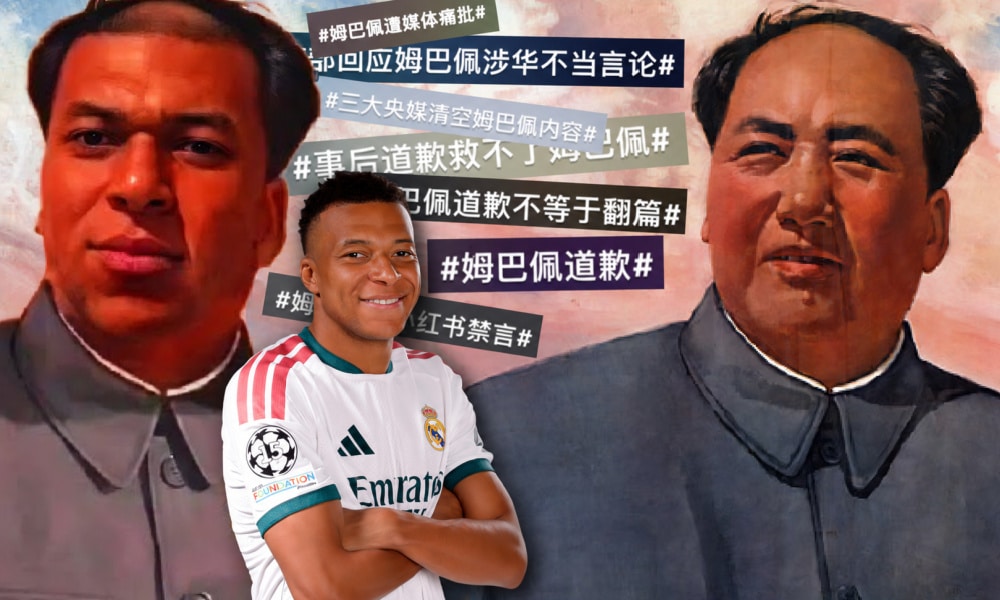
Mbappé, Mao, and the Joke That Shall Not Be Named

Mbappé’s favorite Mao meme sparked major backlash in China. More on what the controversy reveals about political red lines, online humor, and censorship.
Manya Koetse

Published

on

RESOU 热搜 | What’s Trending in China, Explained

Here, I briefly unpack the stories making waves on Chinese social media and share what stands out to me. Don’t miss an update: become a subscriber to Eye on Digital China today.

Oh oh oh, Mbappé, all those goals, yet you lost so many points on Chinese social media over the past 48 hours.

Following his 100th goal for Real Madrid during El Clásico and finishing second on Ballon d’Or night, French football player Mbappé is all the talk on Chinese social media — not for his achievements, but for what is seen as crossing a major red line in an online interview.

On Tuesday night, a text came in from Ruixin: “I am wide awake tonight and somehow witnessed live how the footballer Kylian Mbappé was getting blocked and totally canceled on Chinese social media for his comments about Mao Zedong over the past, like, three hours 😅”

I quickly grabbed my phone and saw the flood of Mbappé posts rapidly coming in, and it was clear that people were very cross with him.

Although it was already clear that this might not blow over any time soon, by early Wednesday morning it became painfully clear how the controversy had snowballed. Dongpeng Beverage Group (东鹏), one of the many Chinese companies that signed the famous sportsman as its brand ambassador, publicly stated that it was cutting all commercial ties with Mbappé. Soon, others followed.
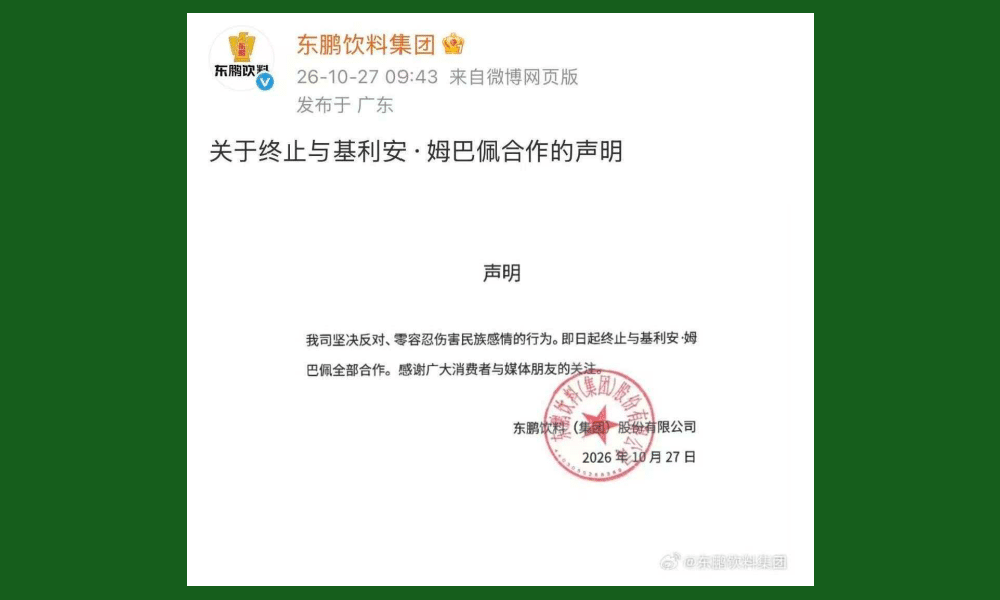
Dongpeng Beverage Group (东鹏): the first in a string of companies to cut ties with French footballer Kylian Mbappé.

Mbappé’s fall from grace in China has been sudden and spectacular, like a major avalanche of backlash that unfolded in one night, and it can all be traced back to one segment of an interview the footballer previously did on a French YouTube show (The Bridge) that resurfaced online — initially through Reddit and X, and then on Chinese social media apps, like football platform Dongqiudi (懂球帝).

In that segment, when asked about his favorite meme, Mbappé replied that one of the memes he finds funniest is:

🗣️ “the one where they put my face on some guy, a Chinese dictator. That really makes me laugh, I use it with my friends all the time.”

The interview segment where Mbappé shares his favorite meme: his face photoshopped onto the face of a “Chinese dictator.”

The show, created by Mbappé’s Real Madrid teammate Aurélien Tchouaméni, added the image Mbappé referred to: his face photoshopped on a Mao propaganda visual. It’s part of a series of memes that emerged in 2024 in which Mbappé’s face is edited onto the faces of dictators.1

Continue Reading

Chapter Dive

The French Protests, Viewed from China: Five Narratives on Chinese Social Media

From the decline of Europe to historical karma: these 5 narratives reveal how Chinese social media discusses the recent unrest in France.
Manya Koetse

Published

on

Originally published in the Eye on Digital China newsletter on Sunday, October 25, 2026.

The protests in France have been trending in China all week. The ways in which they are being discussed perhaps reveal more about Chinese views of France and Europe—and about China’s own place in the world today—than about the protests themselves. Here are five of the main narratives shaping the discussion.

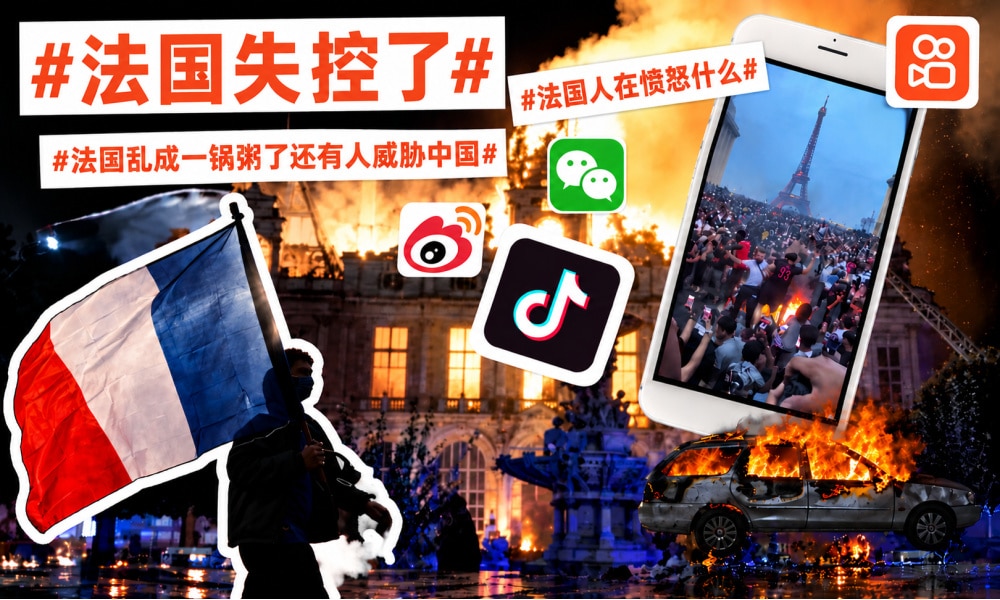
Over the past week, the widespread protests and unrest in France have been trending on Chinese social media. From October 18 to today, turmoil in Paris and other cities consistently appeared in the top trending lists on Weibo, Kuaishou, and other apps, with Chinese netizens and commentators discussing the situation in various ways under numerous hashtags.

The topic remained trending all week not only because of the October 17–18 riots and their aftermath, but also because of the new round of protests on October 24, for which French authorities deployed 70,000 police officers and the Chinese embassy in France issued new warnings.

Here, we’ll take a closer look at five dominant narratives surrounding the protests in France on Chinese social media, and what this says about Chinese perceptions of France and Europe, from common ideas about the decline of Europe to the protests being a form of “historical karma.”[1]


1. “France Has Lost Control”: A Nation in Crisis


How can a developed country like France fail to maintain basic order? One dominant framing of the recent protests on Chinese social media is that they demonstrate the French state’s inability to keep the situation under control, indicating a crisis of governance and security.

One of the highest-ranking hashtags among more than 300 trending topics on Chinese social media apps related to the unrest in France is: “France is out of control” (法国失控了). Along with hashtags like “France is in chaos again,” that hashtag first came up last Sunday on Weibo during a weekend filled with looting, arson, destruction, and violence by groups of rioters in Paris, Marseille, Lyon, Lille, and elsewhere.

The perceived weakness of President Macron’s leadership was highlighted on Chinese social media through memes and jokes mocking the leader for attending a Celine Dion concert right before the situation escalated. A commentary on Sina compared the concert to company executives holding a celebration banquet and handing out bonuses just before the firm collapses, framing the riots as a “run on…

Continue Reading

Subscribe

Eye on Digital China is a reader-supported publication by
Manya Koetse (@manyapan) and powered by What’s on Weibo.
It offers independent analysis of China’s online culture, media, and social trends.

To receive the newsletter and support this work, consider
becoming a paid subscriber.

Manya Koetse's Profile Picture

Get in touch

Have a tip, story lead, or book recommendation? Interested in contributing? For ideas, suggestions, or just a quick hello, reach out here.

Popular Reads